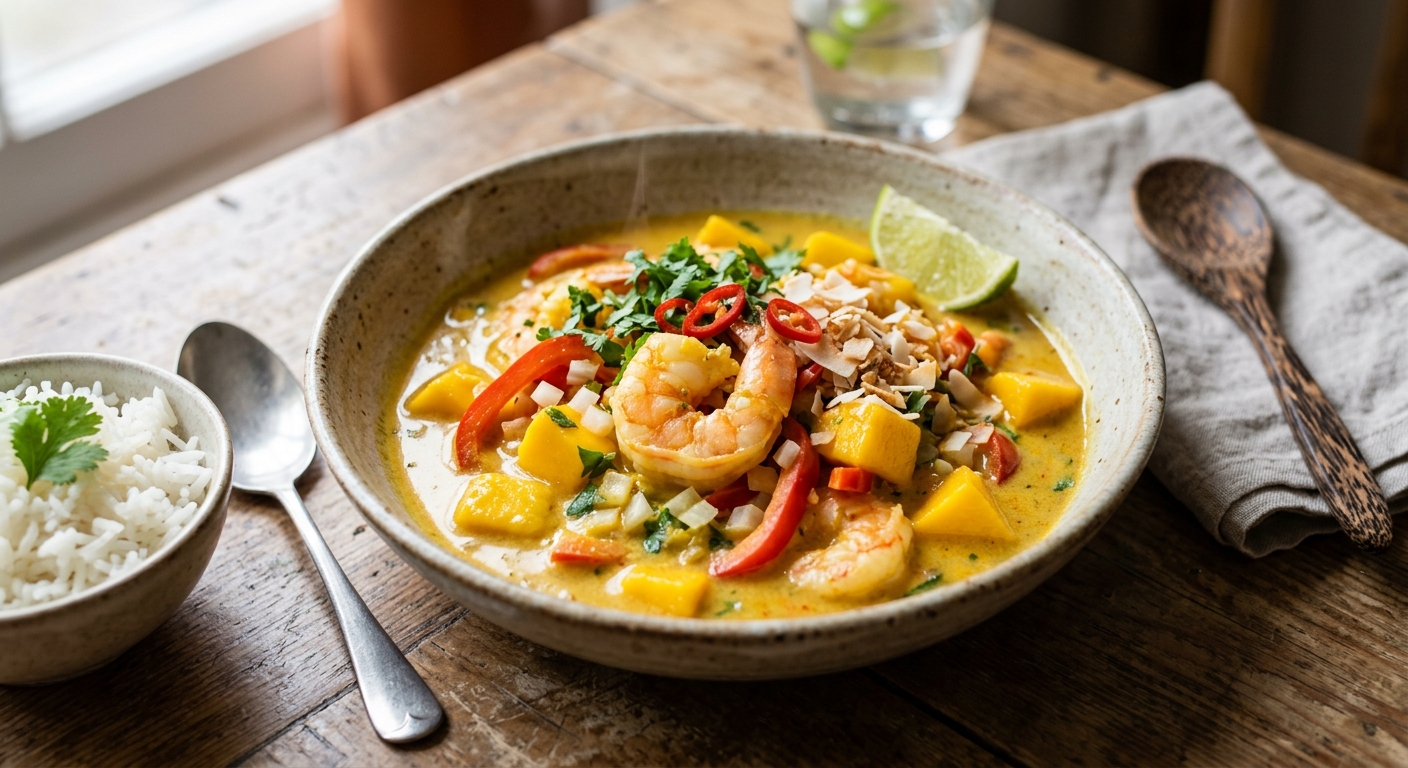
There are curries that warm you, and then there are curries that actively repair you. This Prawn and Mango Coconut Curry sits firmly in the second category. Built around the nutritional pairing of sweet ripe mango and wild-caught prawns, this dish was designed from the ingredient list upward to maximise two chronically under-consumed micronutrients: vitamin C and selenium. Most adults fall short of both, and the consequences, ranging from impaired immunity to sluggish thyroid function, are well documented in clinical nutrition literature. One generous bowl of this curry changes that calculus entirely.
What makes this recipe special beyond its nutrient density is the layering of flavour that Thai-inspired coconut curries are famous for. A hand-pounded or blended aromatic base of lemongrass, galangal, fresh turmeric, and makrut lime zest forms the backbone of the broth. Full-fat coconut milk adds richness and, critically, the medium-chain fatty acids that help absorb the fat-soluble carotenoids present in both mango and turmeric. The mango is added in two stages: half is blended into the sauce for body and natural sweetness, and the other half is stirred in at the end so it retains its texture and fresh tropical brightness.
Prawns are among the most nutritionally efficient proteins you can cook with. A 150-gram portion supplies more selenium per calorie than almost any other whole food, alongside a meaningful dose of iodine, zinc, and complete essential amino acids. They also cook in under four minutes on high heat, which means this recipe is genuinely weeknight-friendly despite its complex flavour profile. Choose sustainably sourced raw king prawns if you can; the texture and nutrient retention are both superior to pre-cooked alternatives.
4
servings
Ingredients
- 600 graw king prawns, peeled and deveined (tails on optional)
- 2 largeripe mangoes (approx. 500g flesh total), peeled and diced, divided
- 400 mlfull-fat coconut milk (one 400ml tin)
- 200 mllow-sodium fish stock or water
- 2 largered bell peppers, deseeded and sliced into strips
- 1 mediumwhite onion, finely diced
- 4 clovesgarlic, minced
- 25 gfresh ginger, peeled and finely grated
- 15 gfresh turmeric, peeled and finely grated (or 1 tsp ground turmeric)
- 2 stalkslemongrass, outer leaves removed, finely sliced
- 2 tbspred curry paste (Thai-style, check for gluten-free if needed)
- 2 tbspextra-virgin coconut oil
- 1 tbspfish sauce (or tamari for pescatarian variation)
- 1 tbspfresh lime juice
- 1 tsppalm sugar or light brown sugar
- 30 gfresh coriander (cilantro), roughly chopped, to serve
- 1 largered chilli, thinly sliced, to serve
- —Colima Sea SaltMicroplastic Free Salt and white pepper to taste
Instructions
Click on an item below to shop for the recommended items for this recipe on Amazon.
As an Amazon Associate, we earn from qualifying purchases.
- Prepare your mango in two batches: place half the diced mango (roughly 250g) into a blender or small food processor. Add 100ml of the coconut milk and blend until completely smooth. Set this mango coconut puree aside. Keep the remaining mango diced and refrigerated until the end of cooking.
- Heat the coconut oil in a wide, heavy-based pan or Dutch oven over medium heat. Add the diced onion with a pinch of salt and cook, stirring occasionally, for 6 to 7 minutes until softened and lightly golden at the edges. Add the garlic, ginger, fresh turmeric, and lemongrass. Stir-fry for 90 seconds until intensely fragrant, being careful not to let the garlic burn.
- Push the aromatics to the side of the pan and add the red curry paste directly onto the exposed base. Toast the paste in the dry spot for 60 seconds, pressing it into the pan with a wooden spoon. This step blooms the fat-soluble spice compounds in the paste and dramatically deepens the flavour. Stir everything together to combine.
- Add the sliced red bell peppers and toss to coat in the curry paste mixture. Cook for 3 minutes over medium-high heat until they begin to soften but still retain some bite. Pour in the remaining 300ml coconut milk, the fish stock, the mango coconut puree, fish sauce, and palm sugar. Stir well and bring to a gentle simmer. Cook uncovered for 8 minutes, allowing the sauce to reduce slightly and the peppers to become fully tender.
- Reduce the heat to low. Taste the curry sauce and adjust seasoning with salt, white pepper, and an extra splash of fish sauce if needed. Add the raw prawns in a single layer, nestling them into the sauce. Spoon sauce over any exposed prawns. Cover with a lid and cook for exactly 3 to 4 minutes until the prawns are pink, opaque, and just cooked through. Do not overcook; they should be just firm and still juicy.
- Remove from heat immediately. Stir in the fresh lime juice and the reserved diced mango. Taste once more and adjust with lime or fish sauce. The residual heat will gently warm the fresh mango without making it mushy. Ladle into bowls over steamed jasmine rice, garnish generously with fresh coriander and sliced red chilli, and serve immediately.
- Build the aromatic base without oil first: place the diced onion, minced garlic, grated ginger, grated turmeric, sliced lemongrass, and red curry paste directly into the slow cooker insert. Stir together with a rubber spatula until the curry paste coats all the aromatics evenly. This dry layering technique concentrates the aromatics at the base and allows them to slowly infuse upward through the liquid as the cooker heats.
- Blend half the mango flesh (roughly 250g) with 100ml of the coconut milk until smooth. Pour this mango coconut puree over the aromatics in the slow cooker. Add the remaining coconut milk, fish stock, fish sauce, palm sugar, and sliced red bell peppers. Stir once gently to combine without disturbing the aromatic layer too much. Do not add the raw prawns yet.
- Place the lid on the slow cooker and cook on Low for 3 hours. The low, steady heat will gently break down the lemongrass, bloom the turmeric, and allow the mango puree to fully integrate into the sauce, creating a velvety texture without any stirring or monitoring required.
- After 3 hours, remove the lid and stir the sauce. Taste and adjust with salt, white pepper, additional fish sauce, or a squeeze of lime. The sauce should be fragrant, golden, and slightly thickened. If it seems very thin, leave the lid off for the remaining cooking time to allow some evaporation.
- Add the raw prawns directly to the slow cooker, pressing them gently under the surface of the sauce. Replace the lid and cook on Low for a further 18 to 22 minutes, checking at 18 minutes. The prawns are done when they are fully pink and opaque but still yielding when pressed. Because slow cooker temperatures vary, check early to avoid overcooking.
- Stir in the fresh lime juice and the reserved diced fresh mango. The contrast of the warm, melded sauce against the cool, fresh mango pieces is especially pronounced in this version. Serve immediately over steamed rice, topped with coriander and chilli.
- Set your Instant Pot or electric pressure cooker to Saute mode on Normal heat. Add the coconut oil. Once shimmering, add the diced onion with a pinch of salt and saute for 4 minutes until softened. Add the garlic, ginger, turmeric, lemongrass, and red curry paste. Stir vigorously for 60 to 90 seconds until the paste is toasted and the rawness of the garlic has cooked off. Press Cancel to turn off the Saute function.
- Blend half the mango flesh (roughly 250g) with 100ml coconut milk until smooth. Pour this puree into the pot along with the remaining coconut milk, fish stock, fish sauce, palm sugar, and sliced red bell peppers. Stir to deglaze the pot, scraping up any browned bits from the bottom with a wooden spoon. This step is critical: any stuck residue can trigger a Burn warning. Confirm no solids remain adhered to the base.
- Secure the lid and set the steam release valve to Sealing. Cook on Manual or Pressure Cook mode at High Pressure for 5 minutes. The pressurised environment drives the coconut milk deep into the bell pepper fibres and fuses the aromatic compounds into the sauce in a fraction of the stovetop time, producing an intensely flavoured base.
- Once the 5-minute cook time is complete, perform a Quick Release by carefully moving the valve to Venting. Stand back from the steam. Once all pressure has released and the float valve has dropped, open the lid away from you.
- Set the pot back to Saute mode on Low heat. Taste the sauce and adjust seasoning with salt, white pepper, lime juice, and fish sauce. Once the sauce is gently simmering, add the prawns in a single layer. Cook for 3 to 4 minutes, stirring once halfway, until the prawns are pink and just cooked through. Press Cancel immediately.
- Stir in the lime juice and the reserved fresh diced mango. The quick residual heat from the pot will gently warm the mango. Serve at once over jasmine rice with coriander and red chilli.
Nutrition Breakdown
Per 1 serving (makes 4)
Vitamins & Minerals
% Daily Value based on a 2,000 calorie diet (FDA reference)
🧬 Essential Amino Acids
% of recommended daily intake (RDA) per serving
🛡 Antioxidant Profile
The Nutrition Science
Selenium is arguably the most underappreciated trace mineral in human nutrition. It functions primarily as a structural component of selenoproteins, most notably glutathione peroxidase (GPx) and thioredoxin reductase, the enzymatic systems responsible for neutralising hydrogen peroxide and lipid hydroperoxides inside cells. Without adequate selenium, these enzymes cannot be synthesised, and oxidative damage accumulates in tissues including the thyroid, liver, and cardiovascular endothelium. Prawns are one of the richest dietary sources of selenium in a bioavailable form: the selenocysteine and selenomethionine found in crustaceans are absorbed at rates of 85 to 90%, far exceeding the absorption efficiency of plant-based selenium. A 150-gram serving of king prawns provides approximately 50 to 60mcg of selenium, meeting or exceeding the adult RDA of 55mcg in a single meal component.
Vitamin C in this dish comes from two sources working synergistically. Red bell peppers are among the most vitamin-C-dense vegetables available, providing roughly 128mg per 100g of raw weight, more than double the concentration found in oranges. Mango contributes an additional 36mg per 100g. Both are added in ways that minimise heat degradation: the bell peppers are cooked only until just tender, and half the mango is stirred in raw at the end. Vitamin C is the dominant water-soluble antioxidant in human plasma. Beyond immune function, it is essential for collagen synthesis via hydroxylation of proline and lysine residues, enhances non-haem iron absorption, and regenerates vitamin E after it has quenched a free radical, creating a recycling loop between the two antioxidants.
The coconut milk in this recipe is not merely a textural choice; it plays a direct role in nutrient bioavailability. Beta-carotene, curcumin, and lycopene are all highly lipophilic, meaning they require dietary fat for incorporation into mixed micelles in the small intestine before absorption can occur. Studies have shown that consuming carotenoids without fat can reduce their bioavailability by as much as 75%. The medium-chain triglycerides (MCTs) in coconut milk are particularly effective at facilitating this process because they are rapidly incorporated into micelles without requiring bile salt activation to the same degree as long-chain fatty acids. This means every bowl of this curry is nutritionally more effective than the sum of its individual ingredients would suggest if they were eaten separately.
Pro Tips
- Buy the freshest raw prawns you can find and do not rinse them under water just before cooking; pat them dry with paper towel instead so they sear rather than steam and develop better flavour.
- The mango-into-sauce technique only works well with fully ripe mangoes. An underripe mango will make the sauce sour and the texture grainy. The flesh should yield easily to pressure and smell fragrant at the stem end.
- To preserve the maximum vitamin C content, add the lime juice and fresh mango off the heat. Vitamin C is highly heat-labile and water-soluble; even two minutes of boiling can degrade 20 to 30% of the content in delicate fruits.




This looks incredible, and I’m genuinely curious about your sourcing for the prawns here – are you recommending wild-caught or farmed, and does it matter for the selenium bioavailability? My functional medicine doc has been pushing me to dial in my selenium intake (my last labs showed I was hovering around insufficient), and I’ve read conflicting things about whether the source affects how well we actually absorb it. Also, the mango and bell pepper combo for vitamin C is smart, but I’m wondering if the cooking time affects that C content noticeably, or if the heat from the coconut curry is gentle enough that we’re retaining most of it?
Tammy’s point about wild-caught prawns having higher selenium from their natural diet is spot-on, and it actually aligns with what my doc mentioned during my last visit when we were troubleshooting my own insufficiency – he specifically noted that the selenium content in seafood is tied to the selenium in their food source, so location and diet matter more than I initially thought. On the vitamin C front, I’ve been curious about this too since I’ve been tracking my inflammatory markers quarterly, and from what I’ve gathered, the gentle simmering in coconut broth shouldn’t cause major losses if you’re not boiling aggressively, though adding the mango and pepper toward the end of cooking would probably preserve
Fred, that’s such a great question – selenium bioavailability is where sourcing really matters! Wild-caught prawns tend to have higher selenium levels because of what they’re eating in their natural environment, but honestly both wild and farmed can work if you’re rotating protein sources throughout the week rather than relying on prawns alone. I’ve found that pairing them with other selenium-rich foods like Brazil nuts or eggs (and the turmeric in this curry is a nice bonus for absorption) gives you more nutritional security than obsessing over one ingredient. What other proteins is your doc recommending you focus on?
This is exactly the kind of systems thinking that gets me excited, Tammy! I’d add that the turmeric here is doing double duty because curcumin actually supports methylation pathways, which is crucial for how your body processes and utilizes that selenium in the first place – so the selenium bioavailability question is really about whether your methylation cycle is humming along, and that depends on having enough folate and choline donors in the meal (hello, mango and coconut). Fred, I’ve been tracking my own selenium levels while experimenting with different seafood rotations, and I noticed my methylation markers improved more when I paired prawns with foods rich in folate and B12 rather
Eddie, I love where your head’s at with the methylation angle, though I’d gently pump the brakes a bit here. Curcumin does have some fascinating effects on gene expression and phase II detoxification, but the evidence that it specifically “supports methylation pathways” in a way that meaningfully impacts selenium utilization is pretty thin – we’re mixing different biochemical systems that don’t necessarily talk to each other the way we’re implying. That said, you’re absolutely right that folate and B12 matter for overall micronutrient status and homocysteine metabolism. The practical win here is just eating nutrient-dense whole foods together, which this curry definitely does, rather than ne