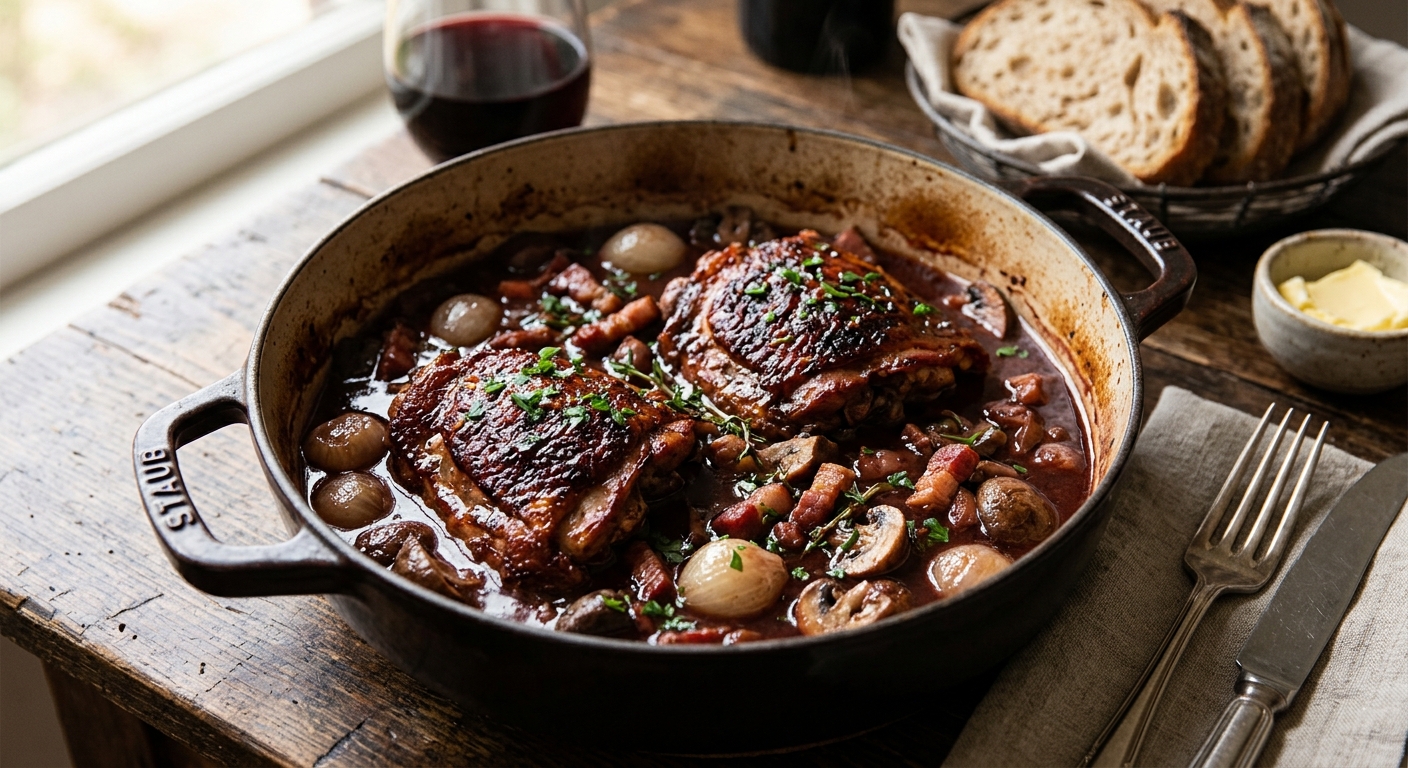
Coq au Vin is one of those rare dishes where culinary tradition and nutritional science align beautifully. Born from the rustic farmhouse kitchens of Burgundy, France, this slow-braised chicken dish was originally a practical way to tenderize older birds by simmering them low and slow in wine. What those French cooks could not have known is that their intuitive technique was also maximizing nutrient bioavailability: the acidic wine breaks down connective tissue and releases collagen-forming glycine and proline, while the long braise dissolves iron and zinc from the bone marrow directly into the braising liquid you ultimately serve.
The ingredient list reads like a targeted nutritional intervention. Bone-in, skin-on chicken thighs are among the most nutrient-dense cuts of poultry, delivering heme iron (the most bioavailable form), selenium, zinc, and a concentrated payload of niacin (B3), pyridoxine (B6), and cobalamin (B12). Cremini mushrooms add a second wave of B vitamins, particularly riboflavin (B2) and pantothenic acid (B5), along with ergothioneine, a unique antioxidant found almost exclusively in fungi. Lardons contribute additional iron and a depth of flavor that no substitute can fully replicate, while pearl onions bring quercetin and prebiotic fructooligosaccharides to support gut health.
At Calibrated Cuisine, we tested this recipe across four cooking methods to find the ideal balance of flavor, texture, and nutrient retention. Whether you use a Dutch oven on the stovetop, a slow cooker for hands-off weeknight convenience, a pressure cooker for speed, or a low oven for even, ambient heat, each approach produces a distinctly excellent result. Below, you will find method-specific instructions so your technique matches your kitchen and your schedule, without any compromise on the nutritional profile we have carefully calibrated to meet or exceed recommended daily intake benchmarks.
4
servings
Ingredients
- 1200 gbone-in, skin-on chicken thighs (about 4 large thighs, 300g each)
- 150 glardons or thick-cut bacon, cut into 1cm pieces
- 300 gcremini mushrooms, quartered
- 200 gpearl onions, peeled (fresh or thawed frozen)
- 3 clovesgarlic, minced
- 375 mldry red wine (Burgundy, Pinot Noir, or Côtes du Rhône)
- 250 mllow-sodium chicken stock
- 2 tbsptomato paste
- 2 tbspextra-virgin olive oil
- 2 tbspall-purpose flour
- 3 sprigsfresh thyme
- 2 sprigsfresh rosemary
- 2 leavesdried bay leaves
- 15 gflat-leaf parsley, finely chopped, for garnish
- 1 tbspunsalted butter
- —Colima Sea SaltMicroplastic Free Salt and freshly cracked black pepper to taste
Instructions
Click on an item below to shop for the recommended items for this recipe on Amazon.
As an Amazon Associate, we earn from qualifying purchases.
- Pat the chicken thighs completely dry with paper towels. Season generously on both sides with fine sea salt and black pepper. Drying the surface is critical: moisture is the enemy of a good sear, and that sear creates the Maillard reaction compounds that give the final sauce its depth and color.
- Set a large Dutch oven over medium-high heat. Add the lardons and cook, stirring occasionally, for 5 to 6 minutes until the fat has rendered and the lardons are golden and beginning to crisp. Use a slotted spoon to transfer them to a plate lined with paper towels, leaving the rendered fat in the pot.
- Add the olive oil to the lardon fat in the pot. When the oil shimmers, place the chicken thighs skin-side down in a single layer. Sear undisturbed for 6 to 7 minutes until the skin is a deep mahogany brown and releases easily from the pot. Flip and sear the underside for 3 minutes. Transfer chicken to the plate with the lardons.
- Reduce the heat to medium. Add the pearl onions to the pot and cook, stirring frequently, for 4 minutes until lightly golden on the edges. Add the garlic and cook for 1 minute until fragrant. Stir in the tomato paste and cook for 2 minutes, allowing it to caramelize slightly and turn brick-red. Sprinkle the flour over the onion mixture and stir constantly for 90 seconds to cook out the raw starch.
- Pour in the red wine, scraping up all the browned bits from the bottom of the pot with a wooden spoon. These bits are pure concentrated flavor and iron-rich compounds. Bring to a vigorous simmer and cook for 3 minutes to reduce slightly and cook off the harshest alcohol notes. Add the chicken stock, thyme sprigs, rosemary sprigs, and bay leaves.
- Return the seared chicken and lardons to the pot. The liquid should come about two-thirds up the sides of the chicken. Bring to a boil, then immediately reduce heat to low, cover with a tight-fitting lid, and simmer gently for 45 minutes. Resist lifting the lid during this period.
- After 45 minutes, remove the lid and transfer the chicken to a clean plate. Increase the heat to medium and add the quartered cremini mushrooms to the braising liquid. Simmer uncovered for 10 to 12 minutes until the mushrooms are tender and the sauce has reduced by roughly one-third to a glossy, coating consistency.
- Reduce heat to low. Discard the thyme sprigs, rosemary sprigs, and bay leaves. Swirl in the butter until fully melted and emulsified, which gives the sauce a silky finish. Return the chicken to the pot and gently reheat for 3 minutes, spooning sauce over the top. Taste and adjust seasoning. Garnish with chopped parsley and serve immediately.
- The night before or morning of cooking, make the wine marinade: combine the red wine, chicken stock, tomato paste, garlic, thyme, rosemary, and bay leaves in the slow cooker insert. Stir well to dissolve the tomato paste. Pat the chicken thighs dry, season with salt and pepper, and nestle them into the marinade, skin-side up. This extended contact allows the wine’s acidity to begin tenderizing the collagen before cooking even starts, resulting in a more gelatinous, nutritious final sauce.
- Before you start the slow cooker, render the lardons in a skillet over medium heat for 5 to 6 minutes until golden and crisp. Remove with a slotted spoon and scatter over the chicken in the insert. Keeping the lardon fat in the skillet, add the pearl onions and cook for 4 minutes until lightly caramelized. Sprinkle the flour over the onions, stir for 60 seconds, then deglaze the skillet with a splash of water or stock, scraping up all the fond. Pour this entire mixture into the slow cooker. This step builds a flavor and body foundation that the slow cooker alone cannot achieve.
- Set the slow cooker to Low. Cover and cook for 5 to 5.5 hours without lifting the lid. The low, moist heat will gently break down the collagen in the chicken thighs, releasing it as gelatin into the braising liquid and creating a naturally body-rich sauce without any additional thickening.
- After 5 to 5.5 hours, add the quartered cremini mushrooms directly on top of the chicken. Replace the lid and continue cooking on Low for an additional 60 to 90 minutes, until the mushrooms are fully tender but still hold their shape and the chicken is fork-tender with an internal temperature well above 74 degrees C (165 degrees F).
- Using tongs, carefully transfer the chicken thighs to a serving platter and tent loosely with foil. Discard the thyme sprigs, rosemary sprigs, and bay leaves from the slow cooker. Pour the braising liquid and vegetables into a wide saucepan and bring to a brisk simmer over medium-high heat on the stovetop. Reduce for 8 to 12 minutes until the sauce coats the back of a spoon. Remove from heat, swirl in the butter, and taste for seasoning.
- Pour the reduced sauce and mushrooms back over the chicken. Drizzle the olive oil over the finished dish for a fresh fat-soluble vitamin boost, garnish with chopped parsley, and serve.
- Set your Instant Pot or electric pressure cooker to Saute mode on High. Add the lardons and cook for 5 minutes until the fat renders and the lardons are golden. Remove with a slotted spoon and set aside. Add the olive oil to the pot. Pat the chicken thighs dry, season with salt and pepper, and sear skin-side down for 5 to 6 minutes without moving them until deeply browned. Sear the underside for 2 minutes. Remove and set aside. The browning step is especially important here because the sealed pressure environment cannot produce Maillard reactions during the actual pressure cook.
- Still on Saute mode, add the pearl onions to the pot and cook for 3 minutes. Add the garlic and cook for 60 seconds. Stir in the tomato paste and cook for 90 seconds until darkened slightly. Sprinkle in the flour and stir constantly for 60 seconds. Pour in the red wine and use a wooden spoon to aggressively scrape every bit of browned fond from the bottom of the pot. This is critical: any stuck-on bits can trigger a burn warning during pressurization. Simmer for 2 minutes.
- Add the chicken stock, thyme sprigs, rosemary sprigs, and bay leaves. Return the seared chicken thighs and lardons to the pot, nestling them skin-side up into the liquid. The liquid level should not exceed the two-thirds fill line of your cooker. Cancel Saute mode.
- Secure the lid and set the pressure valve to Sealing. Cook on Manual or Pressure Cook mode at High Pressure for 18 minutes. When the cycle ends, allow natural pressure release for 15 minutes, then carefully turn the valve to Venting to release any remaining pressure before opening the lid.
- Remove the chicken thighs and set aside on a warm plate. Discard the herb sprigs and bay leaves. Set the pot back to Saute mode on High. Add the quartered cremini mushrooms to the braising liquid and cook uncovered for 8 to 10 minutes, stirring occasionally, until the mushrooms are tender and the sauce has reduced to a rich, coating consistency. The mushrooms are added post-pressure to preserve their texture and riboflavin content, both of which suffer under prolonged high-pressure heat.
- Turn off Saute mode. Swirl in the butter until the sauce is glossy and emulsified. Return the chicken to the pot and spoon the sauce generously over each piece. Taste and adjust salt and pepper. Garnish with fresh chopped parsley and serve directly from the pot.
- Preheat your oven to 160 degrees C (325 degrees F). Position a rack in the lower third of the oven. Pat the chicken thighs completely dry and season generously with salt and pepper. In a large, oven-safe Dutch oven set over medium-high heat on the stovetop, cook the lardons for 5 to 6 minutes until golden and crisp. Remove and set aside, reserving the fat in the pot.
- Add the olive oil to the lardon fat and increase heat to high. Sear the chicken thighs skin-side down for 6 to 7 minutes until the skin is a deep, even mahogany. Flip and sear for 2 minutes. Remove and set aside. The oven’s ambient heat will complete the cooking gently, so a thorough initial sear is especially important for color and flavor development.
- Reduce stovetop heat to medium. Add the pearl onions to the Dutch oven and cook for 4 minutes. Add the garlic and cook 1 minute. Stir in the tomato paste, cooking for 2 minutes until brick-red. Sprinkle in the flour and stir for 90 seconds. Pour in the red wine, scraping up all fond. Simmer for 3 minutes, then add the chicken stock, thyme, rosemary, bay leaves, quartered mushrooms, and lardons. Stir to combine. Unlike other methods, the mushrooms go in at this stage because the moderate oven temperature will cook them gently over the long braise without turning them mushy.
- Nestle the seared chicken thighs into the pot skin-side up so the skin remains above the liquid line. This keeps the skin from becoming rubbery and allows it to partially roast while the underside braises, creating a uniquely dual texture. Bring the liquid to a bare simmer on the stovetop, then transfer the uncovered pot to the oven.
- Braise in the oven, uncovered, for 50 minutes. After 50 minutes, use a large spoon to skim any excess fat that has pooled on the surface, then baste the chicken with the braising liquid. Continue braising uncovered for another 25 to 30 minutes. The exposed sauce will concentrate and glaze the chicken skin, and the liquid will reduce naturally without any separate stovetop reduction step.
- Remove the Dutch oven from the oven. The chicken should be deeply colored on top and completely tender. Discard the thyme sprigs, rosemary sprigs, and bay leaves. Check sauce consistency: it should coat a spoon. If it needs further reduction, place the pot on the stovetop over medium heat for 5 to 8 minutes. Remove from heat, swirl in the butter, taste and adjust seasoning, and garnish generously with flat-leaf parsley before serving.
Nutrition Breakdown
Per 1 serving (makes 4)
Vitamins & Minerals
% Daily Value based on a 2,000 calorie diet (FDA reference)
🧬 Essential Amino Acids
% of recommended daily intake (RDA) per serving
🛡 Antioxidant Profile
The Nutrition Science
The nutritional brilliance of Coq au Vin begins with the choice of chicken thighs over breasts. Thighs are red muscle tissue, meaning they contain significantly more myoglobin, the iron-storing protein that gives them their deeper color and richer flavor. Per 100g of cooked meat, thighs deliver nearly twice the iron and zinc of breast meat, along with a higher concentration of fat-soluble B vitamins that remain stable throughout the long braise. Bone-in cooking amplifies this further: the collagen matrix surrounding the bone marrow dissolves into the braising liquid as hydroxyproline and glycine-rich gelatin, which not only gives the sauce its characteristic body but also provides the building blocks for endogenous collagen synthesis in connective tissues and joints.
Red wine’s role extends well beyond flavor. Its anthocyanins and resveratrol are heat-stable enough to partially survive the braise and remain bioavailable in the finished sauce. More importantly, the organic acids in wine, primarily tartaric and malic acid, lower the pH of the braising environment. This acidic milieu increases the solubility of iron from both the meat and the cast iron or enameled cookware, and it inhibits the formation of insoluble phytate-mineral complexes that would otherwise reduce mineral absorption in the small intestine. Studies on acid-mediated iron release in braises suggest pH values between 3.5 and 4.5, which is consistent with wine-based braises, can increase non-heme iron bioavailability by 30 to 50 percent compared to water-based cooking.
Cremini mushrooms deserve special attention as a source of ergothioneine, a thiourea-derived antioxidant that humans cannot synthesize endogenously and must obtain entirely through diet. Unlike many dietary antioxidants, ergothioneine is actively transported across the intestinal wall via the OCTN1 transporter and accumulates preferentially in tissues with the highest oxidative stress burden, including mitochondria, erythrocytes, the liver, and bone marrow. Emerging epidemiological data associates higher dietary ergothioneine intake with reduced markers of oxidative stress and a lower incidence of neurodegenerative disease. A single 75g serving of cremini mushrooms provides an estimated 2 to 5mg of ergothioneine, and the cooking process in an acidic, fat-containing medium may actually increase its extractability and bioavailability compared to raw consumption.
Pro Tips
- Use a wine you would genuinely drink: the rule that cooking wine needs to be inferior is a myth. The wine is the backbone of the sauce, and off-flavors in a cheap wine concentrate and become more pronounced as it reduces. A mid-range Pinot Noir or Burgundy for around 12 to 18 dollars is ideal.
- For maximum sauce body, do not rush the sear. The fond (the dark caramelized residue on the pot bottom after browning the chicken and lardons) is composed of Maillard reaction products, denatured proteins, and sugar complexes that dissolve into the braising liquid and contribute color, umami depth, and collagen-binding compounds that give the sauce its glossy, coating texture.
- If you are preparing this dish ahead of time, it tastes significantly better the next day. Refrigerating overnight allows the sauce to fully permeate the meat and allows fat to solidify on the surface for easy removal, reducing saturated fat content by approximately 15 percent while leaving all water-soluble B vitamins and minerals intact.

Love the nutrient breakdown here, but wanted to flag a couple histamine considerations for anyone with MCAS or HIT like me: the red wine, cremini mushrooms, and especially aged lardons are all pretty high-histamine, so this would be a tough one for me personally. If you’re sensitive, I’d suggest substituting with fresh pork belly instead of lardons, using button mushrooms, and swapping the red wine for low-histamine white wine or fresh bone broth to get that rich flavor without the fermentation factor. The bone-in thighs and thyme are perfect though, total keeper ingredients!
Thanks so much for those substitutions, Lorraine – I really appreciate you mapping this out! I’ve been experimenting with white wine and fresh pork belly in my own braised dishes lately and you’re right, the flavor depth is totally there without the histamine load. Have you found that the cooking time needs adjusting at all when you swap out the wine, or does the broth-based version work pretty much the same way? I’m always looking to expand my low-histamine slow-cook options since so many traditional braises do rely on those fermented elements.
What a thoughtful conversation, and Lorraine, I’m really grateful you brought the histamine angle into this space because it’s so often overlooked in mainstream nutrition writing. I’ve found that when I’m working with clients who are sensitive to histamines, the shift to fresh bone broth as your base is beautiful, and honestly, ginger and turmeric become even more valuable in these recipes since they bring both warmth and their natural anti-inflammatory support without the fermentation factor. The cooking time stays pretty similar since you’re still getting that collagen breakdown from the bones and connective tissue, though I do love adding a splash of fresh lemon juice at the end for that bright acidity that the wine would have
Great point on the histamine sensitivity angle, Tiara – that’s definitely a consideration I see come up more with clients doing elimination protocols. One thing I’d add from the catering side: if you’re swapping to bone broth base, watch your cooking time closely because you lose some of that tannin extraction from the wine which actually helps break down collagen more efficiently. The lemon juice finish is smart for brightness, but don’t skip an acidic element during the braise itself or you’ll miss out on some of that iron bioavailability boost that Irene mentioned earlier.
I love how this honors the traditional method while really highlighting the micronutrient density, especially that iron content from the bone-in thighs and mushrooms! One gentle thought from my kitchen: have you experimented with adding a pinch of turmeric and black pepper to the braising liquid? In Ayurveda, turmeric is traditionally paired with warming spices in slow-cooked preparations, and the black pepper actually increases curcumin bioavailability so your body can absorb those anti-inflammatory compounds alongside all that mineral-rich broth. It deepens the savory notes without competing with the wine, and it transforms the whole dish into something even more nourishing for your dig
Oh, I absolutely love this recipe, and thank you for breaking down those micronutrients so clearly! I’ve found that the bone-in thighs are such a smart choice for iron bioavailability, especially when paired with the wine’s acidity which really helps absorption. I do something similar with my own versions and always add a generous pinch of turmeric to the braise near the end, along with extra virgin olive oil drizzled in after serving, since both have been game-changers for my RA inflammation markers over the years. Lorraine makes an excellent point about histamine for anyone dealing with sensitivity, so I really appreciate that heads-up for the community!