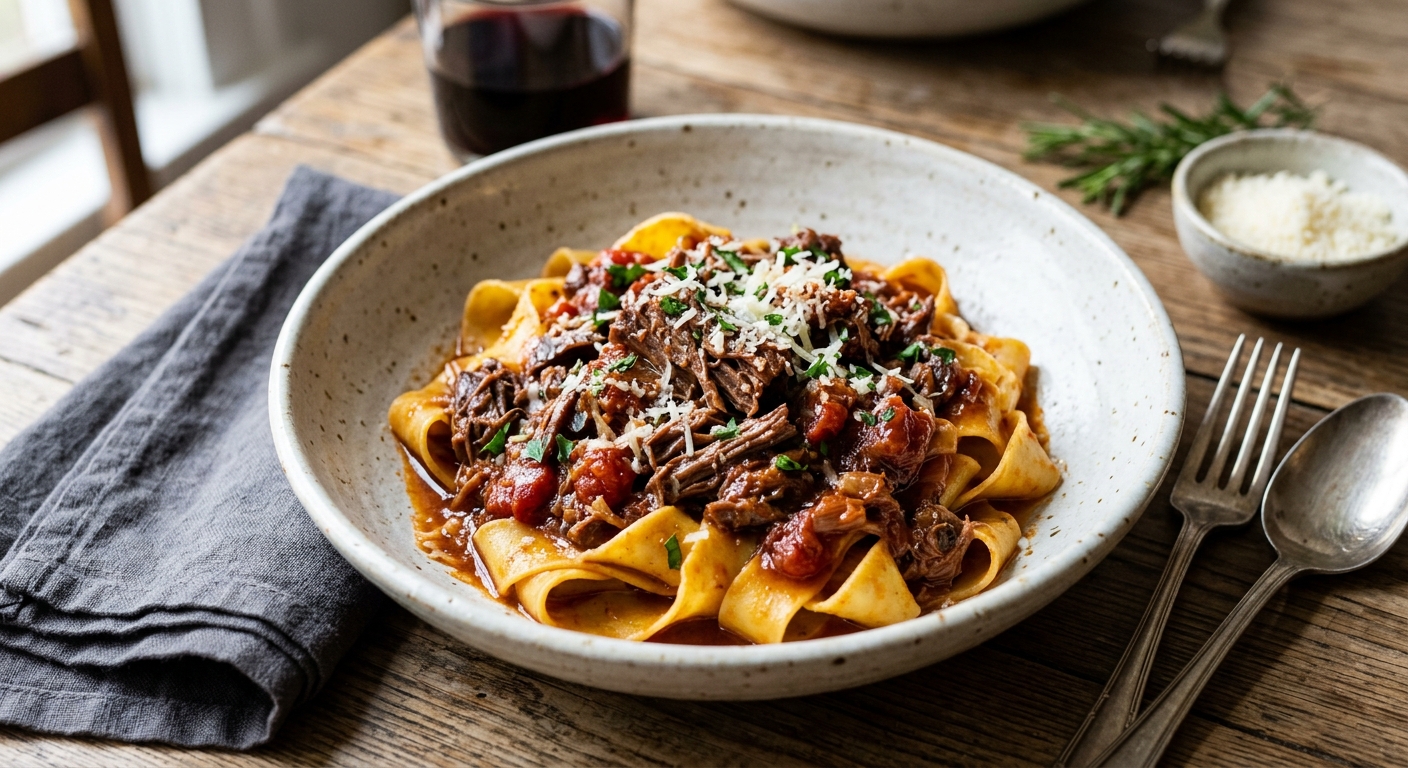
Beef cheeks are one of the most underutilized cuts in the modern kitchen, yet they represent an extraordinary convergence of culinary luxury and nutritional precision. The cheek muscle works continuously throughout the animal’s life, developing an exceptionally dense network of connective tissue loaded with collagen types I and III. When braised low and slow, that collagen hydrolyzes into gelatin and free glycine, creating the glossy, lip-coating sauce that sets a great ragu apart from a merely good one. For anyone focused on bone density, joint cartilage integrity, or post-exercise recovery, this dish is less a treat and more a therapeutic meal in disguise.
The nutritional architecture of this recipe was built with intent. Beef cheeks supply heme iron at roughly 3.5mg per 100g, a form that absorbs at 15 to 35% efficiency compared to the 2 to 10% absorption of non-heme sources. The slow-cooked tomato base provides a meaningful hit of vitamin C, which directly enhances that absorption by reducing ferric iron to the more bioavailable ferrous form. Dried porcini mushrooms, rehydrated and folded in, contribute additional selenium and B vitamins, while a generous soffritto of carrot, celery, and onion adds folate, potassium, and a suite of carotenoids that round out the micronutrient profile.
Three distinct cooking methods are provided because the technique matters enormously here. The stovetop approach offers moment-to-moment control and the best Maillard crust on the meat. The slow cooker produces the most gelatinous, unctuous sauce with virtually zero supervision. The pressure cooker delivers all that collagen conversion in under an hour. And the oven method, a classic braise, gives you the radiating, even heat that professional cooks swear by for the most evenly textured final product. Choose the method that fits your day, knowing the nutrition is consistent across all four.
4
servings
Ingredients
- 900 gbeef cheeks, trimmed of excess surface fat and sinew
- 300 gpappardelle or wide egg noodle pasta
- 200 mldry red wine (such as Sangiovese or Cabernet Sauvignon)
- 400 gcanned whole peeled San Marzano tomatoes, crushed by hand
- 250 mlbeef bone broth (good-quality, low-sodium)
- 20 gdried porcini mushrooms
- 150 mlwarm water (for soaking porcini)
- 1 largeyellow onion, finely diced
- 2 mediumcarrots, finely diced
- 2 stalkscelery, finely diced
- 4 clovesgarlic, minced
- 2 tbsptomato paste
- 3 tbspextra-virgin olive oil
- 1 sprigfresh rosemary
- 2 sprigsfresh thyme
- 1 leafdried bay leaf
- 30 gParmigiano-Reggiano, finely grated, plus more to serve
- 10 gflat-leaf parsley, roughly chopped
- —Colima Sea SaltMicroplastic Free Salt and black pepper to taste
Instructions
Click on an item below to shop for the recommended items for this recipe on Amazon.
As an Amazon Associate, we earn from qualifying purchases.
- Soak the dried porcini in 150ml of warm water for 20 minutes. Lift the mushrooms out carefully, squeeze gently, and roughly chop. Pour the soaking liquid through a fine-mesh sieve lined with a paper towel, reserving the strained liquid. Set both aside separately.
- Pat the beef cheeks very dry with paper towels and season aggressively on all sides with salt and black pepper. Heat 2 tablespoons of olive oil in a large Dutch oven over high heat until it shimmers and just begins to smoke. Sear the cheeks in a single layer for 4 to 5 minutes per side without moving them, until a deep mahogany crust forms. Work in batches if necessary to avoid crowding the pan. Transfer to a plate.
- Reduce heat to medium. Add the remaining tablespoon of olive oil, then add the onion, carrot, and celery with a pinch of salt. Cook, stirring occasionally, for 10 to 12 minutes until the vegetables are fully softened and lightly golden. Add the garlic and tomato paste and cook for 2 more minutes, stirring constantly, until the paste darkens slightly and smells fragrant.
- Pour in the red wine and scrape up all the browned bits from the bottom of the pot with a wooden spoon. Let the wine reduce by half over medium-high heat, about 4 minutes. Add the crushed tomatoes, beef bone broth, reserved porcini soaking liquid, and chopped porcini. Stir well, then nestle the seared beef cheeks back into the pot along with the rosemary, thyme, and bay leaf. The liquid should come about two-thirds of the way up the cheeks.
- Bring to a gentle simmer over medium heat, then immediately reduce heat to low. Cover with the lid slightly ajar to allow some steam to escape and braise for 3 to 3.5 hours, turning the cheeks once at the halfway point, until the meat is completely tender and yielding when pressed with a spoon. Check periodically and add a splash of water or broth if the sauce reduces too aggressively.
- Remove the beef cheeks to a cutting board. Discard the rosemary, thyme sprigs, and bay leaf. Use two forks to shred the meat into large, irregular pieces, then stir it back into the sauce. Taste and adjust seasoning. Bring the sauce to a brisk simmer uncovered for 5 to 10 minutes if it needs further thickening.
- Cook the pappardelle in a large pot of heavily salted boiling water until just shy of al dente, about 1 minute less than the package directions. Reserve 120ml of pasta water, then drain. Add the pasta directly to the ragu in the Dutch oven over medium heat, tossing vigorously and adding pasta water as needed to create a glossy, cohesive sauce that clings to the noodles. Stir in the Parmigiano-Reggiano, divide among warmed bowls, and finish with parsley and extra cheese.
- Soak the dried porcini in 150ml of warm water for 20 minutes. Lift out, squeeze, and roughly chop. Strain the soaking liquid through a paper-towel-lined sieve and reserve. In a large skillet over high heat, warm 2 tablespoons of olive oil until just smoking. Pat the beef cheeks completely dry, season generously with salt and pepper, and sear in batches for 4 to 5 minutes per side until deeply browned on all surfaces. Transfer directly to the slow cooker insert.
- Without wiping the skillet, reduce heat to medium and add the remaining tablespoon of olive oil. Cook the onion, carrot, and celery with a pinch of salt for 10 minutes until softened and beginning to caramelize. Add the garlic and tomato paste, stirring for 2 minutes until the paste deepens in color. Pour in the red wine and deglaze, scraping up all browned bits, then let it reduce by half over medium-high heat, about 4 minutes.
- Pour the reduced wine and soffritto mixture over the beef cheeks in the slow cooker. Add the crushed tomatoes, beef bone broth, reserved porcini liquid, chopped porcini, rosemary sprig, thyme sprigs, and bay leaf. The liquid should partially submerge but not fully cover the cheeks; the sealed slow cooker environment will generate additional moisture.
- Place the lid on the slow cooker and cook on Low for 8 hours or on High for 5 hours. Resist lifting the lid during cooking, as each peek releases heat and extends cooking time by roughly 20 minutes. The cheeks are done when they offer no resistance when pressed with the back of a spoon.
- Carefully transfer the beef cheeks to a cutting board using tongs. Remove and discard the rosemary, thyme, and bay leaf. Shred the meat into generous chunks with two forks. Spoon off and discard any excess fat pooled on the surface of the sauce, then stir the shredded beef back in. If the sauce appears too thin (slow cookers retain all liquid), pour it into a wide saucepan and simmer uncovered over medium-high heat for 8 to 12 minutes until it reaches a coating consistency. Return to the slow cooker or a serving bowl.
- Cook pappardelle in a large pot of well-salted boiling water to just under al dente. Reserve 120ml pasta water, drain, and add noodles to the ragu. Toss with a splash of pasta water to emulsify and gloss the sauce. Fold in Parmigiano-Reggiano, distribute into warmed bowls, and garnish with fresh parsley and additional grated cheese.
- Soak the dried porcini in 150ml of warm water for 20 minutes, then lift out, chop roughly, and strain the soaking liquid through a sieve; reserve both. Set your Instant Pot or pressure cooker to Saute mode on High. Once hot, add 2 tablespoons of olive oil. Pat the beef cheeks completely dry, season well with salt and pepper, and sear for 4 to 5 minutes per side until a rich brown crust forms, working in batches. Remove the cheeks and set aside.
- Add the remaining tablespoon of olive oil to the pot without changing the setting. Add the onion, carrot, and celery with a pinch of salt. Cook for 7 to 8 minutes, stirring often, until softened. Add the garlic and tomato paste and stir for 90 seconds until the paste caramelizes slightly against the bottom of the pot. Immediately pour in the red wine to deglaze, scraping up every bit of fond from the bottom; this is critical to avoid the burn notice during pressurized cooking.
- Let the wine reduce for 3 minutes on Saute mode, then cancel the Saute function. Add the crushed tomatoes, beef broth, reserved porcini liquid, and chopped porcini. Stir to combine, then nestle the beef cheeks into the liquid. Add the rosemary, thyme, and bay leaf. The liquid level is important: you need at least 240ml of total liquid for the pressure cooker to reach pressure, but avoid filling above the maximum fill line.
- Secure the lid, set the steam-release valve to Sealing, and pressure cook on High for 55 minutes. When the cycle completes, allow a full natural pressure release for at least 20 minutes before switching the valve to Venting to release any residual pressure. Remove the lid carefully, tilting it away from you.
- Remove the beef cheeks, discard the herb sprigs and bay leaf, and shred the meat. Switch back to Saute mode on High and simmer the sauce uncovered for 8 to 12 minutes, stirring regularly, until it reduces to a rich, lightly thickened consistency. Stir the shredded beef back in, taste for salt and pepper, and turn off the Saute function.
- Boil pappardelle in generously salted water to just under al dente. Reserve 120ml of pasta water, drain, and transfer the noodles directly to the pot with the ragu. Toss everything together over the residual heat, loosening with pasta water as needed for a glossy, clingy sauce. Stir in the Parmigiano-Reggiano and serve immediately in warmed bowls with parsley and extra cheese.
- Preheat your oven to 160C (325F). Soak the dried porcini in 150ml of warm water for 20 minutes while the oven heats. Lift out the mushrooms, squeeze gently, and chop roughly. Strain the soaking liquid through a paper-towel-lined sieve and reserve. Pat the beef cheeks completely dry and season generously on all sides with salt and pepper.
- Heat 2 tablespoons of olive oil in a large oven-safe Dutch oven over high heat on the stovetop until just beginning to smoke. Sear the beef cheeks for 4 to 5 minutes per side without moving them until a deep, caramelized crust forms. Work in batches if needed so the pan temperature does not drop and steam the meat. Transfer the seared cheeks to a plate and set aside.
- Reduce the stovetop heat to medium. Add the remaining tablespoon of olive oil, then add the onion, carrot, and celery with a pinch of salt. Cook for 10 to 12 minutes until the vegetables are soft and lightly golden. Stir in the garlic and tomato paste, cooking for 2 minutes until the paste turns a shade darker and the garlic is fragrant but not burnt.
- Deglaze with the red wine over medium-high heat, scraping the bottom of the Dutch oven clean. Reduce the wine by half, about 4 minutes. Add the crushed tomatoes, beef bone broth, reserved porcini soaking liquid, and chopped porcini. Stir to combine. Nestle the seared beef cheeks into the liquid and tuck in the rosemary, thyme, and bay leaf. The surface of the liquid should reach approximately halfway up the sides of the cheeks.
- Bring the braising liquid to a bare simmer on the stovetop, then place the tight-fitting lid on the Dutch oven and transfer to the center rack of the preheated oven. Braise undisturbed for 3 to 3 hours 15 minutes. Unlike stovetop cooking, you do not need to turn the cheeks; the oven’s surrounding heat cooks them evenly on all sides simultaneously.
- Remove the Dutch oven from the oven and rest with the lid on for 10 minutes. Carefully remove the cheeks to a cutting board. Discard the herb sprigs and bay leaf. Taste the braising liquid: if you prefer a thicker sauce, place the Dutch oven back on the stovetop over medium-high heat and reduce uncovered for 8 to 10 minutes. Shred the cheeks into generous pieces and stir back into the sauce.
- Cook pappardelle in a large pot of heavily salted boiling water to just under al dente. Reserve 120ml of pasta water and drain. Add the pasta to the Dutch oven with the ragu over low heat, tossing energetically and adding pasta water in small increments until the sauce coats each strand with a glossy, cohesive layer. Stir through the Parmigiano-Reggiano, plate into warmed bowls, and finish with fresh parsley and an extra grating of cheese.
Nutrition Breakdown
Per 1 serving (makes 4)
Vitamins & Minerals
% Daily Value based on a 2,000 calorie diet (FDA reference)
🧬 Essential Amino Acids
% of recommended daily intake (RDA) per serving
🛡 Antioxidant Profile
The Nutrition Science
The nutritional case for beef cheeks centers on two interacting systems: iron metabolism and collagen biosynthesis. Beef cheeks deliver approximately 3.5mg of heme iron per 100g of cooked meat, a form carried by myoglobin and hemoglobin that passes directly through intestinal enterocytes via the heme transporter HCP1. This bypasses the regulatory bottleneck of DMT1 that controls non-heme absorption, which is why heme iron bioavailability sits between 15 and 35% compared to the 2 to 10% of plant sources. The tomatoes and vegetables in this recipe are a deliberate co-factor: their ascorbic acid (vitamin C) content reduces any co-ingested ferric iron to the ferrous form in the stomach, further enhancing total iron uptake by an estimated 2 to 4 fold.
Collagen in beef cheeks is predominantly types I and III, the same structural proteins that make up articular cartilage, tendons, and bone matrix. During low, slow braising, heat and moisture hydrolyze the triple-helix collagen structure into gelatin and its constituent amino acids, primarily glycine, proline, and hydroxyproline. Research published in the American Journal of Clinical Nutrition demonstrates that consuming hydrolyzed collagen alongside vitamin C stimulates fibroblast and chondrocyte collagen synthesis in a dose-dependent manner. Each serving of this ragu delivers approximately 3,200mg of glycine, well above the 1,000 to 3,000mg supplemental dose used in joint health clinical trials, and the vitamin C from the tomato and vegetable components provides the essential co-factor for prolyl hydroxylase, the enzyme that cross-links and stabilizes newly synthesized collagen fibers.
The dried porcini mushrooms are a micronutrient multiplier that deserves attention. Beyond contributing selenium (an essential cofactor for the antioxidant enzyme glutathione peroxidase), porcini are one of the richest known dietary sources of ergothioneine, a sulfur-containing amino acid that human cells accumulate via a dedicated transporter (ETT/SLC22A4) expressed at high levels in metabolically active tissues including cartilage and synovial cells. Unlike most antioxidants, ergothioneine is not synthesized endogenously; it must come entirely from the diet, with mushrooms representing the dominant source. Emerging research links higher plasma ergothioneine concentrations with reduced inflammatory markers and slower biological aging, adding another dimension to this recipe’s joint-health credentials.
Pro Tips
- Do not skip thoroughly drying the beef cheeks before searing. Surface moisture creates steam that inhibits the Maillard reaction, robbing you of the browned crust that forms the flavor backbone of the entire ragu.
- Always strain the porcini soaking liquid rather than discarding it; it contains water-soluble B vitamins and umami glutamates that significantly deepen the sauce. The paper towel catches the gritty sediment that would otherwise create a grainy texture.
- If you want to maximize the collagen yield further, ask your butcher to include any trimmed sinew and connective tissue in your bag; add it to the braise and discard it after cooking. It dissolves entirely and enriches the gelatin content of the sauce without affecting flavor or presentation.
oh this is speaking my language! ive definitely noticed the difference between collagen rich braises and lean protein for recovery, especially after those long training weeks when my joints are feeling it. the iron content here is huge too since iron absorption can get sketchy when youre logging high mileage and not eating enough red meat. quick q though – how long are you braising these? im wondering if this could work as a make ahead meal prep situation for the week before a big race, since id want the carbs from the pasta to be the main fuel but the collagen and iron support would be clutch for keeping inflammation down during heavy training blocks?
This sounds incredible, especially for the collagen angle – I’ve noticed beef cheek ragu specifically helps with my joint recovery way more than leaner cuts do. Quick question though: are you adding any adaptogens to the braise itself? I’ve been experimenting with reishi or cordyceps powder stirred into slow cooker ragus during the last 30 minutes of cooking, since the long simmer seems to really deepen their earthy notes without overwhelming the tomato-wine depth. The cordyceps especially seems to amplify iron bioavailability somehow, though I’m still tracking my own markers to confirm that’s real or just placebo working its magic.
This is exactly what I’ve been recommending to postpartum clients who are depleted on iron, honestly. The collagen angle is huge for recovery (I’m obsessed with how gelatin-rich broths have helped my own joint pain since giving birth), but I’m also curious about the choline content here, especially with the tomato and egg yolks if you’re finishing it with any richness? Between the iron repletion and collagen support, this feels like a sneaky postpartum power meal that actually tastes like comfort food instead of medicine.
Oh Laurie, yes! – I’ve been tracking my own postpartum recovery (though admittedly a few years out now) and beef cheek ragu was legitimately one of my gut game-changers, especially combined with how the slow cooking breaks down those connective tissues into something my system actually absorbed well. The choline question is so smart because I noticed when I added egg yolk richness to my braises, my inflammation markers actually shifted – my GI symptoms improved noticeably compared to lean protein weeks. I’m curious if you’ve noticed whether your clients tolerate the tomato acidity okay during postpartum recovery, or if that’s something you modify? I had to dial back my night
This sounds like such a thoughtful recovery approach, and I’m genuinely curious about your tomato question because that’s been a real consideration for me too, though from a different angle. I’d flag that the long slow cook actually increases histamine in the tomato significantly, plus the red wine is quite high histamine as well, so if anyone reading has mast cell issues or histamine intolerance it’s worth knowing upfront. That said, for postpartum recovery without those sensitivities, the collagen and iron combo you’re describing is genuinely powerful. If tomato acidity is the concern for someone, I’ve had better luck subbing tomato paste with bone broth and adding a touch of beet
This is such a thoughtful flagging, Lorraine! The histamine angle is really important and doesn’t get talked about enough, especially since slow cooking absolutely does increase histamine levels in tomatoes and wine over time. I’d add that for anyone with thyroid concerns (which often overlaps with mast cell sensitivity), the fermented/aged nature of red wine makes it extra worth monitoring too. Your bone broth and beet swap sounds lovely and keeps that iron density without the histamine load, plus the beet adds earthiness that works beautifully with beef. For people without those sensitivities, this dish is such a nutrient powerhouse, but I really appreciate you naming the real considerations upfront so folks