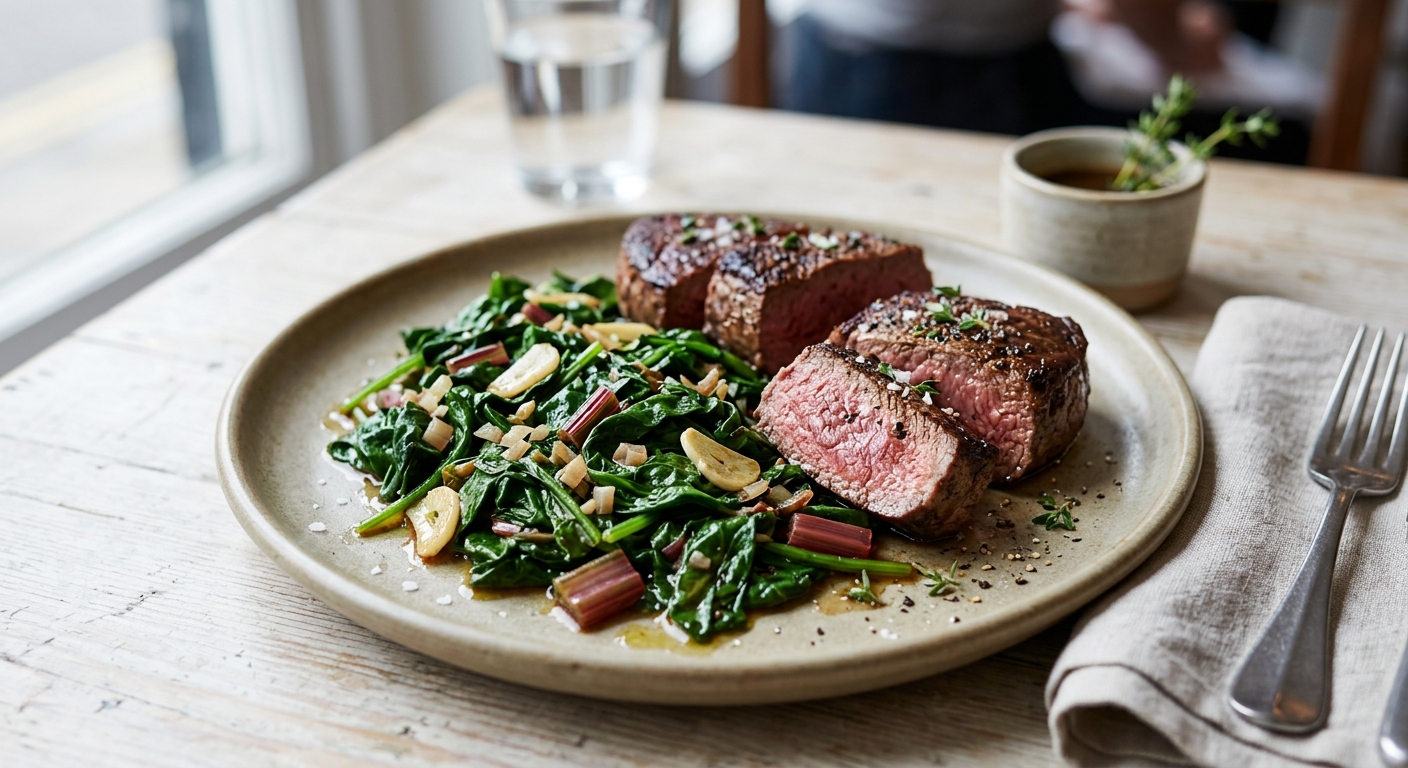
L-carnitine is one of the most underappreciated metabolic compounds in human nutrition, and red meat is its single richest dietary source. A 200g serving of beef sirloin delivers approximately 140 to 160mg of L-carnitine, a conditionally essential nutrient that acts as the molecular ferry responsible for transporting long-chain fatty acids across the inner mitochondrial membrane, where they are oxidised for energy. Without adequate carnitine, fat metabolism stalls, cellular energy production drops, and fatigue sets in. This plate is specifically engineered to load your body with carnitine alongside the cofactors it needs to work: heme iron, B vitamins, and magnesium from the greens.
The leafy green component is not an afterthought. Spinach and Swiss chard contribute extraordinary amounts of folate, magnesium, vitamin K1, and non-heme iron, and when paired with the heme iron from beef, the absorption of non-heme iron rises significantly, a phenomenon known as the meat factor effect. A squeeze of lemon at the finish provides vitamin C, which further reduces ferric iron to the absorbable ferrous form, effectively tripling the bioavailability of the plant-based iron in this dish. The garlic and shallots contribute quercetin and allicin, two compounds with demonstrated effects on metabolic rate and insulin sensitivity.
Beyond the nutritional architecture, this is a genuinely elegant weeknight plate. The beef is seared hard for a deep Maillard crust, the greens are wilted in the residual fond and a splash of broth, and the whole thing comes together in under 30 minutes on the stovetop. The slow cooker version transforms the beef into a braise with meltingly tender results, while the pressure cooker delivers that same depth in a fraction of the time. Choose your method based on your schedule, and every version delivers the same calibrated nutritional payload.
4
servings
Ingredients
- 800 gbeef sirloin or top round, trimmed and cut into 4 steaks (about 200g each)
- 200 gfresh baby spinach, washed
- 200 gSwiss chard, stems thinly sliced, leaves roughly chopped
- 3 tbspextra-virgin olive oil, divided
- 4 clovesgarlic, thinly sliced
- 2 mediumshallots, finely diced
- 240 mllow-sodium beef broth
- 1 tbspWorcestershire sauce
- 1 tspsmoked paprika
- 1 tspground cumin
- 0.5 tspcrushed red pepper flakes
- 1 tbspfresh lemon juice
- 1 tsplemon zest
- 2 tbspfresh flat-leaf parsley, finely chopped
- —Colima Sea SaltMicroplastic Free Salt and freshly cracked black pepper to taste
Instructions
Click on an item below to shop for the recommended items for this recipe on Amazon.
As an Amazon Associate, we earn from qualifying purchases.
- Remove the steaks from the refrigerator 20 minutes before cooking and pat them completely dry with paper towels. Season generously on both sides with salt, pepper, smoked paprika, and cumin, pressing the spices firmly into the surface.
- Heat a large cast iron skillet over high heat for 3 to 4 minutes until it begins to faintly smoke. Add 2 tablespoons of olive oil and swirl to coat. Lay the steaks in the pan without crowding, working in batches if needed. Sear undisturbed for 3 to 4 minutes per side for medium-rare (internal temperature 54 to 57 degrees C), or 5 minutes per side for medium. Transfer to a cutting board and tent loosely with foil to rest for at least 5 minutes.
- Reduce the heat to medium. Add the remaining tablespoon of olive oil to the same skillet. Add the shallots and Swiss chard stems and cook, stirring frequently, for 3 minutes until softened and beginning to caramelise in the beef fond. Add the garlic and red pepper flakes and cook for 60 seconds until fragrant.
- Pour in the beef broth and Worcestershire sauce, scraping the bottom of the pan with a wooden spoon to lift every bit of fond. Let the liquid reduce by half, about 2 minutes. Add the Swiss chard leaves and spinach in large handfuls, turning them with tongs after each addition. Cook just until wilted and vivid green, 2 to 3 minutes. Season with salt and pepper.
- Remove from heat. Stir in the lemon juice and lemon zest. Divide the greens and pan sauce among four plates. Slice each steak against the grain and arrange over the greens. Scatter parsley over the top and serve immediately.
- Pat the beef steaks dry and season on all sides with salt, pepper, smoked paprika, and cumin. Heat 2 tablespoons of olive oil in a large skillet over high heat and sear the steaks for 2 minutes per side until deeply browned. You are building flavour here, not cooking through. Transfer the seared beef to the slow cooker insert.
- Reduce the skillet heat to medium. Add the remaining olive oil, then the shallots and Swiss chard stems. Cook for 3 minutes, then add the garlic and red pepper flakes for 60 seconds. Pour in the beef broth and Worcestershire sauce, scraping up the fond. Pour this entire mixture over the beef in the slow cooker.
- Cover and cook on Low for 6 to 8 hours or on High for 3 to 4 hours, until the beef is completely tender and easily pulled apart with a fork. Resist lifting the lid during cooking, as each peek adds approximately 20 minutes to the cook time.
- During the final 20 minutes of cooking, lift the lid and layer the Swiss chard leaves and baby spinach directly on top of the beef. Replace the lid and cook on High for 15 to 20 minutes until the greens are fully wilted and have absorbed the braising liquid.
- Using tongs, transfer the beef to a cutting board and slice against the grain or pull into large pieces. Stir the lemon juice, lemon zest, and parsley through the braised greens in the slow cooker. Divide the greens and sauce among plates, top with the beef, and finish with a final drizzle of olive oil if desired.
- Select the Saute function on your Instant Pot or electric pressure cooker and set it to High. Once hot, add 2 tablespoons of olive oil. Pat the steaks dry, season with salt, pepper, smoked paprika, and cumin, then sear in the pot for 2 to 3 minutes per side until a dark crust forms. Work in batches to avoid steaming. Remove the beef and set aside.
- Without cleaning the pot, add the remaining olive oil, shallots, and Swiss chard stems. Saute for 2 minutes, then add the garlic and red pepper flakes for 30 seconds. Pour in the beef broth and Worcestershire sauce, scraping the bottom thoroughly with a wooden spoon to deglaze. Any stuck fond left behind can trigger a burn warning.
- Return the seared beef to the pot, nestling the steaks into the liquid. Cancel the Saute function, secure the lid, and set the pressure release valve to Sealing. Cook at High Pressure for 25 minutes. This longer time transforms even sirloin into a tender braise, or use 18 minutes if you prefer it sliceable with a slight chew.
- When the cycle completes, allow natural pressure release for 10 minutes, then carefully switch the valve to Venting to release any remaining steam. Open the lid. Transfer the beef to a cutting board to rest.
- Select Saute on Low. Add the Swiss chard leaves and baby spinach to the hot braising liquid and stir for 2 to 3 minutes until wilted. Stir in the lemon juice, lemon zest, and parsley. Slice or pull the beef, arrange over the greens and sauce on plates, and serve immediately.
- Preheat your oven to 120 degrees C (250 degrees F). Line a baking rack over a rimmed baking sheet. Pat the steaks dry, season with salt, pepper, smoked paprika, and cumin, and place on the rack. Insert a probe thermometer into the thickest steak if available. Roast in the lower third of the oven until the internal temperature reaches 46 degrees C (115 degrees F) for medium-rare, approximately 20 to 30 minutes depending on thickness.
- While the beef is in the oven, toss the Swiss chard leaves and stems, spinach, shallots, and garlic with 2 tablespoons of olive oil, the red pepper flakes, salt, and pepper on a large separate rimmed baking sheet. Spread in a single layer. About 10 minutes before the beef is done, slide this sheet onto the upper rack of the oven. The greens will roast and char slightly at the edges in 8 to 10 minutes.
- When the beef hits its target temperature, remove it from the oven and set the rack aside. Heat a cast iron skillet over the highest heat possible for 4 minutes. Add the remaining tablespoon of olive oil. Sear the roasted steaks for 60 to 90 seconds per side to build a deep mahogany crust. The exterior is already dry from the low oven, so the sear is extremely fast and intense. Rest for 5 minutes.
- Transfer the roasted greens to a large bowl or directly to the hot skillet. Deglaze the skillet with the beef broth and Worcestershire sauce, scraping up any fond, and pour over the greens. Toss together with lemon juice, lemon zest, and parsley.
- Slice the steaks against the grain. Divide the wilted and slightly charred greens among four plates, lay the sliced beef over the top, and spoon any remaining pan juices over everything. Serve at once.
Nutrition Breakdown
Per 1 serving (makes 4)
Vitamins & Minerals
% Daily Value based on a 2,000 calorie diet (FDA reference)
🧬 Essential Amino Acids
% of recommended daily intake (RDA) per serving
🛡 Antioxidant Profile
The Nutrition Science
L-carnitine functions as the essential shuttle system for long-chain fatty acid metabolism. The inner mitochondrial membrane is impermeable to acyl-CoA molecules, meaning that without carnitine, activated fatty acids cannot enter the matrix where beta-oxidation occurs. Carnitine palmitoyltransferase I (CPT1) on the outer membrane conjugates carnitine to the fatty acid, and the resulting acylcarnitine is transported across by the carnitine-acylcarnitine translocase. CPT2 on the inner membrane then regenerates free CoA and delivers the acyl group into the matrix. This is why dietary carnitine intake directly influences the rate of fat oxidation, particularly during moderate-intensity sustained exercise or periods of caloric restriction.
The combination of heme iron from beef and non-heme iron from spinach and Swiss chard is nutritionally strategic. Heme iron, bound within myoglobin and hemoglobin, is absorbed via a dedicated receptor pathway (HCP1) at a rate of 20 to 30%, largely unaffected by dietary inhibitors. Non-heme iron, which dominates in plant sources, is absorbed at only 1 to 10% under normal conditions. The well-documented meat factor effect, attributed in part to an unidentified peptide fraction from meat digestion, enhances non-heme iron absorption by up to threefold when consumed in the same meal. Vitamin C from the lemon juice provides a second, additive mechanism by chemically reducing Fe3+ (ferric) to Fe2+ (ferrous) in the gut lumen, keeping it soluble and available for absorption via the DMT1 transporter.
Zinc, provided at 83% DV per serving primarily from the beef, is a critical cofactor for over 300 enzymatic reactions, including several directly involved in energy metabolism: alcohol dehydrogenase, carbonic anhydrase, and carboxypeptidase. Of particular relevance to this recipe’s metabolic focus, zinc is required for the synthesis of insulin and for the activity of delta-6-desaturase, the rate-limiting enzyme in the conversion of essential fatty acids to their longer-chain, highly bioactive derivatives such as EPA and DHA. Adequate zinc status is therefore a prerequisite for the full metabolic benefit of both the carnitine and the polyunsaturated fats provided by the olive oil in this dish.
Pro Tips
- Do not skip the resting period after searing. As beef rests, myosin proteins continue to contract and then relax, redistributing juices through the muscle fibres. Cutting immediately after cooking loses up to 40% more moisture than resting for 5 minutes, directly affecting the texture and the concentration of water-soluble B vitamins and carnitine in each bite rather than on the cutting board.
- To maximise carnitine retention, avoid cooking the beef past medium (63 degrees C internal). L-carnitine is relatively heat-stable but significant amounts are lost in drip loss from overcooked, well-done meat. If you prefer well-done, collect every drop of resting juice and spoon it back over the sliced beef before serving.
- For an anti-inflammatory upgrade, add one teaspoon of freshly grated turmeric root or half a teaspoon of turmeric powder with the garlic. The curcuminoids in turmeric have synergistic antioxidant activity with quercetin from the shallots, and the black pepper already in this recipe provides piperine, which increases curcumin bioavailability by up to 2000% by inhibiting glucuronidation in the gut wall.

ooh this is so up my alley, i’ve been really focused on heme iron absorption lately since my oldest has been struggling with focus at school and we realized his iron stores were tanking. do you touch on cooking methods in the full post? i’m wondering if the searing temp matters for carnitine retention, or if theres any synergy with the greens since spinach has those oxalates that can compete with iron absorption. we’ve actually been sprouting some legumes on the side to boost bioavailability but honestly the kids revolt when its not meat haha, so this plate sounds like a total win for our dinner rotation!
This sounds like exactly what I’ve been gravitating toward since my thyroid diagnosis, honestly – the combination of heme iron with those specific greens is so thoughtful for absorption. Quick question though: are there any nightshades hiding in the seasoning or garlic prep, and do you happen to know the iodine content of the spinach/chard you’re using? I’ve found that raw spinach can sometimes interfere with my thyroid medication timing, so I’m always curious about cooking methods and whether this would work within a modified AIP framework. The carnitine angle is really interesting for supporting mitochondrial function, which has been part of my recovery focus!
ngl the carnitine angle is fascinating but im curious how much of it survives the searing process – ive been experimenting with raw beef preparations (carpaccio style) and the nutrient density seems way higher, but i havent seen good data comparing bioavailability between raw vs seared carnitine. have you looked into whether the maillard reaction helps or hinders mitochondrial uptake? also those greens are so much more enzyme-rich raw obvi, but i get that wilting them changes their iron bioavailability dramatically so thats a fair tradeoff