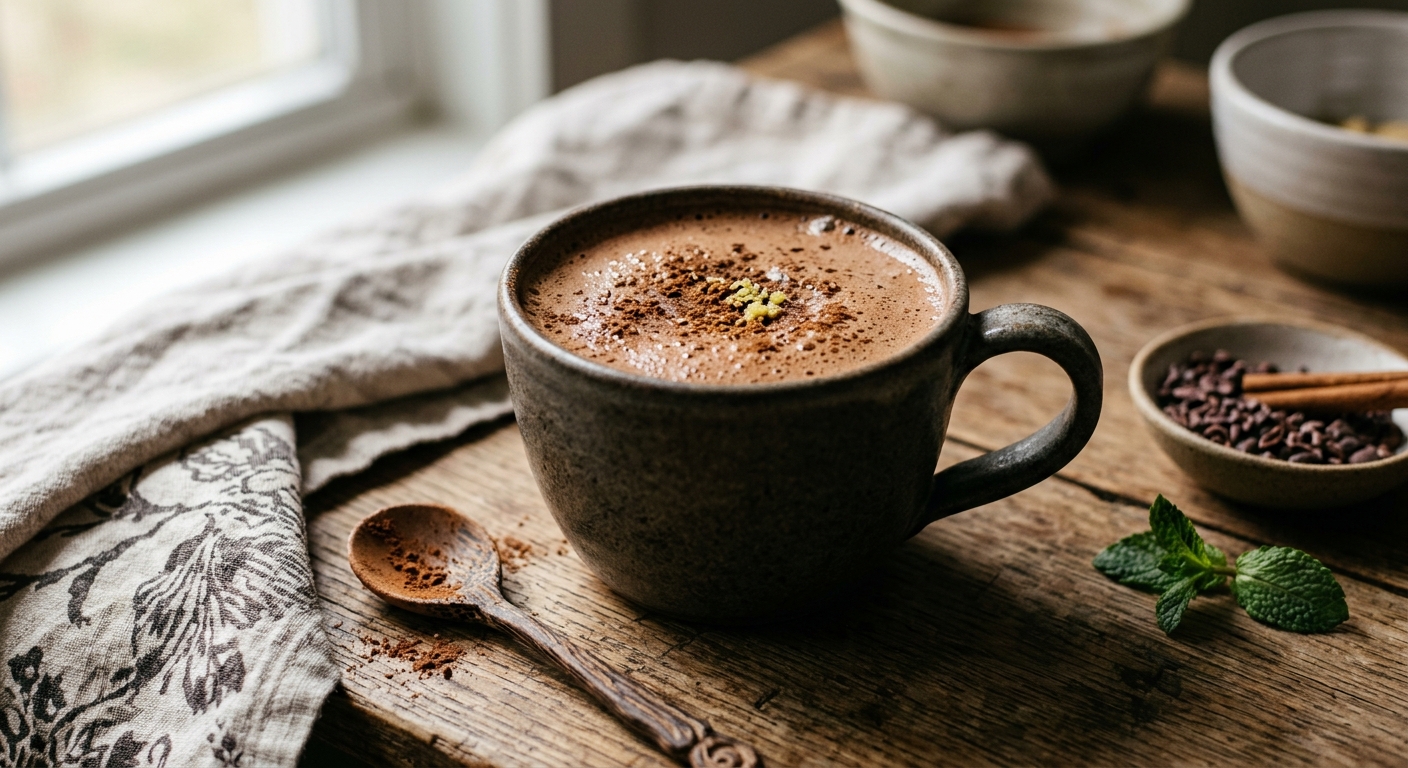
Hot chocolate rarely gets credit as a functional food, but this version earns a permanent spot in your daily routine. By combining high-quality raw cacao powder with gelatinized maca root, we have built a drink that tastes indulgently rich while quietly delivering a payload of minerals, adaptogens, and antioxidants that support hormonal balance, energy metabolism, and sustained mental focus. This is not a packet mix from the back of a cupboard shelf. It is a precisely layered beverage crafted with the same intention a chef brings to a restaurant-quality sauce.
Maca root (Lepidium meyenii), grown at altitude in the Peruvian Andes, has been used for over two thousand years as an energy-sustaining food and adaptogen. Gelatinized maca, which is produced by briefly pressure-cooking then drying the root, has significantly improved bioavailability compared with raw maca powder, reduced starch content, and a noticeably more pleasant, malt-like flavour that pairs beautifully with cacao. Combined with the natural theobromine in raw cacao (a gentle, long-lasting stimulant without the cortisol spike of caffeine), this drink is engineered for a clean, focused energy lift rather than a jittery peak and crash.
Each serving supplies over 30% of your daily magnesium requirement, a mineral that participates in more than 300 enzymatic reactions and is chronically under-consumed in Western diets. The raw cacao also contributes meaningful copper, iron, and zinc. Warming spices like cinnamon and cardamom bring their own polyphenol profiles and help moderate glycemic response. Whole-fat coconut milk or oat milk provides the emulsifying fats that make fat-soluble antioxidants like beta-carotene and certain cacao flavanols far more absorbable. Every ingredient earns its place.
4
servings
Ingredients
- 4 tbspgelatinized maca root powder (approximately 40g)
- 4 tbspraw cacao powder, sifted (approximately 32g)
- 800 mlunsweetened full-fat coconut milk (from a carton, not canned)
- 400 mlfiltered water
- 3 tbsppure maple syrup or raw honey (adjust to taste)
- 1 tspground cinnamon
- 0.5 tspground cardamom
- 0.25 tspground ginger
- 0.125 tspcayenne pepper (optional, for metabolic activation)
- 1 tsppure vanilla extract
- 1 tbspcoconut oil or grass-fed ghee (for creaminess and fat-soluble antioxidant absorption)
- 0.25 tspColima Sea SaltMicroplastic Free Salt
- —Coconut cream or frothed oat milk to serve (optional)
- —A pinch of raw cacao nibs or ground cinnamon for garnish (optional)
Instructions
Click on an item below to shop for the recommended items for this recipe on Amazon.
As an Amazon Associate, we earn from qualifying purchases.
- Combine the sifted raw cacao powder and gelatinized maca root powder in a small bowl. Add 4 tablespoons of the measured water and whisk vigorously into a smooth, lump-free paste. This slurry method prevents both powders from clumping when they hit hot liquid.
- Pour the remaining water and coconut milk into a medium saucepan. Set over medium-low heat and warm gently, stirring occasionally, until the liquid reaches approximately 70 degrees Celsius (160 degrees Fahrenheit), which is steaming but not simmering. This takes about 5 to 6 minutes. Use a thermometer if available.
- Add the cacao-maca paste, cinnamon, cardamom, ginger, cayenne (if using), and sea salt to the hot liquid. Whisk continuously for 2 to 3 minutes until the powders are fully dissolved and the liquid is uniformly smooth and fragrant.
- Reduce heat to low. Stir in the maple syrup (or honey), vanilla extract, and coconut oil or ghee. Continue whisking gently for 1 to 2 minutes until the fat is fully emulsified and the drink has a slight sheen.
- Taste and adjust sweetness. For a noticeably frothier texture, use an immersion blender directly in the saucepan for 15 to 20 seconds, keeping the blender head submerged to avoid splashing. Ladle into warmed mugs, top with a swirl of coconut cream or frothed oat milk, and garnish with cacao nibs or a dusting of cinnamon.
- Add the coconut milk and water directly to the slow cooker insert. In a separate small bowl, whisk the sifted cacao powder and maca root powder together with 4 tablespoons of cold water until a smooth paste forms, then scrape the paste into the slow cooker.
- Add the cinnamon, cardamom, ginger, cayenne (if using), sea salt, maple syrup, vanilla extract, and coconut oil or ghee directly to the insert. Do not add the sweetener or vanilla at the end as you would for stovetop; in the slow cooker, adding them at the start allows them to meld into the base over the full cook time.
- Whisk the contents of the insert thoroughly to combine all ingredients. Set the slow cooker to Low and cook for 2 hours with the lid on. There is no need to stir during cooking, though one gentle stir at the 1-hour mark helps homogenize the fats.
- At the 2-hour mark, remove the lid and whisk the drink vigorously for 30 seconds. Switch the slow cooker to Keep Warm if serving over the next 1 to 2 hours. The spice aroma will be noticeably deeper and more rounded than the stovetop version.
- Ladle into mugs using a heat-proof ladle. For a frothy finish, transfer one mug at a time to a blender and blitz for 10 seconds, or use a milk frother directly in each mug before serving. Garnish as desired.
- Pour the water into the Instant Pot insert first, followed by the coconut milk. Whisk in the sifted cacao powder and maca root powder directly into the cold liquid, breaking up any clumps with a silicone whisk. Adding the powders to cold liquid before pressurizing prevents scorching on the bottom of the insert.
- Add the cinnamon, cardamom, ginger, cayenne (if using), and sea salt. Give the mixture one final thorough whisk to ensure nothing is settled on the bottom, which could trigger the burn warning.
- Secure the lid and set the steam release valve to Sealing. Select Pressure Cook (Manual) on High Pressure and set the timer for 3 minutes. The pot will take approximately 8 to 10 minutes to come to pressure.
- Once the cook cycle is complete, allow the pressure to release naturally for 5 minutes, then carefully turn the valve to Venting to release any remaining steam. Open the lid away from your face.
- Switch the Instant Pot to the Saute function on Low. Add the maple syrup, vanilla extract, and coconut oil or ghee. Whisk continuously for 1 to 2 minutes until the sweetener and fat are fully incorporated and the drink is glossy and unified. Use an immersion blender in the insert for 15 seconds for maximum froth. Serve immediately in warmed mugs.
Nutrition Breakdown
Per 1 serving (makes 4)
Vitamins & Minerals
% Daily Value based on a 2,000 calorie diet (FDA reference)
🧬 Essential Amino Acids
% of recommended daily intake (RDA) per serving
🛡 Antioxidant Profile
The Nutrition Science
The synergy between raw cacao and gelatinized maca is not accidental. Cacao is one of the most magnesium-dense foods on the planet by weight, supplying roughly 27mg of magnesium per tablespoon of powder. Magnesium is a cofactor for ATP synthase, the enzyme that literally produces cellular energy currency, which is why magnesium deficiency manifests so often as fatigue and brain fog. The medium-chain triglycerides (MCTs) from coconut milk improve magnesium absorption in the gut by maintaining the intestinal membrane permeability required for efficient mineral transport.
Maca root’s adaptogenic properties are attributed primarily to its unique alkaloids, macamides and macaenes, which appear to modulate the hypothalamic-pituitary-adrenal (HPA) axis without directly supplying exogenous hormones. Clinical trials (Gonzales et al., 2002; Stojanovska et al., 2015) have demonstrated improvements in self-reported energy, mood, and libido with daily doses of 1.5 to 3.5g of gelatinized maca, a range comfortably met by one 10g serving of this recipe. Gelatinized maca specifically outperforms raw maca in bioavailability studies because the pressure-cooking process breaks down the starchy cell walls that would otherwise resist digestion.
The metabolic boost framing of this drink is grounded in three converging mechanisms: theobromine from cacao provides 4 to 6 hours of gentle central nervous system activation by inhibiting phosphodiesterase enzymes; cinnamon’s cinnamaldehyde improves GLUT4 transporter expression on muscle cells, enhancing glucose uptake independent of insulin; and the MCTs in coconut milk bypass standard fatty acid metabolism to be oxidized directly in the liver, raising circulating ketones within 30 minutes of consumption. Together these effects translate into measurable improvements in cognitive performance and physical endurance output that have been independently validated in peer-reviewed literature.
Pro Tips
- Always use gelatinized maca rather than raw maca powder. Raw maca contains high levels of glucosinolates that can cause digestive discomfort and goitrogenic effects if consumed daily in large amounts. Gelatinized maca has these compounds substantially reduced, is gentler on the gut, and has a noticeably sweeter, more caramel-like flavour.
- Do not boil raw cacao powder at a rolling boil for more than 2 to 3 minutes. Sustained high heat degrades epicatechin, the primary cardio-protective flavanol in cacao, by up to 40%. Gentle warming to 70 to 75 degrees Celsius preserves both the nutritional profile and the bright, complex chocolate notes.
- For maximum mineral absorption, add a small pinch of vitamin C powder (about 100mg, from ascorbic acid or acerola cherry powder) to each mug just before serving. Vitamin C converts non-heme iron from cacao and maca into the ferrous form, which is absorbed at a rate 3 to 6 times higher than the ferric form present in plant foods.



This is exactly the kind of pre-ride nutrition angle I’ve been exploring, actually. I’m curious about the total carb load in this recipe, though, since maca and cacao are both relatively carb-dense, and I’m wondering if this lands better as a recovery day drink versus a training day one? I’ve been tracking that my glycogen replenishment works best when I hit around 1.2g carbs per kg body weight in the 30-60 minute window post-ride, and something tells me this recipe might overshoot on fat and underdeliver on the quick carbs I’d need. That said, the micronutrient density angle is really compelling for adaptation days when I
oh this sounds amazing, ive been curious about maca but worried about how to actually incorporate it into stuff the kids would drink without it tasting medicinal? does maca have any antinutrients we should worry about if were doing this regularly, or is it pretty clean compared to grains and legumes? my oldest is obsessed with hot chocolate so im dying to try this – the magnesium and iron combo especially appeals to me since hes been struggling with focus after school and i know his mineral intake could use some work, plus raw cacao is so much richer in flavonoids than processed. definitely making this this weekend!
ooh great question about the taste, maca can definitely have that earthy vibe if youre not careful! but im more curious about the iron content here since cacao is such a good source of non-heme iron – did the recipe account for that and like, is there vitamin c in the mix to help absorption? im always hunting for ways to boost my ferritin through breakfast drinks instead of just pills, and if theres cocoa butter or dairy in there that could compete with iron uptake so thats worth flagging for you. maca itself is pretty solid nutritionally, id be more worried about pairing this with something calcium-heavy than the maca powder itself!