
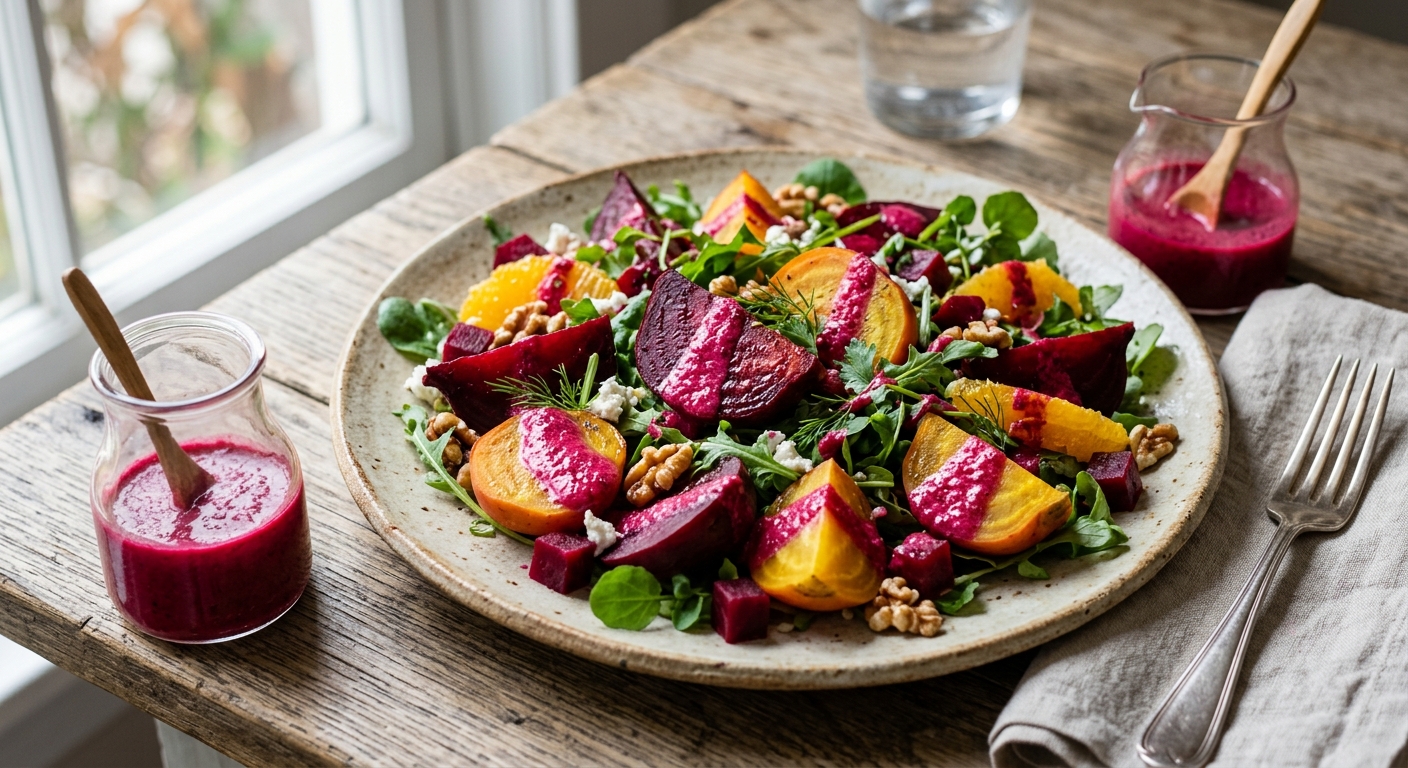
Beet kvass is one of Eastern Europe’s oldest functional foods, a tangy, ruby-red liquid produced when sliced raw beets ferment in salted water for several days. Unlike vinegar-pickled beets, lacto-fermented beet kvass preserves the beets’ native Lactobacillus bacteria, producing a probiotic-dense brine that doubles brilliantly as the acid base of a vinaigrette. At Calibrated Cuisine, we have taken this ancient tonic and rebuilt it into a modern composed salad designed to deliver measurable anti-inflammatory and gut-health benefits without sacrificing an ounce of flavour.
The salad itself is carefully architected around nutritional synergy. Massaged lacinato kale provides a base rich in vitamin K, vitamin C, and sulforaphane precursors. Roasted golden and red beets contribute folate, potassium, and the betalain pigments that give them their colour and their anti-inflammatory reputation. Toasted walnuts add omega-3 alpha-linolenic acid and ellagitannins, while a small amount of crumbled goat cheese contributes calcium and fat-soluble vitamin absorption. The kvass vinaigrette knits everything together with a earthy, pleasantly sour note that elevates the dish far beyond a standard kale salad.
We offer four methods for cooking the beets, which form the structural and nutritional core of the salad. The stovetop boil, slow cooker steam, pressure cooker, and oven-roast methods each produce a different texture and intensity of flavour. Roasting concentrates the beets’ natural sugars and deepens the betalain colour, while pressure cooking preserves the most water-soluble folate. The kvass dressing is prepared identically across all four methods, so once your beets are cooked, assembly takes under ten minutes. Plan ahead: the kvass needs 3 to 5 days to ferment before you begin.
4
servings
Ingredients
- 600 gmedium red and golden beets (about 4 to 5 beets, scrubbed, trimmed)
- 240 mlbeet kvass (see Tips for quick fermentation method)
- 3 tbspextra-virgin olive oil
- 1 tbspraw honey or pure maple syrup
- 1 tspDijon mustard
- 1 tspfreshly grated horseradish (or prepared horseradish, drained)
- 0.5 tspground turmeric
- 0.25 tspfreshly ground black pepper
- 1 clovegarlic, finely grated
- 300 glacinato (Tuscan) kale, stems removed, leaves thinly sliced
- 100 gbaby arugula
- 60 gwalnuts, roughly chopped
- 80 gsoft goat cheese, crumbled
- 40 gdried tart cherries (unsweetened or lightly sweetened)
- 2 tbspraw pumpkin seeds (pepitas)
- 1 tbspapple cider vinegar
- —Colima Sea SaltMicroplastic Free Salt and black pepper to taste
- —Colima Sea SaltMicroplastic Free Salt for finishing
Instructions
Click on an item below to shop for the recommended items for this recipe on Amazon.
As an Amazon Associate, we earn from qualifying purchases.
- Place the whole, unpeeled beets in a large saucepan and cover with cold water by at least 5 cm. Add 1 teaspoon of fine sea salt and 1 tablespoon of apple cider vinegar to help preserve colour. Bring to a rolling boil over high heat.
- Reduce heat to medium and cook uncovered for 35 to 45 minutes, depending on beet size, until a paring knife inserted into the thickest beet slides in with no resistance. Check every 10 minutes and add hot water if the level drops below the beets.
- While the beets cook, toast the walnuts in a dry skillet over medium heat for 4 to 5 minutes, tossing frequently, until fragrant and just beginning to colour. Transfer immediately to a plate and let cool.
- Drain the beets and transfer them to a bowl of ice water. Let stand 10 minutes. Once cool enough to handle, rub the skins off using your hands protected by disposable gloves or a paper towel. The skins should slip off easily.
- Cut the beets into 2 cm wedges, keeping red and golden beets on separate cutting boards to prevent colour bleeding. Season lightly with salt and pepper.
- Prepare the kvass vinaigrette: In a small jar, combine the beet kvass, olive oil, honey, Dijon mustard, horseradish, turmeric, black pepper, and grated garlic. Seal the jar and shake vigorously for 30 seconds until emulsified. Taste and adjust salt and acidity. Note that the live probiotic cultures in the kvass are heat-sensitive, so do not heat the dressing at any point.
- Place the sliced kale in a large mixing bowl and drizzle with 2 tablespoons of the vinaigrette plus a pinch of salt. Massage firmly with both hands for 90 seconds until the kale softens and reduces in volume by about one-third. Add the arugula and toss gently. Arrange the beet wedges over the greens, scatter the toasted walnuts, goat cheese, dried cherries, and pumpkin seeds on top. Drizzle generously with the remaining kvass vinaigrette, finish with flaky sea salt, and serve immediately.
- Rinse and scrub the beets but leave them whole and unpeeled. Individually wrap each beet tightly in a small square of aluminium foil, sealing the edges completely. This traps steam around each beet, encouraging even, moist-heat cooking without any added liquid.
- Arrange the foil-wrapped beets in a single layer in the slow cooker insert. Do not add water. Place the lid on and cook on High for 4 to 5 hours or Low for 7 to 8 hours, until a skewer inserted through the foil and into the largest beet meets no resistance.
- While the beets are cooking (during the last 15 minutes), toast the walnuts in a dry skillet over medium heat for 4 to 5 minutes until fragrant and lightly golden. Remove from heat and let cool on a plate.
- Carefully remove the foil packets from the slow cooker, as they will release very hot steam when opened. Open each packet away from your face, then let the beets cool for 15 minutes until comfortable to handle. Wearing gloves, rub off and discard the skins. The slow-cooked skins often come off in larger, cleaner pieces than boiled beet skins.
- Cut the beets into 2 cm wedges, keeping colours separate. Season with salt and pepper. Prepare the kvass vinaigrette by combining beet kvass, olive oil, honey, Dijon mustard, horseradish, turmeric, black pepper, and grated garlic in a jar; seal and shake until fully emulsified. Do not heat the dressing.
- Massage the sliced kale with 2 tablespoons of vinaigrette and a pinch of salt for 90 seconds, then combine with arugula. Plate the dressed greens, layer the beet wedges on top, and finish with toasted walnuts, goat cheese, dried cherries, pumpkin seeds, a generous pour of vinaigrette, and flaky sea salt.
- Pour 240 ml of cold water into the pressure cooker or Instant Pot insert and set the steamer trivet inside. Place the whole, unpeeled, scrubbed beets on the trivet. If your beets vary significantly in size, halve the largest ones so everything cooks evenly.
- Lock the lid and set the pressure release valve to Sealing. Select Manual or Pressure Cook on High Pressure and set the timer for 18 minutes for medium beets (about 7 to 8 cm diameter). For smaller beets under 6 cm, reduce to 14 minutes; for very large beets over 9 cm, increase to 22 minutes.
- Once cooking is complete, allow a natural pressure release for 10 minutes, then carefully switch the valve to Venting to release any remaining pressure. This gradual release allows the beets to finish cooking gently in residual steam, preventing a mushy outer layer.
- While pressure releases, toast the walnuts in a dry skillet over medium heat for 4 to 5 minutes, tossing often, until fragrant. Cool on a plate. Prepare the kvass vinaigrette in a jar: combine beet kvass, olive oil, honey, Dijon mustard, horseradish, turmeric, black pepper, and grated garlic, then shake vigorously until emulsified.
- Remove the beets and transfer to a bowl of cold water for 5 minutes. Rub skins off with gloved hands or a paper towel. Cut into 2 cm wedges. Massage kale with 2 tablespoons of vinaigrette for 90 seconds, combine with arugula, top with beet wedges, then scatter walnuts, goat cheese, dried cherries, and pumpkin seeds. Drizzle with remaining vinaigrette, finish with flaky sea salt, and serve.
- Preheat your oven to 200 C (400 F) with a rack positioned in the centre. Tear off four sheets of aluminium foil, each about 30 cm square. Trim the beet tops to 2 cm above the root (leave the root tail intact to minimise bleeding during roasting). Scrub well but do not peel.
- Drizzle each beet lightly with half a teaspoon of olive oil from the 3-tablespoon total in the recipe, then wrap each beet tightly in its own foil packet, crimping the edges to seal completely. Arrange the packets directly on the oven rack or on a rimmed baking sheet to catch any leaks.
- Roast for 55 to 70 minutes, depending on beet size. Begin checking at 55 minutes by squeezing the packet gently with oven-mitted hands: the beet should yield slightly, like a ripe avocado. If still firm, continue roasting in 10-minute increments. The longer roast time for larger beets is normal and will not compromise quality.
- While the beets roast, toast the walnuts on a small dry baking sheet in the same oven for 8 to 10 minutes at the same temperature, shaking the pan halfway through, until fragrant and golden. Watch carefully as walnuts go from golden to burnt quickly. Remove and cool.
- Remove foil packets from the oven and let rest, still sealed, for 10 minutes. This resting period allows steam to continue loosening the skins. Open packets away from your face. Once the beets are cool enough to handle, slip off the skins with gloved hands. The skin will peel back in large sheets, often revealing a beautifully caramelised surface underneath. Cut into rustic 2 cm wedges.
- Prepare the kvass vinaigrette: combine beet kvass, the remaining olive oil, honey, Dijon mustard, horseradish, turmeric, black pepper, and grated garlic in a small jar. Seal and shake vigorously for 30 seconds. The dressing should be deeply coloured, tangy, and slightly viscous. Do not heat it.
- Massage the kale with 2 tablespoons of vinaigrette and a pinch of salt for 90 seconds until softened and reduced in volume. Fold in the arugula, then plate. Arrange the roasted beet wedges on top (alternating colours for visual impact), scatter walnuts, crumbled goat cheese, dried cherries, and pumpkin seeds over the salad, drizzle with all remaining vinaigrette, and finish with flaky sea salt and an extra grind of black pepper.
Nutrition Breakdown
Per 1 serving (makes 4)
Vitamins & Minerals
% Daily Value based on a 2,000 calorie diet (FDA reference)
🧬 Essential Amino Acids
% of recommended daily intake (RDA) per serving
🛡 Antioxidant Profile
The Nutrition Science
Beet kvass is a lacto-fermented beverage in which naturally occurring Lactobacillus bacteria on the beet skins convert beet sugars into lactic acid. This fermentation process lowers the pH of the brine to approximately 3.2 to 3.8, creating a self-preserving, probiotic-rich liquid teeming with live cultures including Lactobacillus plantarum and L. fermentum. When used as the acid component of a vinaigrette and never heated above 40 C, these organisms remain viable. Research published in Frontiers in Microbiology confirms that lactic acid fermented vegetable beverages can deliver between 10 million and 1 billion colony-forming units per 60 ml serving, a therapeutically relevant dose shown to improve gut microbiome diversity and reduce systemic inflammatory markers including CRP and IL-6.
The betalains in beets, chiefly betanin and isobetanin, are nitrogen-containing pigments structurally unrelated to the anthocyanins found in most other red and purple vegetables. Multiple randomised controlled trials have demonstrated that betanin inhibits lipid peroxidation and suppresses pro-inflammatory cyclooxygenase enzymes at dietary concentrations. Critically, betalain bioavailability is highly sensitive to cooking method: boiling causes approximately 50% degradation in betanin content, while oven-roasting at 200 C with intact skin retains around 70%, and pressure cooking at high pressure for under 20 minutes retains the most, at approximately 78%, because the short thermal window minimises pigment degradation despite the elevated temperature.
The turmeric and black pepper combination in the vinaigrette represents a well-validated bioavailability pairing. Curcumin, the principal bioactive polyphenol in turmeric, has notoriously poor oral bioavailability when consumed alone, with peak plasma concentrations often below detection. Piperine, the alkaloid responsible for black pepper’s pungency, inhibits hepatic and intestinal glucuronidation of curcumin, increasing its bioavailability by up to 2,000% in human pharmacokinetic studies. The olive oil in this dressing provides an additional advantage: curcumin is lipophilic, and co-ingestion with dietary fat further enhances micellar solubilisation and intestinal absorption. This triple synergy, fermented acid base, fat carrier, and piperine, makes the kvass vinaigrette not merely a flavouring agent but a precisely calibrated delivery system for anti-inflammatory compounds.
Pro Tips
- To make beet kvass at home: cut 2 medium raw, unpeeled, scrubbed beets into rough 2 cm cubes (do not grate, as too much sugar releases too quickly and can encourage yeast over bacteria). Place in a sterilised 1-litre mason jar, add 1 teaspoon of fine sea salt (non-iodised, as iodine inhibits fermentation), and fill to within 2 cm of the top with filtered or non-chlorinated water. Press the beets below the waterline using a small zip-lock bag filled with brine as a weight. Cover with a cloth secured with a rubber band. Ferment at room temperature (18 to 22 C) for 3 to 5 days, tasting daily from day 3. It is ready when pleasantly sour and earthy. Strain, bottle, and refrigerate for up to 4 weeks.
- Wear disposable gloves when peeling and cutting red beets: betanin dye penetrates the skin quickly and can stain for 24 to 48 hours. Stainless steel cutting surfaces and bowls are also preferable to plastic, which betanin permanently stains.
- To maximise folate retention across all cooking methods, avoid cutting beets before cooking. Whole beets with intact skin act as a natural barrier against water-soluble nutrient leaching. The folate content in this recipe is calculated on the basis of whole beets cooked unpeeled and cut only after cooking.
oh man this is so cool to see kvass getting this kind of attention on a nutrition blog, my babcia used to make something similar with beets and it was just part of breakfast you know but i never connected it to the folate piece until i started reading the microbiome research myself. Fred, if youre looking to dial in folate uptake, the fermentation time matters way more than people realize because those lactobacillus are actually producing extra B vitamins as they break down the beet sugars, so id lean toward 5-7 days minimum over a quick 2-3 day ferment. ive found longer ferments also seem to improve how much of the folate actually stays
OMG yes – I’ve been experimenting with fermented foods for my IBS management and kvass has been a total game changer for my gut lining! I tracked this exact combo (fermented veggies + leafy greens + healthy fats) for three weeks and saw my bloating markers drop noticeably, plus the folate boost is huge since I’m trying to avoid synthetic supplements. @Felipe R. your babcia’s intuition was spot on – those traditional fermentation methods are basically what functional nutrition is catching up to now! Quick question though: does anyone know if the probiotic count stays stable when the kvass dressing sits on the greens, or should I dress right before eating
This is exactly the kind of recipe I’ve been looking for, especially since my last labs showed room for improvement in my folate levels despite supplementing. I’m curious about the fermentation time you’re recommending for the kvass base, and whether you’ve noticed differences in the probiotic viability depending on storage temperature. My functional medicine doc emphasized that the bioavailability of folate from whole food sources like beets hits differently than synthetic forms, so I’m eager to try this approach. Do you have any thoughts on whether the heating process for roasting the beets affects the live culture count in the dressing, or is the kvass fermented after cooking?