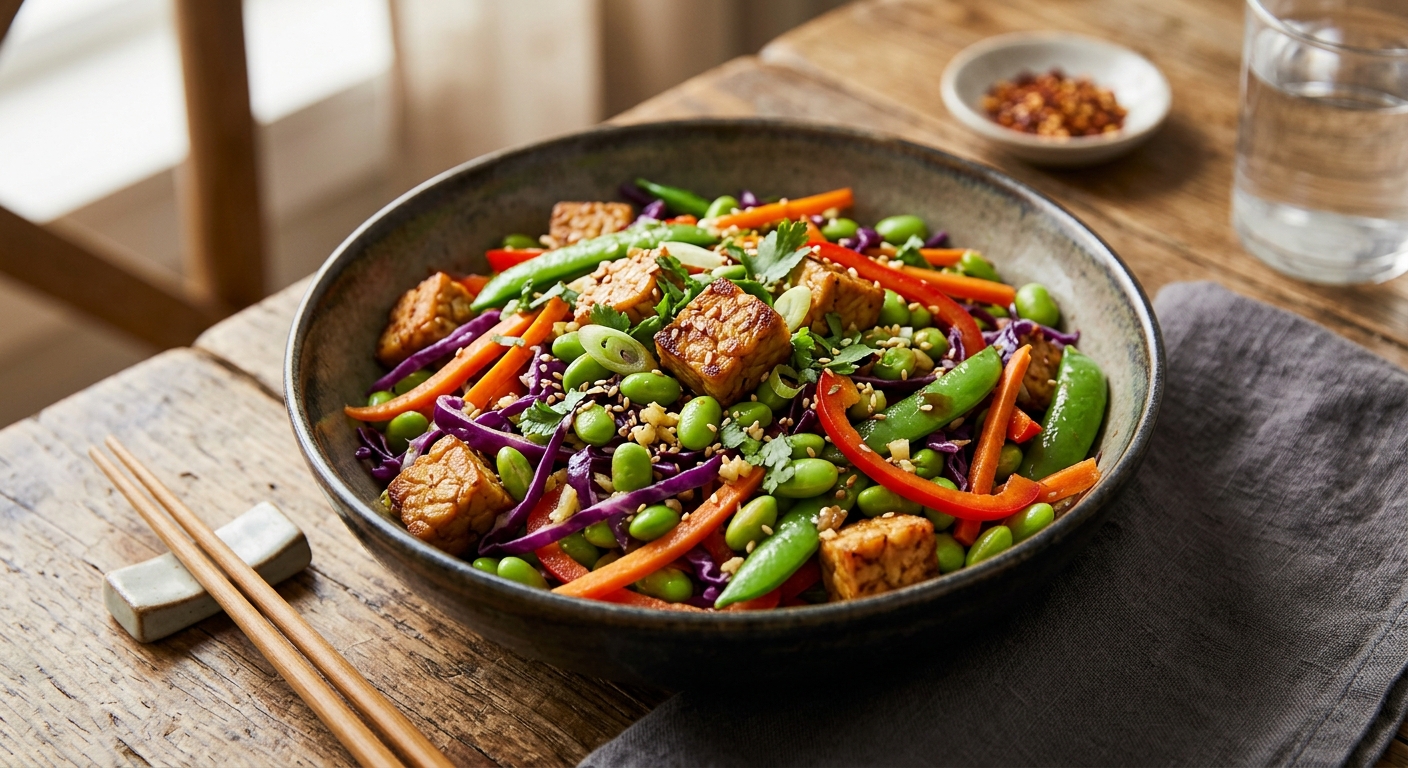
When it comes to plant-based protein, soy stands alone as one of the only vegetable sources providing all nine essential amino acids in meaningful quantities. This stir-fry harnesses that power twice over, pairing shelled edamame (young, whole soybeans at peak nutritional density) with fermented tempeh, whose controlled fermentation process not only boosts bioavailability of zinc and iron but also introduces beneficial probiotics. The result is a dish that performs like a post-workout recovery meal while tasting like something you would order at a high-end pan-Asian restaurant.
The technique here matters as much as the ingredients. Tempeh is seared in a very hot wok or skillet until deeply golden, building a crust that gives the finished stir-fry textural contrast and locking in the nutty, earthy flavour that fermentation creates. A bold sauce of reduced-sodium tamari, fresh ginger, toasted sesame oil, rice vinegar, and a touch of maple syrup ties the dish together while keeping sodium in a sensible range. Shredded purple cabbage, snap peas, and shredded carrots add crunch, colour, and a separate tier of phytonutrients including anthocyanins and beta-carotene.
From a calibration standpoint, a single serving of this stir-fry crosses the 20% Daily Value threshold for iron, calcium, magnesium, vitamin K, folate, and manganese simultaneously, a rare nutritional convergence in a single meal. Paired with a short-grain brown rice or soba noodles, it satisfies both your hunger and your micronutrient targets with room to spare. Whether you build it fast on the stovetop, let the slow cooker develop deeper flavour overnight, or pressure-cook it in under 20 minutes, this is weeknight nutrition without compromise.
4
servings
Ingredients
- 400 gplain tempeh, cut into 1.5 cm cubes
- 300 gshelled edamame, fresh or thawed from frozen
- 200 gsnap peas, strings removed
- 150 gpurple cabbage, finely shredded
- 120 gcarrots, julienned or coarsely grated
- 1 mediumred bell pepper, thinly sliced
- 4 clovesgarlic, minced
- 30 gfresh ginger, peeled and finely grated
- 4 tbspreduced-sodium tamari or soy sauce
- 2 tbsptoasted sesame oil
- 2 tbsprice vinegar
- 1 tbsppure maple syrup
- 1 tbspcornstarch
- 3 tbspAvocado Oil100% Pure Avocado Oil (avocado or refined coconut)
- 2 tbsptoasted sesame seeds
- 3 stalksgreen onions, thinly sliced
- —Colima Sea SaltMicroplastic Free Salt and white pepper to taste
Instructions
Click on an item below to shop for the recommended items for this recipe on Amazon.
As an Amazon Associate, we earn from qualifying purchases.
- Whisk together the tamari, rice vinegar, maple syrup, sesame oil, and cornstarch in a small bowl until the cornstarch is fully dissolved. Set the sauce aside near the stove.
- Heat 2 tablespoons of the neutral oil in a wok or large skillet over high heat until the oil shimmers and just begins to smoke. Add the tempeh cubes in a single layer. Do not stir for 2 minutes, allowing a deep golden crust to form on the bottom. Flip and sear for another 2 minutes. Transfer the seared tempeh to a plate and set aside.
- Add the remaining 1 tablespoon of oil to the same pan over high heat. Add garlic and ginger and stir-fry for 30 seconds until fragrant, scraping up any browned bits from the tempeh.
- Add the red bell pepper, carrots, and snap peas. Stir-fry over high heat for 3 to 4 minutes, tossing constantly, until the vegetables are bright in colour and just tender-crisp. The pan should be very hot so the vegetables char lightly at the edges.
- Add the edamame and purple cabbage. Stir-fry for 2 minutes more, keeping the heat high so the cabbage wilts slightly but retains some texture and colour.
- Return the seared tempeh to the pan. Pour the sauce over everything and toss continuously for 1 to 2 minutes as the sauce thickens and coats every piece. Taste and adjust seasoning with white pepper and a pinch of salt if needed.
- Remove from heat immediately. Divide among four bowls, scatter with toasted sesame seeds and green onions, and serve at once over brown rice or soba noodles.
- Pan-sear the tempeh cubes in 2 tablespoons of neutral oil in a skillet over high heat for 2 minutes per side until golden. This step is critical even for the slow cooker method because it develops the Maillard flavour compounds that the low, moist heat cannot replicate. Transfer to the slow cooker insert.
- In the slow cooker insert, add the garlic, ginger, red bell pepper, carrots, and purple cabbage directly on top of the tempeh. Do not stir yet.
- Whisk together the tamari, rice vinegar, maple syrup, and 120 ml of water in a bowl. Reserve the sesame oil and cornstarch for the end. Pour the sauce mixture over the vegetables and tempeh. Place the lid on and cook on Low for 2 hours 40 minutes.
- After 2 hours 40 minutes, stir in the edamame and snap peas. Replace the lid and cook for a further 20 minutes on Low until the edamame is heated through and the snap peas are just tender.
- In a small bowl, whisk the cornstarch with 2 tablespoons of cold water to form a slurry. Stir it into the slow cooker along with the toasted sesame oil. Replace the lid and cook on High for 10 minutes until the sauce thickens to a glossy consistency.
- Taste and season with white pepper and salt as needed. Serve over brown rice or soba noodles, garnished with sesame seeds and green onions.
- Select the Saute function on High. Add 2 tablespoons of neutral oil and, once hot, sear the tempeh cubes in a single layer for 2 minutes without moving them. Flip and sear for 1 minute more. Press Cancel. The sear will be lighter than stovetop but is still important for flavour.
- Add the garlic, ginger, red bell pepper, and carrots directly to the pot with the tempeh. Stir briefly to coat in the residual oil.
- Whisk together the tamari, rice vinegar, maple syrup, and 80 ml of water. Pour over the contents of the pot. Do not add the sesame oil or cornstarch yet. Secure the lid, set the valve to Sealing, and cook on Manual High Pressure for 4 minutes.
- Perform an immediate quick pressure release by carefully switching the valve to Venting. Remove the lid away from you. The vegetables will be tender but not mushy at this stage.
- Select Saute on Normal. Stir in the edamame, purple cabbage, and snap peas. Cook, stirring frequently, for 3 to 4 minutes until the edamame is heated through and the cabbage has just wilted.
- Whisk the cornstarch with 2 tablespoons of cold water and stir the slurry into the pot along with the toasted sesame oil. Continue stirring on Saute for 1 to 2 minutes until the sauce is glossy and thickened. Press Cancel.
- Season with white pepper and salt to taste. Serve immediately over brown rice or soba noodles, topped with sesame seeds and sliced green onions.
- Preheat the oven to 220 C (425 F) with two racks positioned in the upper and lower thirds. Line two large rimmed baking sheets with parchment paper.
- In a large bowl, toss the tempeh cubes with 2 tablespoons of neutral oil, half the minced garlic, and a pinch of salt. Spread in a single layer on one baking sheet. On the second baking sheet, toss the red bell pepper, carrots, and snap peas with the remaining 1 tablespoon of oil and spread in an even layer. The edamame, cabbage, and remaining garlic will be added later.
- Roast both sheets simultaneously for 15 minutes. Remove the vegetable sheet, add the edamame and purple cabbage to it, toss everything gently, and return it to the oven. Flip the tempeh cubes on the first sheet. Roast both sheets for another 10 to 12 minutes until the tempeh is deeply golden and the vegetables are caramelised at the edges.
- While the pans are in the oven, combine the tamari, rice vinegar, maple syrup, grated ginger, sesame oil, and cornstarch in a small saucepan. Whisk over medium heat for 2 to 3 minutes until the sauce thickens to a pourable glaze consistency. Remove from heat.
- Transfer all roasted vegetables and tempeh into one large bowl. Pour the warm sauce over the top and toss thoroughly to coat every piece. Allow to rest for 2 minutes so the sauce absorbs into the tempeh.
- Divide among four bowls over brown rice or soba noodles. Top with toasted sesame seeds and green onions. Season with white pepper to taste and serve.
Nutrition Breakdown
Per 1 serving (makes 4)
Vitamins & Minerals
% Daily Value based on a 2,000 calorie diet (FDA reference)
🧬 Essential Amino Acids
% of recommended daily intake (RDA) per serving
🛡 Antioxidant Profile
The Nutrition Science
The nutritional synergy in this stir-fry begins with the difference between edamame and tempeh despite both being soy-derived. Edamame is the whole, immature soybean eaten fresh, retaining high concentrations of folate (roughly 482 mcg per 100g cooked), vitamin K, and the isoflavone daidzein in its most bioavailable glycoside form. Tempeh, by contrast, is made from mature fermented soybeans, and that fermentation by Rhizopus oligosporus mold does something remarkable: it breaks down phytic acid, the antinutrient that binds zinc, iron, and calcium in raw legumes. Studies published in the Journal of Agricultural and Food Chemistry show that fermenting soybeans into tempeh reduces phytic acid content by up to 40%, directly increasing mineral bioavailability. You get more usable iron from fermented tempeh than from an equal weight of cooked soybeans.
The iron in this dish deserves special attention. At 4.8mg per serving, you are looking at 27% of the Daily Value from non-heme (plant) iron. Non-heme iron has a lower baseline absorption rate (2 to 20%) than heme iron from meat (15 to 35%), but this recipe is intelligently constructed to close that gap. The 52mg of vitamin C per serving from red bell pepper and snap peas dramatically enhances non-heme iron absorption by reducing ferric iron (Fe3+) to ferrous iron (Fe2+) in the gut, the form that intestinal cells can actually transport. Research consistently shows that consuming vitamin C alongside non-heme iron can increase absorption by 2 to 4 fold. Avoiding tea or coffee within 90 minutes of this meal will further preserve that advantage.
The isoflavone content warrants its own discussion. A full serving of this stir-fry provides an estimated 30 to 40mg of combined isoflavones (genistein, daidzein, and glycitein) from the combined edamame and tempeh. This falls within the range of 25 to 50mg per day associated in observational studies with reductions in LDL cholesterol and improvements in arterial flexibility. Isoflavones act as selective estrogen receptor modulators (SERMs), binding weakly to estrogen receptors and producing tissue-specific effects. Current evidence from the American Journal of Clinical Nutrition supports their role in cardiovascular protection and bone mineral density maintenance, particularly in populations with lower baseline soy consumption.
Pro Tips
- Steam or blanch the tempeh for 5 minutes before searing if you find plain tempeh too bitter. This mellows the fermentation flavour without sacrificing the protein or probiotic benefits, and the surface dries out quickly to give you an even better crust.
- For maximum iron absorption, squeeze a wedge of lime over each bowl just before serving. The additional vitamin C acts as a final absorption booster, and the acidity brightens the entire flavour profile without adding calories.
- Frozen shelled edamame is nutritionally equivalent to fresh and is available year-round. Thaw it in a bowl of cold water for 10 minutes before cooking so it does not cool the pan down and cause steaming instead of searing or stir-frying.




This is such a smart combo! I love that you’re highlighting how edamame and tempeh together create that complete amino acid profile, and honestly the iron and calcium pairing in one dish is something I always point out to clients who worry about nutrient density on plant-based diets. The ginger-sesame glaze detail makes me think you’re also optimizing for absorption, since that fat from sesame helps with fat-soluble nutrient uptake. Do you have thoughts on whether the cooking method affects the bioavailability of the soy proteins, or is this more about keeping the whole food intact?
Oh this combo is genius for my gut – I’ve been tracking tempeh specifically because it’s so much easier on my digestion than other proteins, plus the fermentation makes it way more bioavailable! The edamame adds those prebiotic fibers that my microbiome absolutely loves, and I’ve noticed my inflammation markers drop noticeably when I’m eating fermented soy regularly vs just plain tofu. Ginger and sesame are also total game-changers for me – I’m tagging my friend Sarah here who’s been struggling with post-workout bloating, because this recipe feels like it could be her elimination diet win!
oh this is perfect timing – ive been experimenting with tempeh as a post ultra fuel because it sits way better than heavier proteins and the complete amino acids help with that muscle breakdown you get after 50+ miles. been adding edamame to my meal prep for the same reason, so seeing them together with that ginger-sesame situation has me excited to try this combo on a shorter recovery day. do you find the soy proteins work well for inflammation management post-race, or is that more about the overall nutrient density?