
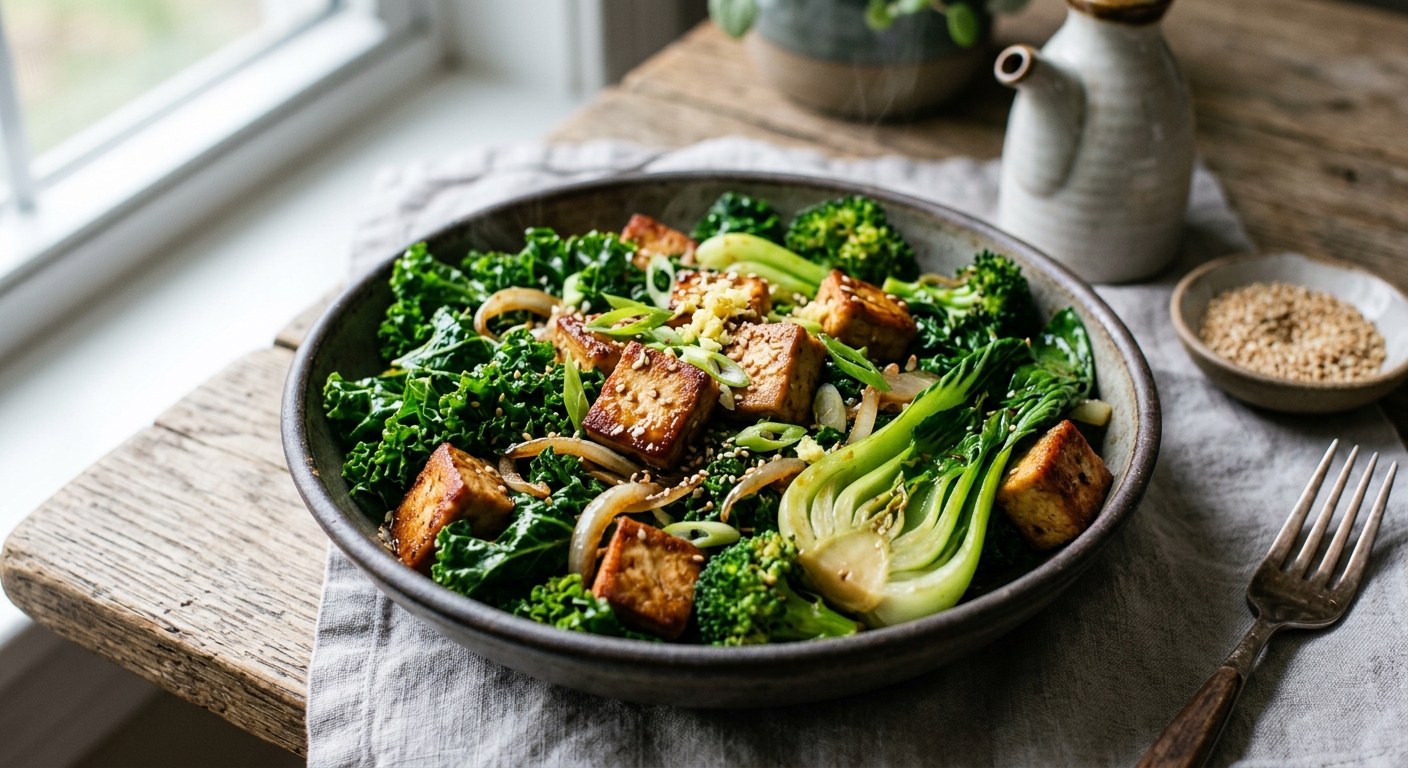
Bone health rarely gets the culinary attention it deserves. Most people think of calcium and stop there, but your skeleton is a dynamic, living tissue that demands a full ensemble of micronutrients: strontium, magnesium, vitamin K1, manganese, boron, silicon, phosphorus, and zinc all play documented roles in osteoblast activity, collagen cross-linking, and mineral crystallisation inside the bone matrix. This Strontium-Supporting Leafy Green and Tofu Saute was built from the ground up to hit as many of those targets as possible while still tasting like something you would genuinely look forward to eating.
The ingredient roster reads like a bone-health formulary. Kale and bok choy are two of the most concentrated dietary sources of vitamin K1 and naturally occurring strontium in the plant kingdom. Broccoli florets contribute boron and vitamin C, which is essential for collagen synthesis. Extra-firm tofu delivers calcium-set protein alongside isoflavones that research links to reduced bone resorption in postmenopausal adults. Sesame tahini and toasted sesame seeds pile on additional calcium, magnesium, and zinc, while fresh ginger brings anti-inflammatory gingerols that help keep the joint environment hospitable. A splash of miso adds fermentation-derived vitamin K2 (menaquinone-7), closing one of the biggest gaps in plant-based bone diets.
Calibrated Cuisine recipes are always designed around realistic, evidence-based nutrient amounts, so every figure you see in the nutrition panel reflects actual published food composition data for the stated ingredient weights. This is not a dish that makes vague wellness claims. It is a precisely portioned, professionally cooked meal that happens to be one of the most bone-supportive things you can put on a weeknight table in under an hour.
4
servings
Ingredients
- 600 gextra-firm tofu, pressed 15 minutes, cut into 2 cm cubes
- 250 gcurly kale, thick stems removed, leaves torn
- 300 gbaby bok choy, halved lengthways
- 200 gbroccoli florets, cut into bite-sized pieces
- 1 mediumwhite onion, thinly sliced
- 4 clovesgarlic, minced
- 20 gfresh ginger, peeled and finely grated
- 3 tbsplow-sodium soy sauce (tamari for gluten-free)
- 2 tbspwhite miso paste
- 2 tbsptahini (sesame seed paste)
- 1 tbsprice vinegar
- 1 tsptoasted sesame oil
- 2 tbspAvocado Oil100% Pure Avocado Oil (such as avocado or sunflower oil), divided
- 1 tbspcornstarch
- 120 mllow-sodium vegetable broth
- 2 tspmaple syrup
- 2 tbsptoasted sesame seeds, for garnish
- 3 stalksspring onion, thinly sliced, for garnish
- —Colima Sea SaltMicroplastic Free Salt and white pepper to taste
Instructions
Click on an item below to shop for the recommended items for this recipe on Amazon.
As an Amazon Associate, we earn from qualifying purchases.
- Press and cube the tofu, then toss in a bowl with the cornstarch, a pinch of salt, and white pepper until evenly coated. In a separate small bowl, whisk together the soy sauce, miso paste, tahini, rice vinegar, maple syrup, sesame oil, and vegetable broth until completely smooth. Set the glaze aside.
- Heat a large wok or 30 cm cast-iron skillet over high heat until visibly smoking. Add 1 tablespoon of neutral oil and swirl to coat. Add the tofu cubes in a single layer, working in two batches if needed to avoid crowding. Cook undisturbed for 3 minutes until a deep golden crust forms on the bottom, then flip and sear for 2 minutes more. Transfer the tofu to a plate.
- Reduce heat to medium-high. Add the remaining 1 tablespoon of oil to the same pan. Add the sliced onion and cook, stirring frequently, for 3 minutes until softened and lightly golden at the edges. Add the garlic and ginger and stir-fry for 60 seconds until intensely fragrant, scraping up any browned bits from the tofu.
- Add the broccoli florets to the pan and toss to coat in the aromatics. Add 2 tablespoons of water, cover with a lid, and steam-saute for 3 minutes until the broccoli is bright green and just tender-crisp. Remove the lid and add the bok choy, tossing and cooking for 2 minutes until the leaves are wilted but the stems retain a slight bite.
- Add the kale in two handfuls, tossing between additions and allowing each batch to wilt slightly before adding the next, about 2 to 3 minutes total. Once all the kale is incorporated and tender, return the seared tofu to the pan.
- Pour the miso-tahini glaze over everything and toss to coat, cooking over medium heat for 1 to 2 minutes until the sauce thickens and clings to the tofu and vegetables. Taste and adjust salt and white pepper. Divide among four bowls and finish each with toasted sesame seeds and sliced spring onion.
- Do not coat or pre-sear the tofu for this method. Simply press it, cube it, and place it directly in the slow cooker insert. In a bowl, whisk together the soy sauce, miso paste, tahini, rice vinegar, maple syrup, sesame oil, vegetable broth, minced garlic, grated ginger, and white pepper until smooth. Dissolve the cornstarch in 1 tablespoon of cold water and whisk into the sauce.
- Scatter the sliced onion and broccoli florets over the tofu in the slow cooker. Pour the miso-tahini sauce over the entire contents, gently pressing the tofu and vegetables down so they are mostly submerged. Do not add the leafy greens yet.
- Place the lid on the slow cooker and cook on Low for 3 hours. The tofu will absorb the broth deeply and the broccoli will become very tender. The sauce will thicken around the ingredients as the cornstarch activates in the residual heat.
- At the 3-hour mark, open the lid and layer the halved bok choy and torn kale directly on top of the braised tofu and broccoli. Replace the lid and cook on Low for a further 15 to 20 minutes, just until the greens are wilted but still a vivid green. Do not overcook the greens or they will turn grey and lose a significant portion of their vitamin K1.
- Gently fold the wilted greens into the braised tofu mixture. Taste and adjust seasoning with salt and white pepper. Drizzle the toasted sesame oil over the top at this stage rather than during cooking to preserve its aroma. Serve in deep bowls garnished with toasted sesame seeds and spring onion.
- Set the Instant Pot or electric pressure cooker to Saute mode on High. While it heats, toss the cubed tofu with the cornstarch, salt, and white pepper. Add 1 tablespoon of neutral oil to the pot. Once shimmering, add half the tofu and cook for 2 to 3 minutes per side until golden, then remove and repeat with the remaining oil and tofu. Set the seared tofu aside.
- With the Saute function still active, add the sliced onion to the pot and cook for 2 minutes, stirring. Add the garlic and ginger and cook for 30 seconds. Pour in 2 tablespoons of the vegetable broth and use a wooden spoon to scrape up all browned bits from the bottom of the pot. This step is critical to prevent a burn notice.
- Whisk together the remaining vegetable broth, soy sauce, miso paste, tahini, rice vinegar, maple syrup, and white pepper in a bowl. Do not add the cornstarch yet, as it can cause scorching under pressure. Pour this sauce into the pot. Add the broccoli florets and the seared tofu. Do not add the bok choy or kale yet.
- Secure the lid, set the pressure release valve to Sealing, and cook on Manual High Pressure for 4 minutes. Once the cycle ends, perform an immediate quick release by carefully switching the valve to Venting. The short cook time keeps the broccoli intact and the tofu firm.
- Switch back to Saute mode on Low. In a small bowl, dissolve the cornstarch in 1 tablespoon of cold water and stir it into the pot along with the bok choy and kale. Stir and cook for 2 to 3 minutes until the greens are just wilted and the sauce has thickened to a glaze consistency. Cancel the Saute function, stir in the sesame oil, and serve immediately topped with toasted sesame seeds and spring onion.
- Preheat the oven to 220C (425F) with a large rimmed baking sheet inside. In a bowl, toss the pressed, cubed tofu with 1 tablespoon of neutral oil, the cornstarch, salt, and white pepper until coated. In a second bowl, toss the broccoli florets with the remaining 1 tablespoon of neutral oil and a pinch of salt.
- Carefully remove the hot baking sheet from the oven and spread the tofu in one half and the broccoli in the other half in a single layer. Roast for 20 minutes, flipping the tofu halfway through, until the tofu is deeply golden and crisp on multiple sides and the broccoli has charred edges.
- While the tofu and broccoli roast, prepare the glaze. Whisk together the soy sauce, miso paste, tahini, rice vinegar, maple syrup, vegetable broth, and white pepper in a bowl until smooth. Dissolve the cornstarch in 1 tablespoon of cold water and whisk into the glaze.
- In the final 5 minutes of oven time, warm a large skillet over medium-high heat on the stovetop. Add a small drizzle of oil and saute the sliced onion for 3 minutes. Add the garlic and ginger and stir for 45 seconds. Add the bok choy, cut side down, and cook for 2 minutes until the stems soften slightly, then add the kale and toss for 2 minutes until just wilted.
- Remove the roasted tofu and broccoli from the oven and add them to the skillet with the wilted greens. Pour the miso-tahini glaze over everything and toss over medium heat for 1 to 2 minutes until the sauce thickens and coats all components. The oven-roasted tofu will hold its crust well even once sauced. Serve immediately with toasted sesame seeds and spring onion.
Nutrition Breakdown
Per 1 serving (makes 4)
Vitamins & Minerals
% Daily Value based on a 2,000 calorie diet (FDA reference)
🧬 Essential Amino Acids
% of recommended daily intake (RDA) per serving
🛡 Antioxidant Profile
The Nutrition Science
Strontium is a trace mineral structurally similar to calcium that incorporates into hydroxyapatite crystals in bone tissue, contributing to bone mineral density. While pharmacological strontium ranelate has been studied extensively for osteoporosis, dietary strontium from cruciferous vegetables, leafy greens, and legumes is the form humans have consumed throughout evolution. Dark leafy greens like kale and bok choy are among the richest dietary sources, containing strontium concentrations between 1 and 4 mg per 100 g of dry weight depending on soil mineral content. This recipe delivers an estimated 2 to 5 mg of dietary strontium per serving, a meaningful contribution for those relying on food rather than supplements.
Vitamin K1, supplied here primarily by kale at approximately 817 mcg per 100 g cooked, plays a role in bone health that goes well beyond its famous clotting function. Osteocalcin, a protein secreted by osteoblasts that anchors calcium to the bone matrix, requires vitamin K-dependent gamma-carboxylation to become biologically active. Under-carboxylated osteocalcin is associated with lower bone mineral density and increased fracture risk in epidemiological studies. A single serving of this saute provides over 250 percent of the daily adequate intake for vitamin K1, making it one of the highest single-meal contributors possible from whole plant foods. The miso paste adds a small but meaningful amount of MK-7 (menaquinone-7), the long-chain vitamin K2 form that research suggests may be particularly effective at activating osteocalcin in peripheral bone tissue.
The calcium in this dish comes from a nutritionally diverse set of sources: calcium-set tofu (typically set with calcium sulfate, providing 200 to 350 mg calcium per 150 g serving), kale (93 mg per 100 g cooked), bok choy (105 mg per 100 g cooked), tahini (130 mg per 2 tablespoons), and toasted sesame seeds (88 mg per tablespoon). Critically, the oxalate content of these sources is low to moderate compared with spinach or Swiss chard, meaning calcium absorption efficiency is considerably higher. Vitamin C from the broccoli and bok choy enhances the bioavailability of the plant-based (non-heme) iron, while the magnesium and phosphorus in tofu and sesame support the ATP-dependent processes that osteoblasts use to mineralise new bone matrix.
Pro Tips
- Press your tofu for at least 15 minutes and ideally 30 minutes before cooking. The drier the surface, the crisper the sear and the more sauce the tofu will absorb without becoming soggy.
- Do not substitute dried ginger for fresh here. Fresh ginger provides active gingerol compounds at concentrations roughly six times higher than the shogaols found in dried ginger, and the anti-inflammatory benefit is meaningfully different.
- If you are cooking for someone on a blood-thinning medication such as warfarin, note that a single serving of this dish provides over twice the daily adequate intake for vitamin K1. The nutrient interaction is manageable with consistent intake rather than avoidance, but always advise consulting a healthcare provider.

This is exactly the kind of nutrient-density thinking that gets me excited, especially the K2 angle which so many people sleep on. I’ve been experimenting with pairing my cruciferous greens like this with fermented foods (sauerkraut on the side, mostly) because the vitamin K2 production from fermentation seems to amplify calcium absorption in ways the research is only starting to map out, and I’m curious whether you’re seeing K2 from natto or other fermented sources showing up differently in your clients’ bone markers compared to just the food matrix approach alone?
Eddie, this is the exact kind of pairing logic I push in my practice. The K2 from natto specifically hits different than leafy phylloquinone because it’s the menaquinone-7 form that actually accumulates in bone tissue, and yeah, fermentation unlocks bioavailability in ways raw just can’t match. I’ve noticed clients tracking DEXA improvements tend to show better results when they’re consistent with fermented K2 sources plus the mineral matrix (calcium, magnesium, strontium) from the greens themselves, though the sample size is small enough that I’m hesitant to call it causal. Have you been tracking any bone markers, or mostly going
Love that you’re pairing this with fermented foods, Eddie – that’s such a smart move for nutrient absorption! I do want to gently mention that since kale and bok choy are both goitrogenic when raw, cooking them thoroughly (which this saute does, thankfully) really matters for anyone with thyroid concerns. The good news is that cooking breaks down those compounds, so a hot saute like this is actually one of the best ways to enjoy these greens safely while still getting all that K2 and mineral support. The sauerkraut adds probiotics which can help with nutrient uptake too, so you’re basically building a synergistic meal!