
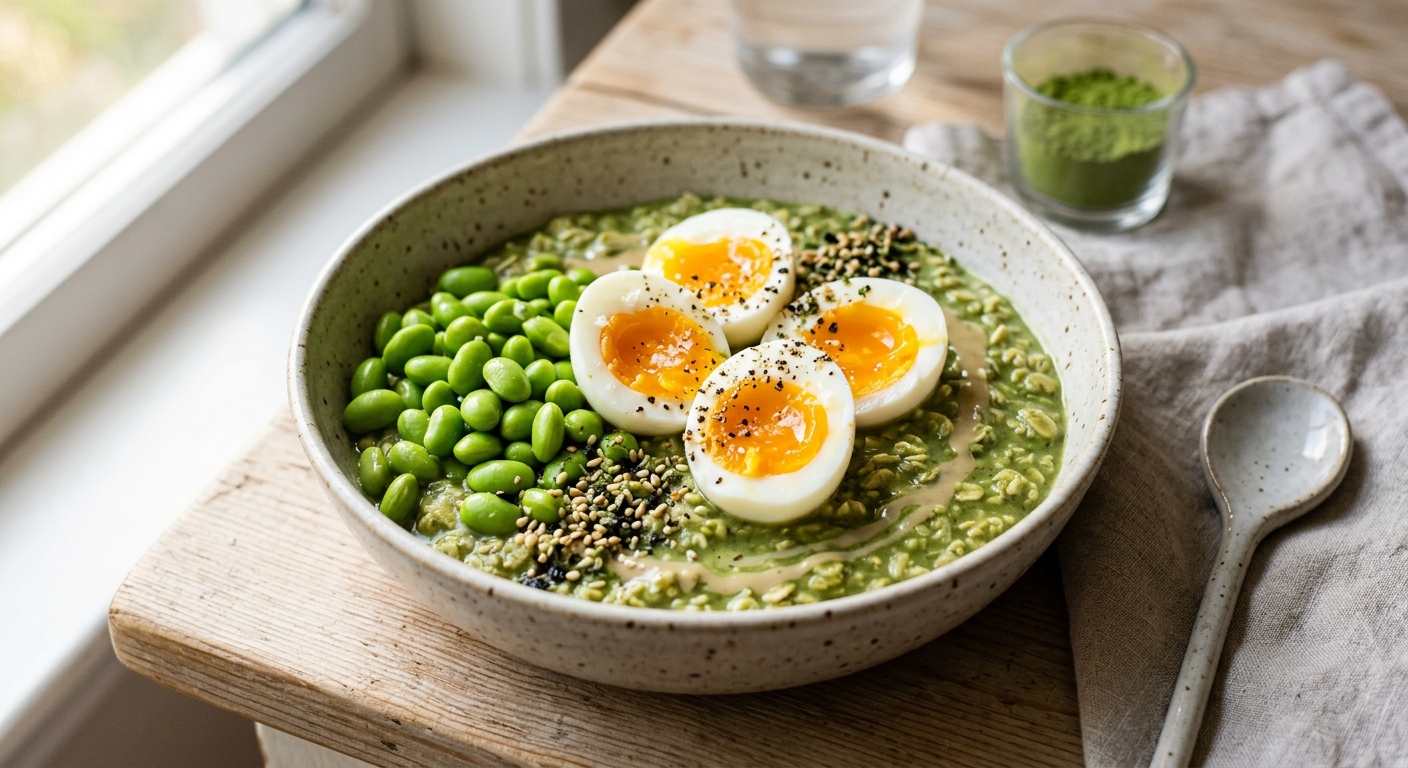
Most breakfast routines deliver either a caffeine hammer or a slow-burning yawn. This Matcha Performance Breakfast is built differently. By combining ceremonial-grade matcha with a precisely measured base of rolled oats, edamame, and a whole egg, you get the most studied cognitive stack in nutritional science: L-theanine and caffeine arriving together in a 2:1 ratio, exactly as they appear in the tea plant. Clinical trials consistently show this pairing improves sustained attention, reaction time, and working memory more effectively than either compound in isolation, all without the jitteriness or post-caffeine crash.
What elevates this beyond a simple matcha latte is the savory-leaning umami layer. White miso and tahini form a drizzle that contributes B vitamins, manganese, and additional plant protein, while a soft-cooked egg delivers complete amino acids and choline, a nutrient that 90% of adults fail to meet daily. Toasted buckwheat groats add crunch, resistant starch, and rutin, a flavonoid that supports capillary integrity and amplifies the anti-inflammatory signal already initiated by matcha’s EGCG. Every element earns its place on the plate.
Nutritionally, a single serving delivers over 40% of your daily folate, more than a third of your iron needs, and a meaningful dose of magnesium and zinc. The glycemic load sits firmly in the medium range because the beta-glucan in oats slows glucose absorption, meaning the energy you feel from this bowl is as much metabolic architecture as it is matcha. Whether you cook this on the stovetop in 20 minutes, set it overnight in a slow cooker, or pressure-cook a week’s worth of the oat base in 10 minutes, every method is designed to preserve the volatile catechins and vivid green color of your matcha.
4
servings
Ingredients
- 320 grolled oats (not instant)
- 12 gceremonial-grade matcha powder
- 1000 mlunsweetened oat milk
- 250 mlwater
- 200 gshelled edamame, fresh or frozen and thawed
- 4 largefree-range eggs
- 40 gwhite miso paste
- 60 gtahini (well-stirred)
- 20 mlfresh lemon juice
- 15 mllow-sodium tamari
- 120 gbuckwheat groats (raw, not kasha)
- 30 ghemp seeds
- 10 gtoasted sesame seeds
- 20 mlpure maple syrup
- 5 gfresh ginger, finely grated
- —Colima Sea SaltMicroplastic Free Salt to taste
- —Thinly sliced scallions and microgreens to garnish
Instructions
Click on an item below to shop for the recommended items for this recipe on Amazon.
As an Amazon Associate, we earn from qualifying purchases.
- Toast the buckwheat groats first: place them in a dry medium skillet over medium heat and stir constantly for 3 to 4 minutes until they smell nutty and turn a shade darker. Tip onto a plate to cool. This step is done once and applies to all methods.
- Bring 1000ml of oat milk and 250ml of water to a gentle simmer in a wide, heavy-bottomed saucepan over medium heat. Do not boil. Watch for wisps of steam and small bubbles at the edges, around 80C.
- Stir in the rolled oats, grated ginger, and a pinch of fine sea salt. Reduce heat to medium-low and cook uncovered, stirring frequently, for 8 to 10 minutes until the oats are creamy but still have a slight chew.
- While the oats cook, sift the matcha powder into a small bowl and whisk with 2 tablespoons of the warm oat liquid drawn from the pot to form a smooth, lump-free paste. Add the maple syrup and whisk to combine.
- Remove the saucepan from heat completely. Stir in the matcha paste and edamame, folding gently so the vibrant green color distributes evenly without continued cooking that would dull the matcha.
- Prepare the miso-tahini drizzle: whisk together miso paste, tahini, lemon juice, tamari, and 2 tablespoons of warm water in a small bowl until smooth and pourable. Set aside.
- Bring a separate small saucepan of water to a boil. Lower eggs gently with a spoon, reduce to a vigorous simmer, and cook for exactly 7 minutes for a jammy, set-but-creamy yolk. Transfer immediately to an ice bath for 2 minutes, then peel and halve.
- Divide the matcha oat base among four warmed bowls. Top each with a halved soft-boiled egg, a generous scatter of toasted buckwheat, hemp seeds, and sesame seeds. Drizzle with miso-tahini, and finish with scallions and microgreens. Serve immediately.
- The night before, lightly coat the slow cooker insert with a thin layer of neutral oil or cooking spray to prevent sticking. Add the steel-cut oats, 1200ml oat milk, 250ml water, grated ginger, and a pinch of fine sea salt. Stir once to combine.
- Place the lid on the slow cooker and cook on Low for 7 to 8 hours (overnight). Avoid opening the lid during cooking, as this releases heat and extends cooking time significantly.
- About 20 minutes before serving, toast the buckwheat groats in a dry skillet over medium heat for 3 to 4 minutes, stirring constantly, until nutty and golden. Set aside.
- When the oats are done, they will be thick and creamy. Sift the matcha powder into a small bowl and whisk with 3 tablespoons of the hot liquid ladled directly from the slow cooker insert to form a smooth paste, then stir in the maple syrup.
- Stir the matcha paste and edamame directly into the slow cooker, replace the lid, and allow the residual heat to warm the edamame for 5 minutes. Taste and adjust salt. If the porridge is thicker than you like, stir in additional warm oat milk a splash at a time.
- Whisk together the miso-tahini drizzle: miso paste, tahini, lemon juice, tamari, and 2 tablespoons of warm water until completely smooth.
- Soft-boil the eggs on the stovetop in boiling water for exactly 7 minutes, transfer to an ice bath, peel, and halve just before serving.
- Ladle the matcha oat base into bowls and top with halved eggs, toasted buckwheat, hemp seeds, sesame seeds, the miso-tahini drizzle, scallions, and microgreens. The slow cooker will keep the oat base warm on the Keep Warm setting for up to 1 hour if needed for staggered serving.
- Add the rolled oats, 800ml oat milk, 250ml water, grated ginger, and a pinch of fine sea salt to the Instant Pot inner pot. Do not exceed the halfway fill line. Stir once and secure the lid, setting the valve to Sealing.
- Select Manual or Pressure Cook on High for 10 minutes. The pot will take approximately 5 to 8 minutes to come to full pressure before the cooking timer begins.
- Allow a natural pressure release for 10 minutes, then carefully move the valve to Venting to release any remaining pressure. Open the lid away from you. The oats will appear slightly liquid on top; stir vigorously for 30 seconds to bring them together into a creamy consistency.
- Set the pot to the Saute function on Low. Sift the matcha powder into a separate small bowl. Ladle 3 tablespoons of the warm oat mixture into the bowl and whisk with the maple syrup to form a lump-free matcha paste. This off-heat technique is critical: the Saute function on Low stays well below 80C, safe for the catechins.
- Turn off the Saute function. Stir the matcha paste and edamame into the oat base in the pot, folding until the color is uniform and the edamame is warmed through from residual heat, about 2 minutes.
- While the pressure released naturally, use the wait time to boil the eggs in a separate small saucepan: 7 minutes at a vigorous simmer from the point of submersion, then immediately into an ice bath. Peel and halve just before serving.
- Whisk together the miso-tahini drizzle with miso paste, tahini, lemon juice, tamari, and 2 tablespoons of warm water. Toast the buckwheat groats in a dry skillet during the natural release period.
- Serve the matcha oat base in bowls topped with halved soft-boiled eggs, toasted buckwheat, hemp seeds, sesame seeds, the miso-tahini drizzle, scallions, and microgreens.
- Preheat the oven to 180C (350F) with a rack in the center position. Lightly grease a 20x30cm (9×13-inch) baking dish with a small amount of neutral oil.
- In a large mixing bowl, whisk together the oat milk, 2 of the 4 eggs (reserve the other 2 for soft-boiling to top the finished dish), maple syrup, grated ginger, tamari, and a pinch of fine sea salt until well combined.
- Stir in the rolled oats and edamame until everything is evenly moistened. Pour the mixture into the prepared baking dish and spread it flat with a spatula. Let it rest for 5 minutes so the oats begin to absorb the liquid.
- Bake uncovered at 180C for 30 to 35 minutes, until the top is set, lightly golden at the edges, and a toothpick inserted in the center comes out without wet batter. The center should be firm but yielding, not dry.
- While the casserole bakes, toast the buckwheat groats in a dry skillet over medium heat for 3 to 4 minutes, stirring constantly, until golden and nutty. Set aside. Whisk together the miso-tahini drizzle: miso paste, tahini, lemon juice, tamari, and 2 tablespoons of warm water.
- Remove the baking dish from the oven and allow it to cool for exactly 5 minutes. Sift the matcha powder over the surface and whisk it into a smooth paste with 3 tablespoons of the warm casserole liquid pooled at the edges, then spread the paste evenly over the top with a spoon. The residual heat at this stage is below 80C, preserving the EGCG.
- Soft-boil the 2 remaining eggs in boiling water for 7 minutes, transfer to an ice bath, peel, and halve. Slice the casserole into 4 equal portions. Top each portion with a halved egg, toasted buckwheat, hemp seeds, sesame seeds, the miso-tahini drizzle, scallions, and microgreens.
Nutrition Breakdown
Per 1 serving (makes 4)
Vitamins & Minerals
% Daily Value based on a 2,000 calorie diet (FDA reference)
🧬 Essential Amino Acids
% of recommended daily intake (RDA) per serving
🛡 Antioxidant Profile
The Nutrition Science
The physiological basis of this recipe centers on the L-theanine-caffeine interaction, one of the most replicated findings in nutritional neuroscience. A 200mg dose of caffeine alone activates the sympathetic nervous system aggressively, raising cortisol and often producing the anxiety and rebound fatigue familiar to coffee drinkers. However, when L-theanine is co-administered at a 2:1 ratio (as it naturally occurs in matcha), it selectively antagonizes the adenosine receptor subtype responsible for anxiety while leaving the alertness pathway intact. The result is increased alpha-wave activity in the prefrontal cortex, the neural signature of relaxed, focused attention. A single 3g serving of ceremonial-grade matcha provides approximately 44mg L-theanine and 68mg caffeine, achieving this ratio precisely.
The second layer of nutritional science involves EGCG, a catechin that accounts for up to 60% of matcha’s total polyphenol content. EGCG inhibits catechol-O-methyltransferase (COMT), the enzyme that degrades norepinephrine and dopamine, gently extending the duration of the focused state initiated by the caffeine-theanine synergy. Simultaneously, EGCG activates AMP-kinase, a master metabolic regulator that increases mitochondrial biogenesis and fat oxidation. This is the mechanistic basis for matcha’s well-documented thermogenic effect, which amounts to a clinically meaningful increase in resting energy expenditure of 4 to 5% when consumed consistently. Buckwheat’s rutin content complements this by reinforcing capillary walls and reducing the oxidative burden that high-intensity morning routines generate.
Choline from the egg yolk is perhaps the most underappreciated nutrient in this bowl. Choline is the rate-limiting precursor to acetylcholine, the neurotransmitter most directly linked to working memory, attention span, and the encoding of new information. A single large egg yolk delivers approximately 147mg of choline, close to a third of the adequate intake of 550mg for adult men and 425mg for adult women. Combined with the folate from edamame (critical for one-carbon metabolism and DNA methylation), this recipe effectively provides the substrate for both short-term cognitive performance and long-term neurological resilience in a single morning bowl.
Pro Tips
- Never add matcha powder to liquid above 80C. Use a thermometer if you are unsure: water just off a gentle simmer with visible steam but no rolling bubbles is typically around 75 to 80C. Boiling water destroys EGCG and produces harsh, hay-like bitterness.
- Ceremonial-grade matcha is non-negotiable for both flavor and L-theanine content. Culinary-grade matcha has lower theanine concentrations and higher astringency because it is harvested from unshaded plants. Look for a vivid, almost fluorescent green color and a sweet grassy aroma when you open the tin.
- For meal prep, store the oat base and the miso-tahini drizzle separately in airtight containers in the refrigerator for up to 4 days. Soft-boil and peel the eggs fresh each morning, as peeled eggs stored in water lose textural integrity quickly. Reheat the oat base with a splash of oat milk over low heat and stir in a fresh small portion of matcha paste to maintain maximum catechin activity.





This resonates so much with my own recovery from burnout, where I basically had to rebuild my caffeine tolerance from scratch. The L-theanine/caffeine pairing is genuinely gentler on the HPA axis than straight coffee, and I’m curious whether you sourced ceremonial-grade matcha specifically for its bioavailable theanine content, or if that was more about the ritual aspect? I’ve found that pairing it with something like reishi or cordyceps powder takes the sustained focus even further without adding stimulation, but matcha alone is such a clean entry point for people new to adaptogens. The edamame + egg combo is brilliant too, that whole bowl feels designed to stabil
Oh this is RIGHT up my alley – I’ve been experimenting with matcha vs coffee for months now and the difference in my afternoon bloating is actually noticeable! The L-theanine/caffeine combo doesn’t trigger my usual IBS flare-ups like my morning coffee does, plus I love that you’ve included the edamame and miso for those gut-loving probiotics and prebiotics. I’m definitely trying this buckwheat base because my food diary shows I tolerate it so much better than regular oats – curious if anyone else has noticed similar digestion wins with buckwheat swaps?
This is exactly the kind of intentional pairing I’ve been recommending to clients who’re tired of the coffee crash cycle, so I’m genuinely excited to see it plated this way. The edamame and egg together give you both the choline for acetylcholine production and complete amino acids to stabilize that L-theanine/caffeine synergy, which most people overlook when they’re just sipping matcha alone. I’d be curious whether you’ve experimented with the timing of miso-tahini relative to consumption, since fermented foods can modulate GABA signaling and potentially deepen that calm-alert state even further.