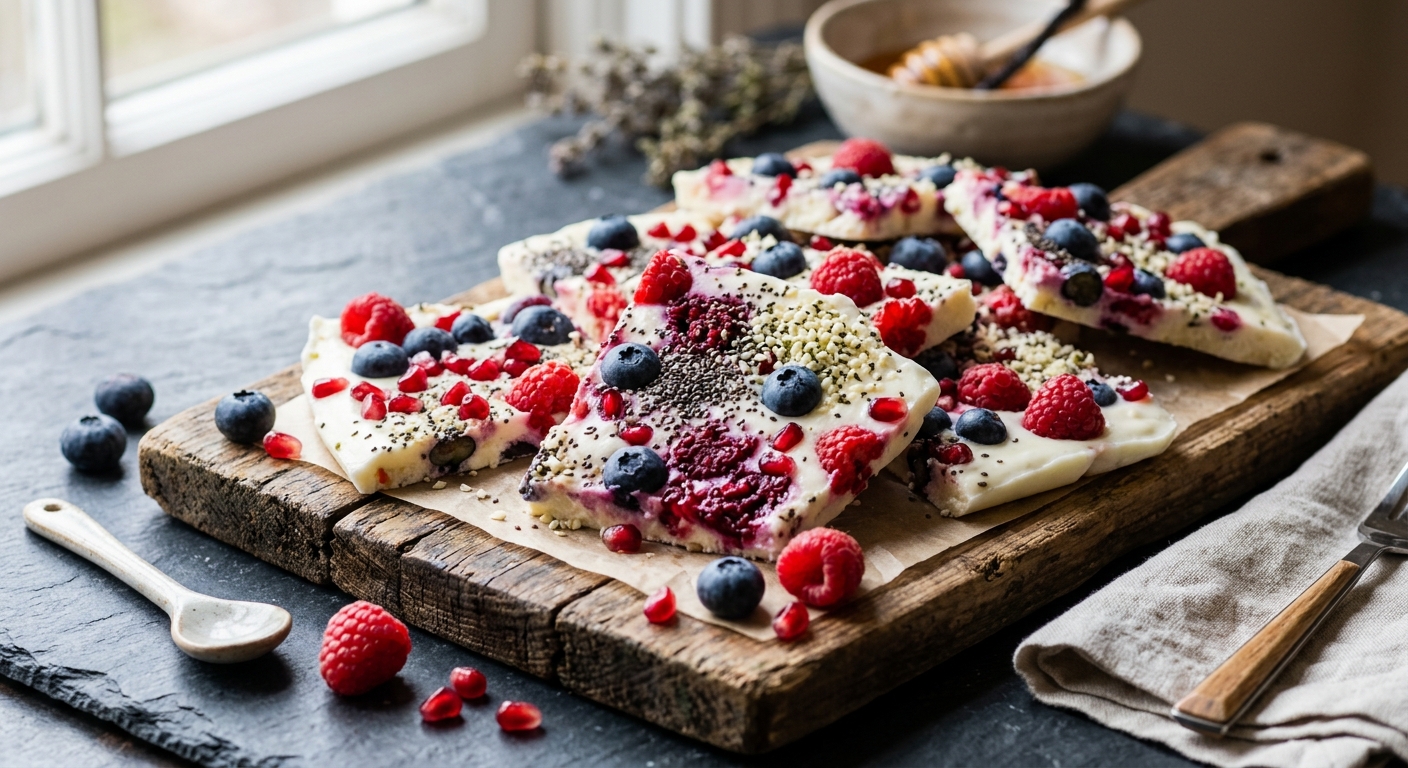
Frozen yogurt bark sits at the intersection of effortless elegance and genuine nutrition science. Unlike conventional desserts that ask you to trade pleasure for health, this bark demands no such compromise. A thin, frozen canvas of full-fat Greek yogurt is studded with blueberries, raspberries, pomegranate arils, chia seeds, hemp seeds, and pumpkin seeds, then finished with a thread of raw honey and a pinch of turmeric-spiked coconut flakes. The result is a shatteringly crisp, intensely flavored slab that you break into rustic shards and serve straight from the freezer.
The nutritional architecture of this dish is deliberate. Greek yogurt contributes Lactobacillus acidophilus and Bifidobacterium strains that have been shown in clinical research to modulate gut microbiome composition and reduce systemic inflammatory markers including CRP and IL-6. The berry medley piles on anthocyanins, ellagic acid, and resveratrol, three of the most studied anti-inflammatory plant compounds in nutritional epidemiology. Chia and hemp seeds layer in alpha-linolenic acid (ALA), the plant-derived omega-3 precursor, while pumpkin seeds add a meaningful dose of zinc and magnesium, two minerals frequently deficient in Western diets and directly implicated in immune regulation.
Because this is a no-cook dessert at its core, the cooking method section below takes a creative but honest approach. The stovetop method involves gently warming a honey-turmeric glaze and toasting seeds to unlock their nutty depth before assembly. The slow cooker method creates a warm berry compote layer that is chilled before spreading, adding jammy complexity. The pressure cooker method produces a rapid berry coulis swirled through the bark for a marble effect. An oven-based version lightly toasts a granola seed cluster topping that adds dramatic crunch. Each method produces a genuinely distinct bark with its own character.
4
servings
Ingredients
- 500 gfull-fat plain Greek yogurt (at least 5% fat, with live cultures)
- 2 tbspraw honey, divided
- 1 tsppure vanilla extract
- 100 gfresh or frozen blueberries
- 75 gfresh or frozen raspberries
- 60 gpomegranate arils
- 2 tbspchia seeds
- 2 tbsphemp hearts (hulled hemp seeds)
- 2 tbspraw pumpkin seeds (pepitas)
- 1 tbspunsweetened coconut flakes
- 0.25 tspground turmeric
- 0.25 tspground cinnamon
- —Pinch of Colima Sea SaltMicroplastic Free Salt
Instructions
Click on an item below to shop for the recommended items for this recipe on Amazon.
As an Amazon Associate, we earn from qualifying purchases.
- Line a large rimmed baking sheet (approximately 30x40cm) with parchment paper. Set aside in the freezer to chill for at least 10 minutes while you prepare the components.
- Place a small saucepan over medium-low heat. Add 1 tablespoon of the raw honey, the turmeric, cinnamon, and a pinch of sea salt. Stir constantly with a silicone spatula for 1 to 2 minutes until the honey liquefies and the spices bloom into a fragrant, golden glaze. Remove from heat immediately and set aside to cool for 5 minutes.
- Place a dry skillet over medium heat. Add the pumpkin seeds and coconut flakes. Toast, stirring frequently, for 2 to 3 minutes until the pumpkin seeds begin to pop and the coconut turns pale golden. Remove from heat and allow to cool completely on a plate. Do not toast the chia or hemp seeds as their delicate ALA fatty acids oxidise under direct heat.
- In a medium bowl, combine the Greek yogurt, vanilla extract, remaining 1 tablespoon of honey, and the cooled turmeric-honey glaze. Fold together gently until evenly combined and a pale golden colour is achieved. Taste and adjust sweetness.
- Retrieve the chilled baking sheet. Pour the yogurt mixture onto the centre and use an offset spatula to spread it in an even layer approximately 6 to 8mm thick. Work quickly to prevent the cold pan from setting the yogurt unevenly.
- Scatter blueberries, raspberries, and pomegranate arils evenly across the surface, pressing each berry lightly into the yogurt so it adheres. Sprinkle the toasted pumpkin seeds and coconut flakes over the top, followed by the chia seeds and hemp hearts.
- Transfer the baking sheet to the freezer. Freeze uncovered for 30 minutes, then loosely cover with a second sheet of parchment and freeze for a further 2.5 to 3 hours until the bark is completely solid throughout. To serve, lift the parchment from the tray and break the bark into irregular shards using your hands or the back of a chef’s knife. Serve immediately or store shards in an airtight container in the freezer for up to 2 weeks.
- Combine the blueberries, raspberries, pomegranate arils, 1 tablespoon of honey, cinnamon, and turmeric in the slow cooker insert. Stir to coat the berries. Place the lid on and cook on Low for 1 hour 30 minutes, until the berries have completely broken down into a thick, glossy compote. Stir once at the 45-minute mark.
- Remove the lid for the final 15 minutes of cooking to allow excess moisture to evaporate and the compote to thicken further. The finished compote should coat the back of a spoon. Transfer to a shallow bowl and refrigerate uncovered for at least 45 minutes until fully chilled and set to a spreadable, jammy consistency. Do not proceed until the compote is cold, or it will melt the yogurt layer.
- Line a large rimmed baking sheet with parchment paper and place it in the freezer for 10 minutes. Meanwhile, in a medium bowl, whisk together the Greek yogurt, vanilla extract, remaining 1 tablespoon of honey, and sea salt until smooth and uniform.
- Remove the chilled baking sheet from the freezer. Spread the chilled berry compote in a thin, even layer across the parchment using an offset spatula, leaving a 1cm border. Freeze this compote layer for 20 minutes until it is semi-firm and no longer liquid on the surface.
- Retrieve the tray from the freezer. Carefully spoon the yogurt mixture over the compote layer and spread gently with the spatula to cover evenly, being careful not to drag and mix the two layers together. The contrast between the deep purple compote base and the pale yogurt top is the visual payoff of this method.
- Scatter the chia seeds, hemp hearts, pumpkin seeds, and coconut flakes evenly over the yogurt surface. Transfer the tray to the freezer and freeze uncovered for 30 minutes, then cover loosely and freeze for a further 3 hours until the bark is solid all the way through. Break into shards and serve directly from the freezer.
- Add the blueberries, raspberries, and pomegranate arils to the pressure cooker insert along with 2 tablespoons of water and 1 tablespoon of honey. Stir to combine. Seal the lid and cook on High pressure for 3 minutes.
- When the cook time is complete, perform a quick pressure release. Open the lid carefully. The berries will have collapsed into a vivid, deeply coloured liquid. Pour the contents through a fine-mesh strainer set over a bowl, pressing the solids firmly with the back of a spoon to extract every drop of coulis. Discard the solids or reserve for another use. Stir the turmeric and cinnamon into the warm coulis.
- Allow the coulis to cool to room temperature, then refrigerate for 20 to 30 minutes until it thickens slightly to a pourable but not watery consistency. Meanwhile, line a large rimmed baking sheet with parchment and chill it in the freezer.
- In a medium bowl, combine the Greek yogurt, vanilla extract, remaining 1 tablespoon of honey, and sea salt. Stir until smooth. Remove the chilled baking sheet from the freezer and spread the yogurt mixture into an even layer approximately 6 to 8mm thick using an offset spatula.
- Drizzle the chilled berry coulis in irregular lines and pools across the surface of the yogurt. Using a toothpick or skewer, drag it through the coulis in alternating directions to create a marbled swirl pattern throughout the bark. Work quickly and with confidence for the most dramatic results.
- Immediately scatter the chia seeds, hemp hearts, pumpkin seeds, and coconut flakes over the marbled surface. Freeze uncovered for 30 minutes to set the surface, then cover loosely and freeze for a further 3 hours until completely solid. Break into shards and serve. The marble pattern will be fully revealed once the bark is broken open.
- Preheat the oven to 165C (325F) fan-forced (or 175C conventional). Line a small baking sheet with parchment paper. In a bowl, combine the pumpkin seeds, hemp hearts, coconut flakes, turmeric, cinnamon, 1 tablespoon of honey, and a pinch of sea salt. Stir until every seed is coated in the honey and spice mixture.
- Spread the seed mixture in a thin, single layer on the prepared small baking sheet. Bake in the preheated oven for 10 to 12 minutes, stirring once at the 6-minute mark, until the seeds are golden, fragrant, and the honey has caramelised to a glossy lacquer. Watch closely in the final 2 minutes as the honey can burn quickly.
- Remove the seed cluster from the oven and allow it to cool completely on the tray, at least 25 minutes. It will crisp into a crunchy granola-like sheet as it cools. Once fully cool, break it into small irregular clusters. This topping can be made up to 3 days in advance and stored in an airtight container at room temperature.
- Line a large rimmed baking sheet with parchment and chill in the freezer for 10 minutes. In a medium bowl, whisk together the Greek yogurt, vanilla extract, remaining 1 tablespoon of honey, and sea salt until completely smooth and creamy.
- Remove the chilled baking sheet from the freezer. Spread the yogurt mixture into an even 6 to 8mm layer. Arrange the fresh blueberries, raspberries, and pomegranate arils across the surface, pressing each piece gently into the yogurt. Scatter the chia seeds across the bark evenly.
- Distribute the cooled granola seed clusters generously over the top, pressing lightly so they adhere to the yogurt surface without sinking. Freeze uncovered for 30 minutes, then cover loosely and freeze for a further 3 hours until fully solid. Break into shards to serve. The granola clusters add an exceptional textural contrast to the smooth, cold bark beneath.
Nutrition Breakdown
Per 1 serving (makes 4)
Vitamins & Minerals
% Daily Value based on a 2,000 calorie diet (FDA reference)
🧬 Essential Amino Acids
% of recommended daily intake (RDA) per serving
🛡 Antioxidant Profile
The Nutrition Science
The probiotic dimension of this dessert is its most clinically significant feature. Full-fat Greek yogurt labelled with live and active cultures typically contains 10 to 100 billion CFU per 100g, predominantly Lactobacillus acidophilus, Lactobacillus bulgaricus, and Streptococcus thermophilus. A 2019 meta-analysis published in the American Journal of Clinical Nutrition found that regular yogurt consumption significantly reduced serum CRP, a primary biomarker of systemic inflammation, with the greatest effect seen in participants consuming full-fat varieties. The fat matrix in full-fat yogurt appears to protect probiotic bacteria during gastric transit, improving colonisation rates in the large intestine compared to low-fat formulations. Critically, freezing yogurt does not kill probiotic bacteria; it suspends them in a state of dormancy from which the majority recover viability upon reaching the warmer environment of the gut.
The omega-3 fatty acid contribution from chia and hemp seeds addresses one of the most consistent nutritional deficiencies associated with chronic inflammation: an unfavourable dietary omega-6 to omega-3 ratio. The modern Western diet averages a ratio of 15:1 to 20:1, while evidence supports an optimal ratio of 4:1 or lower for anti-inflammatory benefit. Two tablespoons of chia seeds contribute approximately 3.5g of ALA, and two tablespoons of hemp hearts add a further 1.7g of ALA along with 0.5g of the longer-chain stearidonic acid (SDA), which converts to EPA more efficiently than ALA alone. Together, these two seeds meaningfully shift the omega balance of a single serving toward the protective range.
Turmeric inclusion, even at a quarter teaspoon, is nutritionally intentional rather than decorative. Research from the Linus Pauling Institute establishes that curcumin bioavailability is dramatically enhanced in the presence of fat, and the full-fat yogurt base in this recipe serves precisely that purpose. The fat-soluble curcumin dissolves into the lipid fraction of the yogurt, improving mucosal absorption by an estimated 7 to 8 fold compared to consuming curcumin with a fat-free carrier. The piperine-free approach used here is suitable for individuals on anticoagulant medications for whom black pepper-derived piperine interactions are a concern.
Pro Tips
- For the crispest, most shatteringly thin bark, spread the yogurt no thicker than 8mm. Thicker layers take longer to freeze solid and produce a chewy rather than snappy texture when broken.
- If using frozen berries, thaw them for 5 minutes only and pat dry with paper towels before pressing into the yogurt. Excess moisture from fully thawed berries bleeds into the yogurt layer and creates an icy, grainy texture after freezing.
- To preserve the maximum number of live probiotic cultures, always work with yogurt that has been removed from the refrigerator no more than 20 minutes before spreading. Prolonged exposure to room temperature before freezing can stress the bacterial cultures.
- Store finished bark shards separated by layers of parchment paper in an airtight container in the freezer for up to 2 weeks. Bark left uncovered in the freezer will develop freezer burn and lose the vibrant berry colour within 3 to 4 days.
Nice approach here, especially with the seeds providing omega-3s to balance out what’s typically a fairly omega-6 light dessert. One small note: if you’re using conventional seeds, make sure the ratio is working in your favor, since many seed oils are heavily processed omega-6. I’d suggest emphasizing the flax or chia if those are in your mix, as they shift the balance meaningfully. The probiotic angle is solid too, though I always remind patients that live cultures survive freezing better than most people think, but consistency matters more than temperature for actual gut colonization. Have you tested whether your yogurt cultures remain viable after the freeze, or is it more about the broader anti-inflammatory package
Love this approach, though I’d push back slightly on one technical point: if you’re spreading the yogurt too thin before freezing, you risk losing some of that probiotic viability through ice crystal formation. I’ve had better results keeping it around 1/2 inch thick and freezing fast on a sheet pan, then breaking into shards after. Also, raw honey is gorgeous here, but if anyone’s using it at scale for a catering situation, I’ve found that a quick bloom of the berries in the honey first actually amplifies the polyphenol extraction without cooking them. The bark stays snappy and you get deeper flavor.
Chris N., what a thoughtful technical point about the thickness and freeze rate, I’m absolutely going to try that 1/2 inch method in my next class because my students have mentioned the texture being a bit icy sometimes. Your tip about blooming the berries in honey first is brilliant, too, and I’m already thinking about how that would work for the batch I’m planning next week, especially since deeper flavor always helps people really taste the nutritional benefits rather than just eating them because they should. Thank you for sharing these practical refinements, it’s this kind of technique knowledge that transforms a good recipe into something truly special!