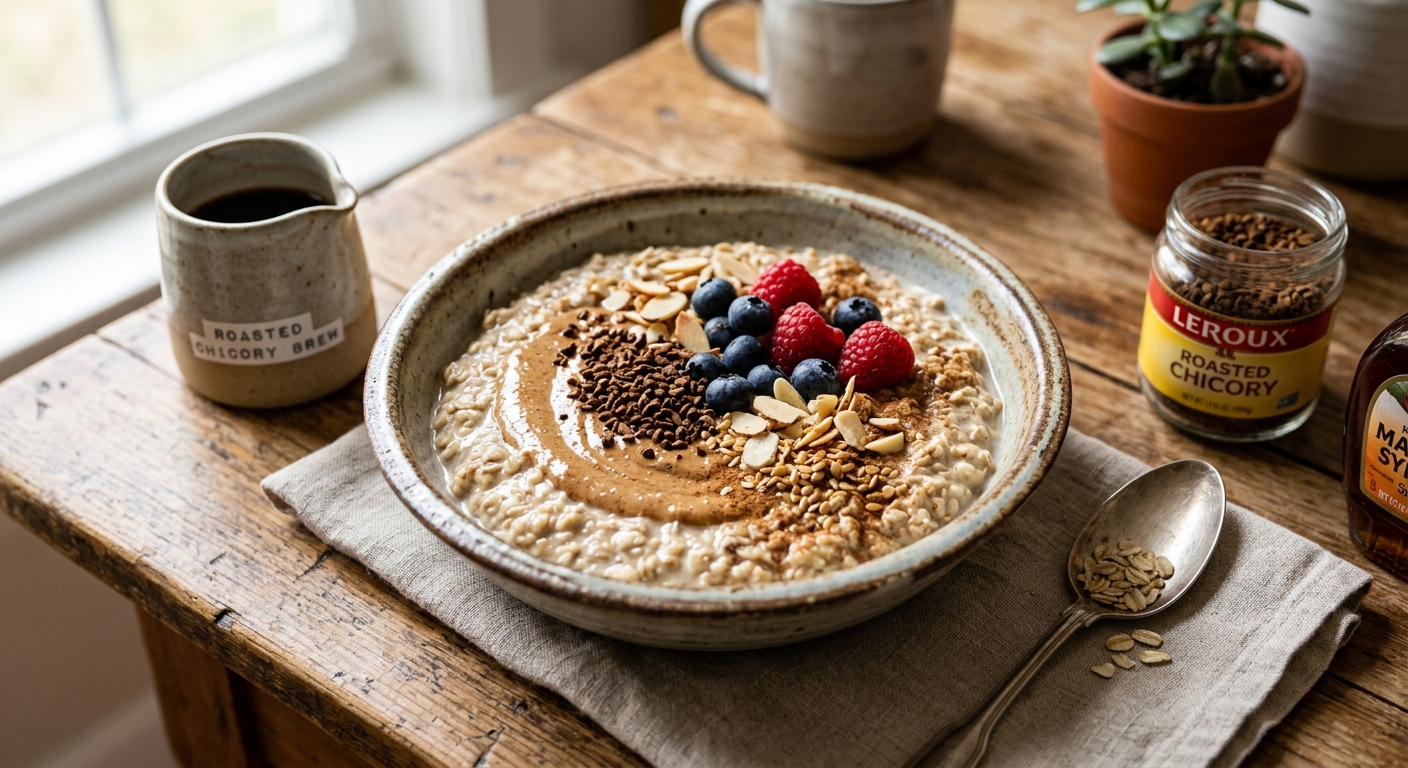
Imagine your morning coffee ritual and your most nourishing breakfast colliding into a single, deeply satisfying bowl. These Chicory Root Latte Overnight Oats begin with a homemade chicory root brew, rich and roasted with notes of dark chocolate and hazelnut, that replaces ordinary milk as the steeping liquid for rolled oats. The result is a layered, custard-soft breakfast that tastes indulgent but is quietly doing serious metabolic work from the very first spoonful.
Chicory root (Cichorium intybus) has been cultivated as a coffee substitute since the Napoleonic era, but modern nutrition science has reframed it as something far more valuable: one of the single richest dietary sources of inulin-type fructans on the planet. Dried chicory root contains 35 to 48 percent inulin by weight, and even in a brewed and rehydrated form, a meaningful dose survives into your bowl. Paired with the beta-glucan soluble fiber in oats, this recipe creates a dual-fiber synergy that slows gastric emptying, dampens post-meal glucose excursions, and selectively nourishes Bifidobacterium and Lactobacillus colonies in the colon.
Every element in this recipe was chosen with metabolic precision. Whole rolled oats provide sustained energy via their low-to-medium glycemic index and rich mineral profile. Ground flaxseed adds lignans and omega-3 alpha-linolenic acid. A touch of Ceylon cinnamon contributes cinnamaldehyde, a compound with documented insulin-sensitizing properties. Unsweetened almond butter weaves in monounsaturated fats to further blunt glycemic response. Together, they create a breakfast that keeps blood sugar steady, microbiome communities thriving, and energy output calibrated for hours.
4
servings
Ingredients
- 320 gwhole rolled oats (old-fashioned, not instant)
- 40 groasted chicory root granules (e.g. Leroux or Caf-Lib brand), divided
- 800 mlfiltered water (for brewing chicory)
- 400 mlunsweetened oat milk
- 30 gground flaxseed (golden)
- 4 tbspnatural almond butter (no added sugar or oil)
- 3 tbsppure maple syrup
- 1 tspground Ceylon cinnamon
- 0.5 tspground cardamom
- 1 tsppure vanilla extract
- 20 gchia seeds
- 120 gplain unsweetened whole-milk yogurt (or coconut yogurt for dairy-free)
- 60 gfresh blueberries, for topping
- 30 graw walnut halves, roughly chopped, for topping
- 8 gextra chicory root granules, for finishing dusting
- —Colima Sea SaltMicroplastic Free Salt, one small pinch
Instructions
Click on an item below to shop for the recommended items for this recipe on Amazon.
As an Amazon Associate, we earn from qualifying purchases.
- Brew the chicory concentrate: Combine 800 ml of filtered water and 32 g of chicory root granules in a small saucepan. Bring to a gentle simmer over medium heat, stirring occasionally. Reduce heat to low and steep for 8 minutes, keeping the liquid just below a boil. Do not allow a rolling boil, as high heat degrades some of the inulin oligomers. Strain through a fine-mesh sieve into a large measuring jug, pressing the granules firmly with a spoon to extract maximum liquid. You should have roughly 650 to 700 ml of dark, aromatic brew. Discard the spent granules.
- Build the latte base: While the chicory brew is still warm (not hot), whisk in the 400 ml of oat milk, 3 tablespoons of maple syrup, 1 teaspoon of Ceylon cinnamon, 0.5 teaspoon of cardamom, 1 teaspoon of vanilla extract, and a small pinch of fine sea salt. Whisk until fully integrated. Taste and adjust sweetness. Let the latte base cool to room temperature, about 10 minutes.
- Combine the oat mixture: In a large mixing bowl, combine the 320 g of rolled oats, 30 g of ground flaxseed, and 20 g of chia seeds. Stir dry ingredients together first so the flax and chia distribute evenly throughout the oats before liquid is added.
- Steep and portion: Pour the cooled latte base over the oat mixture. Stir thoroughly for 60 seconds, making sure every oat is saturated. The chia seeds will begin absorbing liquid immediately. Divide the mixture evenly among four jars or airtight containers (approximately 350 to 380 ml capacity each). Spoon 1 tablespoon of almond butter into each jar and use a chopstick or skewer to swirl it through the oats in a ribbon pattern rather than fully mixing, so you get pockets of nutty richness.
- Refrigerate overnight: Seal the jars and refrigerate for a minimum of 6 hours, ideally overnight (8 hours is optimal). The oats will absorb the chicory latte, the chia seeds will gel, and the flaxseed will hydrate into a silky, custard-like texture throughout.
- Serve and garnish: Remove jars from the refrigerator. If the oats have thickened beyond your preference, stir in a splash of oat milk to loosen. Spoon 30 g of yogurt on top of each jar. Arrange 15 g of blueberries and 7 to 8 g of chopped walnuts over the yogurt. Dust lightly with the reserved chicory root granules and an extra pinch of cinnamon. Serve cold, or allow to sit at room temperature for 10 minutes for a slightly warmer texture.
- Switch ingredient type for best results: For the slow cooker method, replace the 320 g of rolled oats with 280 g of steel-cut oats. Steel-cut oats withstand prolonged heat without turning to mush and develop a deeper, nuttier flavor that complements the roasted chicory beautifully. Keep all other ingredients the same.
- Build the chicory latte directly in the slow cooker insert: Add 800 ml of filtered water, 32 g of chicory root granules, 400 ml of oat milk, 1 teaspoon of cinnamon, 0.5 teaspoon of cardamom, 1 teaspoon of vanilla extract, 3 tablespoons of maple syrup, and a pinch of sea salt directly to the slow cooker insert. Stir everything together. Unlike the stovetop method, you do not pre-brew the chicory separately: the granules will steep and infuse throughout the long, slow cook, creating a fully integrated flavor rather than a concentrated brew layer.
- Add oats and flax: Stir in the 280 g of steel-cut oats and 30 g of ground flaxseed. Do not add the chia seeds yet. Stir once more to combine everything, then secure the lid. Cook on Low for 7 to 8 hours. Do not cook on High, as the oats will stick to the bottom and the chicory can develop a bitter note at sustained high temperatures.
- Check consistency and finish: When the cook time is complete, uncover and stir vigorously from the bottom up, where oats will be most concentrated. The mixture should be thick and creamy with a deep mahogany color from the chicory. If it appears too thick, stir in up to 100 ml of additional warm oat milk. Now stir in the 20 g of chia seeds and the 4 tablespoons of almond butter directly into the slow cooker pot. Replace the lid and allow residual heat to bloom the chia seeds for 10 to 15 minutes.
- Portion and serve warm or cold: Ladle into four bowls or jars. Top each with 30 g of yogurt, 15 g of blueberries, and 7 to 8 g of chopped walnuts. Dust with reserved chicory granules. This slow cooker version is excellent served warm immediately, but can also be refrigerated and reheated the next morning with a splash of oat milk, making it a true meal-prep workhorse.
- Prepare the chicory infusion in the Instant Pot insert: Set the Instant Pot to Saute mode on Normal heat. Add 800 ml of filtered water and 32 g of chicory root granules. Stir and bring to a light simmer, which takes about 3 to 4 minutes. Allow to simmer for 3 minutes, then press Cancel. This brief saute extraction mimics an espresso-style short steep, concentrating the chicory flavor before pressure cooking begins.
- Add remaining liquid and oats: Pour in the 400 ml of oat milk directly into the hot chicory infusion in the insert (do not strain the granules yet). Add the 280 g of steel-cut oats, 30 g of ground flaxseed, 3 tablespoons of maple syrup, 1 teaspoon of Ceylon cinnamon, 0.5 teaspoon of cardamom, 1 teaspoon of vanilla extract, and a pinch of sea salt. Stir well. The total liquid-to-oat ratio is higher than stovetop to account for pressure absorption dynamics and to prevent the “burn” warning.
- Pressure cook: Secure the lid and set the steam release valve to Sealing. Cook on Manual High Pressure for 10 minutes. The Instant Pot will take approximately 8 to 10 minutes to reach pressure before the countdown begins.
- Natural release and finish: Allow the pressure to release naturally for 10 minutes, then carefully turn the steam release valve to Venting to release any remaining pressure. Open the lid and stir the oats thoroughly, scraping from the bottom. The chicory granules will have dissolved almost entirely into the oats; any remaining solids are harmless and add texture. Stir in the 20 g of chia seeds and 4 tablespoons of almond butter immediately while the oats are hot so the chia can begin to gel in the residual warmth. Replace the lid (unplugged) for 5 minutes.
- Serve or store: Divide into four bowls. Top each with 30 g of yogurt, 15 g of blueberries, and 7 to 8 g of chopped walnuts. Finish with a dusting of reserved chicory granules and a curl of cinnamon. Leftover portions can be refrigerated for up to 4 days and rehydrated with a splash of oat milk when reheating.
- Preheat and prepare the baking dish: Position a rack in the center of the oven and preheat to 175C (350F). Lightly grease a 20×30 cm (8×12 inch) ceramic or glass baking dish with a thin film of neutral oil or cooking spray. Return to rolled oats for this method: 320 g is correct, as rolled oats bake without becoming mushy and hold their structure better in a casserole format.
- Brew a strong chicory concentrate: In a small saucepan, combine 800 ml of filtered water and all 40 g of chicory root granules (using the full amount here, including the finishing portion, as some flavor bakes off in the oven). Simmer over medium-low heat for 10 minutes to create a very strong concentrate. Strain through a fine-mesh sieve, pressing firmly. You should have roughly 620 to 650 ml of concentrate. Whisk in the 400 ml of oat milk, 3 tablespoons of maple syrup, 1 teaspoon of cinnamon, 0.5 teaspoon of cardamom, 1 teaspoon of vanilla extract, and a pinch of sea salt.
- Assemble the casserole: In a large bowl, combine the 320 g of rolled oats, 30 g of ground flaxseed, and 20 g of chia seeds. Pour the warm chicory latte mixture over the oats and stir to combine. Let stand for 5 minutes so the chia seeds begin to gel and the mixture tightens slightly. This pre-hydration step is critical: it prevents the oat bake from being dry in the center and wet on the edges during baking.
- Layer and add almond butter: Pour half the oat mixture into the prepared baking dish and spread evenly. Drizzle 2 tablespoons of almond butter in thin lines across the surface using a spoon or piping bag. Pour the remaining oat mixture on top and smooth gently. Drizzle the remaining 2 tablespoons of almond butter over the top surface. The top layer of almond butter will caramelize slightly in the oven, creating a nutty, golden crust.
- Bake, rest, and serve: Bake uncovered for 45 to 50 minutes, until the top is set and lightly golden and the edges have pulled away from the sides of the dish very slightly. A toothpick inserted in the center should come out with moist but not wet crumbs. Remove from the oven and allow to rest for 10 minutes before cutting. Slice into four equal portions. Plate each slice and top with 30 g of yogurt spooned alongside, 15 g of blueberries, and 7 to 8 g of chopped walnuts. Dust with the reserved chicory granules (any remaining from the full 40 g allocation) and serve.
Nutrition Breakdown
Per 1 serving (makes 4)
Vitamins & Minerals
% Daily Value based on a 2,000 calorie diet (FDA reference)
🧬 Essential Amino Acids
% of recommended daily intake (RDA) per serving
🛡 Antioxidant Profile
The Nutrition Science
Chicory root’s nutritional superpower is its extraordinarily high concentration of inulin-type fructans (ITF), a class of soluble dietary fiber that human digestive enzymes cannot break down. Instead, inulin travels intact to the colon, where it undergoes selective fermentation by Bifidobacterium longum, Bifidobacterium breve, and Lactobacillus acidophilus. This fermentation produces short-chain fatty acids (SCFAs), principally butyrate, propionate, and acetate, which lower colonic pH, inhibit pathogenic bacteria growth, reduce intestinal permeability, and signal to enteroendocrine cells to release GLP-1 and PYY, the hormones responsible for satiety and glucose regulation. A meta-analysis published in the British Journal of Nutrition (2017) found that 10 g per day of chicory-derived inulin significantly increased Bifidobacterium populations within two weeks of supplementation.
The combination of oat beta-glucan and chicory inulin in this recipe creates what researchers call a synbiotic-adjacent effect: two structurally distinct prebiotic fibers feeding complementary microbial communities simultaneously. Oat beta-glucan forms a viscous gel in the small intestine that slows the absorption of glucose and cholesterol-containing bile acids, a mechanism formally recognized by the FDA in its qualified health claim for oats and cardiovascular disease risk reduction. Meanwhile, ground flaxseed contributes both soluble mucilaginous fiber and insoluble lignans, the latter of which are converted by gut bacteria into the mammalian lignans enterodiol and enterolactone, compounds associated with improved insulin receptor sensitivity in several observational cohorts.
Ceylon cinnamon deserves particular attention in a metabolic context. Unlike cassia cinnamon (the dominant supermarket variety), Ceylon cinnamon contains only trace amounts of coumarin, allowing it to be consumed regularly without hepatotoxicity concerns. Its principal bioactive compound, cinnamaldehyde, has been shown in randomized controlled trials to reduce fasting blood glucose by 10 to 29 percent in type 2 diabetic subjects at doses of 1 to 6 g per day. The proposed mechanism involves cinnamaldehyde’s activation of the Nrf2 antioxidant pathway and its direct potentiation of GLUT-4 transporter expression, essentially mimicking some downstream effects of insulin signaling. At 1 teaspoon per recipe (approximately 1 g per serving), this recipe delivers a clinically interesting, if modest, dose within the evidence-based range.
Pro Tips
- Source roasted chicory root granules rather than raw powder for this recipe: the roasting process develops the complex, coffee-like Maillard compounds that give the latte its depth of flavor, and raw inulin powder will taste flat and medicinal by comparison.
- If you experience bloating or gas when first introducing chicory root, start with half the chicory quantity (16 g per batch) for the first week and gradually increase over 2 to 3 weeks, as the gut microbiome needs time to upregulate the bacterial populations capable of efficiently fermenting inulin without excess gas production.
- For maximum inulin retention in the stovetop method, ensure your brew never exceeds a full boil: inulin begins to hydrolyze into fructose monomers above 85C with extended exposure, which diminishes the prebiotic effect. A gentle simmer at 80 to 82C preserves oligomer chain length and delivers the full fermentable benefit.


This sounds amazing for gut health, though I’m curious how you’re handling the chicory root if anyone in the group has thyroid concerns – I’ve learned chicory can be goitrogenic for some people, especially in larger amounts. The good news is that cooking and fermenting really help reduce that impact, so if this recipe involves any heating of the chicory or letting it sit overnight, that’s actually working in our favor! Have you noticed whether your readers with thyroid issues tolerate the chicory well, or do you recommend any specific preparation tweaks for them?
Great question from Tammy about the goitrogenic potential here. I’d gently push back on the “metabolic-boosting” framing in the post though – inulin is fantastic for prebiotic effects and can improve glycemic response, but the metabolism boost claim oversells what the research actually shows. That said, I love that chicory is getting attention as an inulin source since it’s way more accessible than Jerusalem artichokes, and the amount in one bowl is pretty moderate for most people. Tammy’s point about thyroid sensitivity is spot on though – anyone with Hashimoto’s or iodine deficiency should definitely be mindful of cumulative goitrogen load rather than
omg yes pete, the inulin excitement is so real though haha – ive been using chicory root in my fermentation blends lately and the way it feeds my LAB cultures is *chef’s kiss*, but you’re totally right about not overselling the metabolism piece. i think whats cooler is how inulin actually changes your gut ecosystem over time, like the selective feeding of bifido and lactobacillus species – thats the actual win. and tammy makes such a good point about cumulative load, especially if someone’s already dealing with thyroid stuff, since its not just the one bowl right, its everything else they might be eating. total respect for the evidence-based pushback here