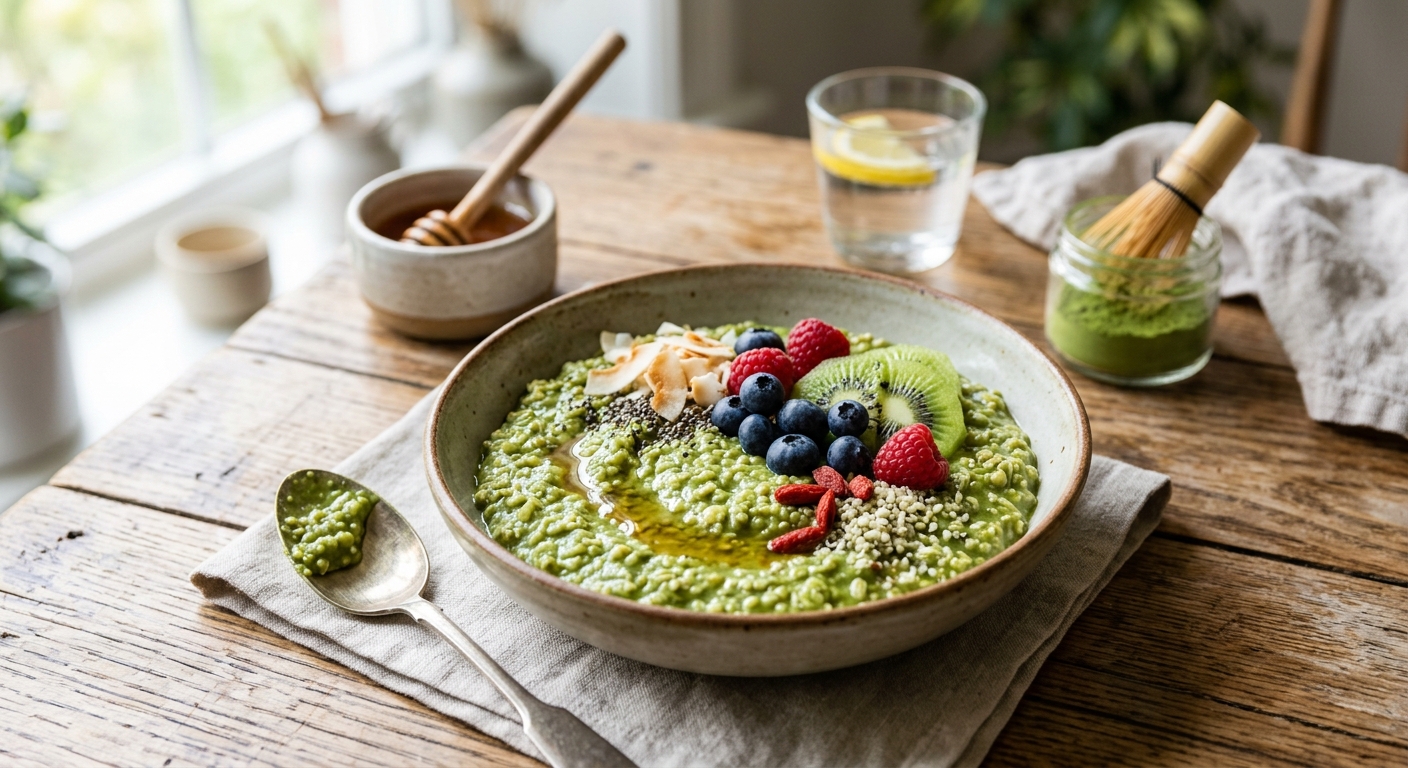
Imagine a breakfast that does not just fuel your morning but actively recalibrates your metabolism before you leave the kitchen. This Matcha Green Tea Breakfast Bowl combines the sustained energy of whole-grain oats, the complete protein of white quinoa, and the thermogenic power of ceremonial-grade matcha into a single, deeply satisfying bowl. The result is a velvety, earthy, subtly sweet porridge that tastes like a matcha latte transformed into something you can eat with a spoon, and that keeps you full, focused, and energised for hours.
The nutritional architecture here is deliberate. Rolled oats contribute beta-glucan soluble fibre, which slows gastric emptying and blunts the post-meal glucose spike. Quinoa fills the amino acid gaps that oats leave behind, making the protein in this bowl genuinely complete. Pumpkin seeds add zinc and magnesium, two minerals critical for thyroid hormone synthesis and glucose metabolism respectively. And then there is the matcha itself: a concentrated source of EGCG (epigallocatechin gallate), the catechin that has been shown in multiple randomised controlled trials to increase fat oxidation during moderate exercise and elevate 24-hour energy expenditure when consumed consistently.
At Calibrated Cuisine we chose three cooking methods that each treat the grains differently. The stovetop method gives you maximum control and a silky, risotto-like texture. The slow cooker produces an overnight oat-style bowl with a deeper, toasted flavour from the low, long heat. The pressure cooker delivers a perfectly hydrated, almost pudding-thick consistency in under twenty minutes, ideal for weekday mornings when time is short. Whichever method you choose, the matcha is always whisked in off the heat to preserve its delicate catechins and that vivid jade-green colour.
4
servings
Ingredients
- 160 grolled oats (not instant)
- 90 gwhite quinoa, rinsed thoroughly
- 12 gceremonial-grade matcha powder, sifted
- 900 mlunsweetened oat milk
- 400 mlcold filtered water
- 2 tbspraw honey, plus extra to serve
- 1 tsppure vanilla extract
- 0.5 tspground ginger
- 0.25 tspground cinnamon
- 40 gpumpkin seeds (pepitas), raw
- 20 gwhite sesame seeds
- 150 gfresh blueberries
- 100 gfresh raspberries
- 30 gflaxseed meal (ground flaxseed)
- 1 tbspextra-virgin coconut oil
- —Colima Sea SaltMicroplastic Free Salt, a generous pinch
Instructions
Click on an item below to shop for the recommended items for this recipe on Amazon.
As an Amazon Associate, we earn from qualifying purchases.
- Toast the seeds: Place a medium, dry saucepan over medium heat. Add the pumpkin seeds and sesame seeds and toast, shaking the pan frequently, for 3 to 4 minutes until the sesame seeds are golden and the pumpkin seeds begin to pop. Transfer immediately to a small bowl and set aside.
- Cook the quinoa base: In a large, heavy-bottomed saucepan (at least 3 litres), combine the rinsed quinoa with the 400ml cold water and a pinch of sea salt. Bring to a boil over medium-high heat, then reduce to a gentle simmer, cover, and cook for 12 minutes until the water is almost fully absorbed and the quinoa tails have unfurled. Do not drain.
- Add the oats and liquid: Pour the oat milk directly into the quinoa pan. Stir in the rolled oats, ground ginger, cinnamon, and coconut oil. Increase the heat to medium and cook, stirring frequently with a wooden spoon, for 10 to 12 minutes until the mixture has thickened to a creamy porridge consistency that falls slowly from the spoon. Adjust thickness with a splash of extra oat milk if needed.
- Bloom the matcha: Remove the pan from the heat entirely. In a small heatproof bowl, sift the matcha powder and add 3 tablespoons of the hot porridge liquid (about 80 degrees C, not boiling). Whisk vigorously in a W-motion for 30 seconds until the matcha is completely dissolved and frothy with no green lumps.
- Combine and finish: Stir the dissolved matcha paste into the porridge along with the vanilla extract, raw honey, and flaxseed meal. Fold gently but thoroughly until the colour is a uniform, deep jade green.
- Serve immediately: Ladle into four bowls. Top each with the toasted seeds, a generous handful of blueberries and raspberries, an extra drizzle of honey, and a final dusting of sifted matcha if desired.
- Lightly grease the slow cooker insert: Rub the interior of a 4 to 5 litre slow cooker with the coconut oil, coating the bottom and sides up to about 5cm. This prevents the oats from crusting to the sides overnight.
- Layer the grains: Add the rinsed quinoa to the greased insert first, followed by the rolled oats (or steel-cut oats). Do not stir yet.
- Add all liquids and spices: Pour in the oat milk and cold water. Add the ground ginger, cinnamon, vanilla extract, sea salt, and raw honey. Stir gently once to distribute the spices without disturbing the grain layers.
- Cook overnight: Place the lid on the slow cooker and cook on Low for 7 to 8 hours. The grains will hydrate slowly, absorb almost all of the liquid, and develop a lightly caramelised depth of flavour at the edges. Do not cook on High, as this scorches the oat milk and dulls the sweetness.
- Toast the seeds in the morning: While the slow cooker finishes, toast the pumpkin seeds and sesame seeds in a dry skillet over medium heat for 3 to 4 minutes until golden and fragrant. Set aside.
- Dissolve the matcha separately: Whisk the sifted matcha powder with 4 tablespoons of just-boiled water (cooled to approximately 80 degrees C) in a small bowl until completely smooth and frothy. Stir in an extra tablespoon of honey if a sweeter bowl is preferred.
- Finish and serve: Stir the slow cooker porridge well to reintegrate any liquid sitting at the surface. Fold in the flaxseed meal. Ladle into four bowls, then swirl a generous tablespoon of the matcha liquid over each portion. Top with berries and toasted seeds and serve at once.
- Combine grains and liquid: Add the rinsed quinoa, rolled oats, oat milk, water, ground ginger, cinnamon, coconut oil, and sea salt to the Instant Pot or electric pressure cooker inner pot. Stir once to combine. Do not add honey or vanilla yet as both degrade under pressure.
- Pressure cook: Seal the lid and set the steam-release valve to Sealing. Select Manual or Pressure Cook at High pressure and set the timer to 10 minutes. The pot will take approximately 8 minutes to come to pressure.
- Natural pressure release: When the cook cycle ends, allow the pressure to release naturally for 10 minutes (do not touch the valve). After 10 minutes, carefully turn the valve to Venting to release any residual steam. Open the lid away from you.
- Stir vigorously: The mixture will appear very thick and slightly set on top. Add the vanilla extract, raw honey, and flaxseed meal and stir with a wooden spoon or silicone spatula for 1 to 2 minutes, scraping the bottom of the pot, until creamy and homogeneous. The agitation loosens the starch and creates a smooth porridge texture. Add a splash of warm oat milk if needed to reach your preferred consistency.
- Dissolve the matcha off-heat: In a small bowl, whisk the sifted matcha powder with 3 tablespoons of 80-degree-C water (use the Keep Warm function water or a separate kettle) until completely smooth. Fold the matcha paste thoroughly into the porridge in the pot.
- Toast seeds and plate: While the porridge rests on Keep Warm, toast the pumpkin and sesame seeds in a dry pan on the stovetop for 3 to 4 minutes. Ladle the vivid green porridge into four bowls, top with toasted seeds, fresh blueberries and raspberries, and a drizzle of raw honey.
- Preheat and prepare the dish: Preheat your oven to 175 degrees C (350 degrees F). Grease a 20 x 30cm (8 x 12 inch) ceramic or glass baking dish with the coconut oil, coating the bottom and sides thoroughly.
- Par-cook the quinoa: Combine the rinsed quinoa with 300ml of the measured water in a small saucepan. Bring to a boil, reduce to a simmer, cover, and cook for 10 minutes until just tender and the water is absorbed. The quinoa does not need to be fully cooked at this stage. Remove from heat and allow to cool for 5 minutes.
- Mix the baked oatmeal base: In a large mixing bowl, combine the rolled oats, par-cooked quinoa, flaxseed meal, ground ginger, cinnamon, vanilla extract, sea salt, and raw honey. Pour in the oat milk and the remaining 100ml water. Stir until fully combined. The mixture should be quite liquid as it will absorb during baking.
- Bloom the matcha: In a small bowl, whisk the sifted matcha with 3 tablespoons of warm oat milk (about 70 degrees C) until smooth. Pour the matcha mixture into the oat base and fold thoroughly until the batter is uniformly green.
- Bake: Pour the mixture into the prepared baking dish and spread evenly. Scatter the raw pumpkin seeds and sesame seeds across the top, pressing them lightly into the surface. Bake uncovered at 175 degrees C for 38 to 42 minutes until the top is just set, lightly golden at the edges, and a toothpick inserted in the centre comes out without liquid batter (moist crumbs are fine).
- Rest and serve: Allow the baked bowl to rest for 5 minutes before scooping. This allows the structure to set and makes serving cleaner. Spoon into four bowls, top with fresh blueberries and raspberries, and finish with a drizzle of raw honey and a light dusting of sifted matcha.
Nutrition Breakdown
Per 1 serving (makes 4)
Vitamins & Minerals
% Daily Value based on a 2,000 calorie diet (FDA reference)
🧬 Essential Amino Acids
% of recommended daily intake (RDA) per serving
🛡 Antioxidant Profile
The Nutrition Science
The metabolism-boosting reputation of matcha is not marketing copy. A landmark meta-analysis published in the American Journal of Clinical Nutrition found that green tea catechins combined with caffeine increased 24-hour energy expenditure by 4.6% and fat oxidation by 16% compared to placebo, with EGCG identified as the primary active compound. A 3g serving of ceremonial-grade matcha (the amount used per serving in this recipe) delivers approximately 68mg of EGCG, which sits squarely within the effective dose range used in intervention trials. The mechanism involves EGCG inhibiting catechol-O-methyltransferase (COMT), the enzyme that breaks down norepinephrine, thereby extending sympathetic nervous system stimulation of brown adipose tissue thermogenesis.
The grain combination of oats and quinoa is nutritionally synergistic in a specific and measurable way. Oats are limited in lysine, the essential amino acid most critical for muscle protein synthesis, while quinoa contains all nine essential amino acids including lysine at concentrations exceeding the FAO reference protein. By combining both in a single bowl, this recipe achieves a complete amino acid profile from entirely plant-based sources, with particular strength in threonine and histidine, which are critical for gut mucosal integrity and haemoglobin synthesis respectively. The beta-glucan fibre in oats, at approximately 1.5g per serving here, further engages the GLP-1 satiety pathway, which synergises with EGCG-mediated appetite suppression to make this one of the most clinically credible breakfast formats for metabolic health.
Pumpkin seeds and sesame seeds together contribute meaningful amounts of zinc, magnesium, and copper, three minerals that act as cofactors for over 300 enzymatic reactions involved in energy metabolism, including the mitochondrial enzyme succinate dehydrogenase (Complex II of the electron transport chain). Magnesium deficiency, which affects an estimated 45% of adults in Western populations, directly impairs insulin receptor signalling. The 138mg of magnesium per serving in this bowl represents 33% of the daily value, making it one of the most efficient single-meal sources of this chronically under-consumed mineral.
Pro Tips
- Always sift matcha before dissolving it: even high-quality ceremonial matcha contains micro-clumps that will not fully dissolve without sifting, leaving bitter green specks in your bowl.
- Cool your liquid to around 80 degrees C before adding matcha. Temperatures above 85 degrees C degrade EGCG and other catechins by up to 30%, and also produce a more bitter, astringent flavour.
- Rinse the quinoa until the water runs clear to remove saponins, the naturally occurring bitter coating. A 30-second rinse in a fine-mesh strainer under cold running water is sufficient and makes a noticeable difference to the final flavour.
- For a higher-protein version, replace half the oat milk with a plain, unsweetened pea protein milk, which adds approximately 4g of additional complete protein per serving without altering the flavour profile or colour.
- Frozen blueberries work excellently as a topping and are nutritionally equivalent to fresh. Thaw overnight in the refrigerator or add frozen directly to the hot bowl and allow them to warm through for 2 minutes before eating.




Love the matcha focus, though I’m curious about your sourcing on the ceremonial grade matcha – that’s one area where pesticide load can really vary depending on origin and harvest timing, since tea plants accumulate heavy metals from soil. Have you tested specific brands or regions? Also, if someone’s using conventional oats here, that’s a major glyphosate exposure point worth flagging even though the recipe doesn’t mention it. The quinoa and seeds are solid choices though, especially if sourced organic. Would be great to see a sourcing note in future versions since this bowl is otherwise really thoughtfully formulated for micronutrient density.
good catch on the sourcing thing, klara – i actually test my matcha batches for lead and cadmium now after reading some scary studies on japanese tea farms. but heres what matters more for this bowl imo: the quinoa and pumpkin seeds are gonna give you way more bioavailable zinc and magnesium than the matcha itself, and thats where the real metabolic leverage is. matcha’s great for the catechins and focus, but if your mineral status is tanked, no amount of antioxidants will fix your metabolism. whats your current testing protocol for heavy metals in your sources?
Zack, this is exactly the clinical thinking we need more of – mineral sufficiency as the foundation matters way more than people realize. The quinoa/pumpkin seed combo you mentioned hits that right, though I’d add that pumpkin seeds tip heavily toward omega-6 (around 114:1 ratio), so they’re best balanced with something like walnuts or chia in the same meal to avoid compounding systemic inflammation. Your heavy metal testing approach is solid; I’ve seen how lead burden specifically dampens mitochondrial function independent of antioxidant intake. Have you noticed any difference in energy or inflammation markers since you started that protocol?