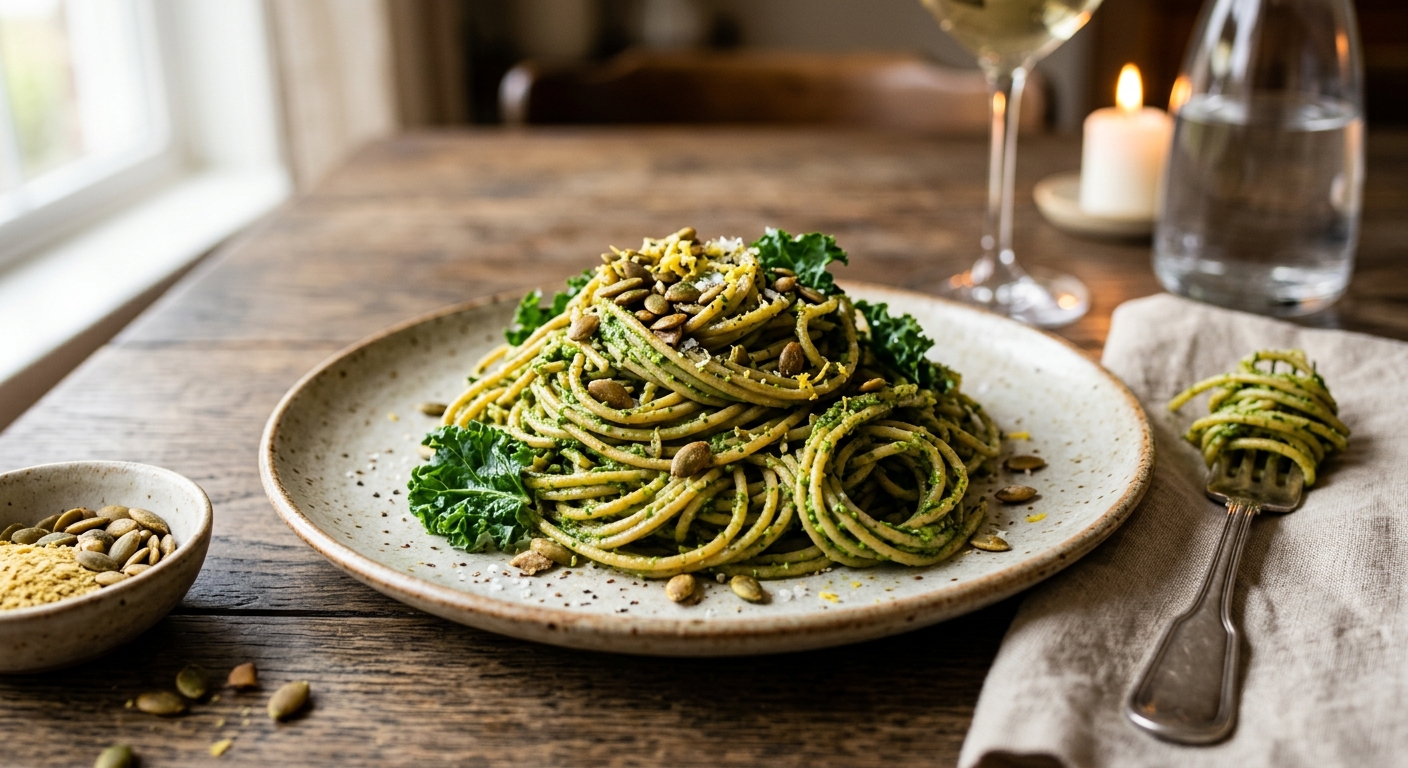
Pesto does not have to begin and end with basil and pine nuts. This pumpkin seed and kale pesto reimagines the classic Italian sauce as a nutritional powerhouse, anchored by two of the most mineral-dense whole foods available at any grocery store. Pumpkin seeds (pepitas) are one of the richest plant-based sources of zinc on the planet, and when paired with the iron and vitamin K abundance of lacinato kale, the result is a sauce that earns its place on your table not just for flavor, but for function.
Whole-wheat pasta forms the backbone of this dish, providing a slow-digesting carbohydrate base that keeps blood sugar steady and adds its own contribution of B vitamins and fiber. The pesto itself is finished with nutritional yeast for a savory, cheesy depth that also brings a full spectrum of B vitamins, and a generous squeeze of lemon juice whose vitamin C content actively enhances the absorption of non-heme iron from both the kale and the pasta. Every ingredient earns its place through a dual lens of flavor and nutritional science.
What sets this recipe apart from standard pesto pasta is the intentional layering of technique. Toasting the pumpkin seeds unlocks deeper, nuttier volatile compounds via the Maillard reaction, while massaging the raw kale with a pinch of salt before blending breaks down tough cell walls and tames any bitterness. The result is a silky, vivid-green sauce that clings beautifully to every strand of pasta and tastes as though it came from a restaurant kitchen, not a nutrition textbook.
4
servings
Ingredients
- 360 gwhole-wheat spaghetti or linguine
- 120 graw pepitas (hulled pumpkin seeds)
- 150 glacinato (Tuscan) kale, stems removed, leaves roughly torn
- 30 gnutritional yeast
- 3 clovesgarlic, peeled
- 60 mlextra-virgin olive oil
- 30 mlfresh lemon juice (about 1 large lemon)
- 1 tsplemon zest
- 120 mlreserved pasta cooking water (added gradually)
- 1 tbspextra-virgin olive oil (for toasting seeds)
- 40 gpumpkin seeds, extra, lightly toasted (for garnish)
- 10 gfresh flat-leaf parsley leaves (for garnish)
- —Colima Sea SaltMicroplastic Free Salt and freshly cracked black pepper to taste
- —Pinch of red chili flakes (optional)
Instructions
Click on an item below to shop for the recommended items for this recipe on Amazon.
As an Amazon Associate, we earn from qualifying purchases.
- Toast the pepitas: Place a large, dry skillet over medium heat. Add the 120g of pepitas in a single layer and toast, stirring frequently, for 4 to 5 minutes until they are golden, fragrant, and several seeds have begun to puff and pop. Transfer immediately to a plate to cool. Reserve 40g of the best-looking toasted seeds for garnish.
- Prepare the kale pesto base: Place the torn kale leaves in a large bowl and drizzle with a pinch of fine sea salt. Using your hands, firmly massage the kale for 60 to 90 seconds until the leaves darken, soften, and reduce significantly in volume. This breaks down cellular structure and removes bitterness.
- Bring a large pot of water to a rolling boil over high heat. Season aggressively with salt (the water should taste pleasantly salty). Cook the whole-wheat pasta according to package directions, aiming for al dente. Before draining, use a ladle or heatproof measuring cup to reserve at least 180ml of starchy pasta cooking water. Drain the pasta and set aside.
- While the pasta cooks, build the pesto: In a food processor, combine the massaged kale, 80g of the cooled toasted pepitas, nutritional yeast, garlic cloves, lemon juice, lemon zest, and a generous pinch of salt. Pulse 8 to 10 times to break everything down into a coarse rubble. With the motor running, drizzle in the 60ml of olive oil in a slow, steady stream. Process for 45 seconds until the pesto is thick, mostly smooth, and vividly green. Taste and adjust salt and lemon.
- Finish the dish: Return the drained pasta to the warm pot over the lowest possible heat. Add the pesto and toss vigorously, adding reserved pasta cooking water a splash at a time (start with 60ml) until the sauce loosens and coats every strand in a glossy, clingy emulsion. The starch in the water binds the oil and pesto into a unified sauce. Season with black pepper and chili flakes if using.
- Serve immediately in warm bowls topped with the reserved toasted pepitas, fresh parsley, an extra drizzle of olive oil, and a light grating of lemon zest.
- Toast the pepitas on the stovetop first: In a dry skillet over medium heat, toast all 120g of pepitas for 4 to 5 minutes, stirring often, until golden and fragrant. Transfer to a plate. Reserve 40g for garnish. Allow to cool for 10 minutes before blending.
- Make the kale pesto: Massage the torn kale leaves with a pinch of salt in a bowl for 60 to 90 seconds until wilted and darkened. Combine the massaged kale, 80g of cooled toasted pepitas, nutritional yeast, garlic, lemon juice, lemon zest, 60ml olive oil, and a pinch of salt in a blender or food processor. Blend on high for 60 seconds until smooth and vibrant. Scrape into the slow cooker insert.
- Add liquid and set to warm: Pour 240ml of low-sodium vegetable broth or water into the slow cooker along with the pesto. Stir to combine and set the slow cooker to Low. Cover and allow the sauce to gently warm and meld for 2 to 3 hours. The low, even heat blooms the garlic without rawness and deepens the overall flavor of the sauce. Stir once halfway through.
- Cook the pasta separately: About 20 minutes before serving, bring a large pot of well-salted water to a boil on the stovetop. Cook the whole-wheat pasta until just shy of al dente (1 to 2 minutes less than package directions), as it will continue to absorb moisture. Reserve 180ml of pasta water before draining.
- Finish in the slow cooker: Add the drained pasta directly to the slow cooker. Toss thoroughly to coat, adding reserved pasta water in 60ml increments if the sauce is too thick. Replace the lid and cook on Low for a further 20 to 25 minutes, allowing the pasta to finish cooking and absorb the pesto sauce. Stir once at the halfway point. Taste and adjust salt, pepper, and lemon. Serve directly from the insert topped with reserved pepitas and fresh parsley.
- Toast pepitas on the stovetop using the saute function: If using an Instant Pot, press Saute and set to Medium. Add 1 tbsp olive oil and all 120g of pepitas. Toast for 3 to 4 minutes, stirring constantly, until golden and fragrant. Press Cancel. Transfer all pepitas to a plate; reserve 40g for garnish.
- Build the pesto separately: Allow the pepitas to cool for 5 minutes. In a blender, combine the massaged (see stovetop step 2 for technique) kale, 80g cooled pepitas, nutritional yeast, garlic, lemon juice, lemon zest, 60ml olive oil, and salt. Blend on high for 60 seconds to a smooth, vibrant pesto.
- Load the pressure cooker: Break the whole-wheat spaghetti or linguine in half so it fits inside the pot without overlapping too heavily. Add 700ml of cold water (or low-sodium vegetable broth) and a generous pinch of salt. Gently pour the pesto over the pasta and use a spatula to push the pasta strands under the liquid as much as possible. Do not stir once loaded, as this can trigger a burn warning.
- Pressure cook: Secure the lid and set the valve to Sealing. Cook at High Pressure for 4 minutes (for standard whole-wheat pasta; check your brand as thickness varies). When the cook time ends, perform a Quick Release by carefully turning the valve to Venting. Open the lid away from you.
- Emulsify and serve: The pasta will look saucy and loose at first. Stir vigorously with tongs for 60 to 90 seconds; the residual starch will rapidly thicken the sauce into a glossy, cohesive coating. If too thick, stir in water 30ml at a time. If too loose, press Saute for 2 minutes and stir continuously. Taste and correct seasoning with salt, pepper, lemon juice, and chili flakes. Serve in warm bowls topped with reserved pepitas and fresh parsley.
- Preheat your oven to 190C (375F). Toast the pepitas in the oven itself: Spread all 120g of pepitas in a single layer on a dry rimmed baking sheet. Roast on the middle rack for 6 to 8 minutes, stirring once at the 4-minute mark, until golden and fragrant. Watch carefully as oven-toasted seeds can go from perfect to burnt quickly. Remove and cool. Reserve 40g for garnish.
- Par-cook the pasta: Bring a large pot of well-salted water to a boil. Cook the whole-wheat pasta for 3 minutes less than the package directions (it will finish in the oven). Reserve 300ml of pasta cooking water before draining. The pasta should be distinctly underdone and have a firm, chalky center.
- Make the pesto: Massage the kale with a pinch of salt (60 to 90 seconds by hand) until softened. Blend the massaged kale, 80g cooled pepitas, nutritional yeast, garlic, lemon juice, lemon zest, 60ml olive oil, and salt in a food processor or blender until smooth and bright green.
- Assemble the bake: In a large mixing bowl, combine the pesto with 180ml of the reserved pasta water and whisk briefly to loosen into a pourable sauce. Add the par-cooked pasta and toss to coat thoroughly. Transfer the entire mixture to a lightly oiled 23x33cm (9×13 inch) baking dish. Pour over an additional 60 to 80ml of reserved pasta water to ensure there is visible moisture around the pasta edges, which will steam and cook the pasta through.
- Bake and finish: Cover the dish tightly with foil and bake for 18 minutes. Remove the foil and bake for a further 7 minutes uncovered until the top strands of pasta are golden at the tips and the sauce is bubbling at the edges. Remove from the oven and rest for 5 minutes. The sauce will tighten as it cools slightly. Taste and adjust salt and lemon. Scatter the reserved toasted pepitas and fresh parsley generously over the top and serve straight from the baking dish.
Nutrition Breakdown
Per 1 serving (makes 4)
Vitamins & Minerals
% Daily Value based on a 2,000 calorie diet (FDA reference)
🧬 Essential Amino Acids
% of recommended daily intake (RDA) per serving
🛡 Antioxidant Profile
The Nutrition Science
Zinc is the star mineral in this recipe, and pumpkin seeds are one of the most concentrated plant-based sources available, providing approximately 2.9mg of zinc per 30g serving. Zinc participates in over 300 enzymatic reactions in the human body, spanning DNA synthesis, immune cell maturation, wound healing, and the regulation of taste and smell. The zinc from pumpkin seeds is bound to phytates in the seed matrix, which can inhibit absorption. However, toasting the seeds activates endogenous phytase enzymes and physically disrupts the phytate-mineral complex, meaningfully improving bioavailability. The lemon juice in this pesto further assists absorption by lowering the pH of the meal environment, making zinc ions more soluble and accessible to intestinal transport proteins.
Kale provides two key nutritional synergies in this dish. First, it is exceptionally rich in non-heme iron and folate, and the vitamin C naturally present in kale (as well as the added lemon juice) converts ferric iron (Fe3+) to ferrous iron (Fe2+), the form that intestinal enterocytes can actually absorb via the DMT1 transporter. Studies suggest that consuming vitamin C alongside non-heme iron can increase absorption by two to four times. Second, kale’s high vitamin K1 (phylloquinone) content supports the carboxylation of osteocalcin and matrix Gla protein, proteins essential for directing calcium into bone tissue rather than arteries. The lutein and zeaxanthin in kale are fat-soluble carotenoids; their absorption is significantly enhanced by the olive oil and pumpkin seed fat in this pesto, making the combination of ingredients in this sauce genuinely more bioavailable together than apart.
Whole-wheat pasta contributes to the mineral story in a way that refined pasta cannot. The bran and germ layers retained in whole-wheat flour are the primary reservoirs of magnesium, manganese, phosphorus, and B vitamins. Magnesium, of which this dish provides 43% of the daily value, is a cofactor for ATP synthesis, meaning it is directly involved in every energy-producing reaction in the body. Nutritional yeast completes the B-vitamin profile, adding a meaningful dose of thiamine, riboflavin, niacin, B6, and B12 (if fortified), making this dish one of the most comprehensively micronutrient-complete plant-based pasta meals you can assemble from whole-food ingredients.
Pro Tips
- For maximum zinc bioavailability, soak the raw pepitas in cold water for 4 to 8 hours, then rinse and dry thoroughly before toasting. This pre-activates phytase enzymes and partially degrades phytate bonds before heat is applied, improving mineral absorption compared to toasting unsoaked seeds.
- Do not skip the kale massaging step. Lacinato kale contains tough cellulose fibers and glucosinolate compounds that, while beneficial, can taste harsh when raw. Massaging with salt physically ruptures cell walls, releasing moisture and volatile bitter compounds, and also partially converts glucosinolates into more bioavailable isothiocyanates.
- The pesto can be made up to 3 days in advance and stored in a sealed jar in the refrigerator with a thin layer of olive oil pressed over the surface to prevent oxidation and preserve its vivid green color. The assembled pasta dish is best eaten fresh, as whole-wheat pasta continues to absorb sauce on standing.


This is exactly the kind of recovery meal I’ve been experimenting with on my non-interval days, though I’m curious about the total carb load here with the whole wheat pasta. How many grams of carbs are we looking at per serving, and does this work better as a post-ride refuel on higher intensity training days or more of a steady-state recovery meal? The zinc content is fantastic for immune function after hard efforts, but I’m trying to dial in whether the pumpkin seed fat ratio makes this better suited for fat-adaptation windows versus my carb-loading phases.
Oh, I’m absolutely making this for next week’s class! I used to make a traditional basil pesto with pine nuts for decades, but I’ve been looking for ways to highlight zinc and magnesium for my students who are interested in immune support and energy, so pumpkin seeds are such a smart swap. I’m curious about the massaging technique you used on the kale, since I find it can sometimes get bitter if you’re too aggressive, especially with lacinato. Did you find a particular massage method worked best to keep that beautiful green color while softening the leaves?
Oh this is PERFECT for me – I’ve been experimenting with pumpkin seeds specifically because they’re one of the few nuts/seeds my gut tolerates without inflammation spikes, and the zinc + magnesium combo is exactly what my elimination diet revealed I was deficient in! I’m definitely trying this next week and will track how it affects my IBS symptoms compared to my usual basil pesto (which honestly causes bloating, probably the pine nuts). The whole wheat pasta + kale combination should give me those prebiotics too – so excited to see how this impacts my digestion markers!