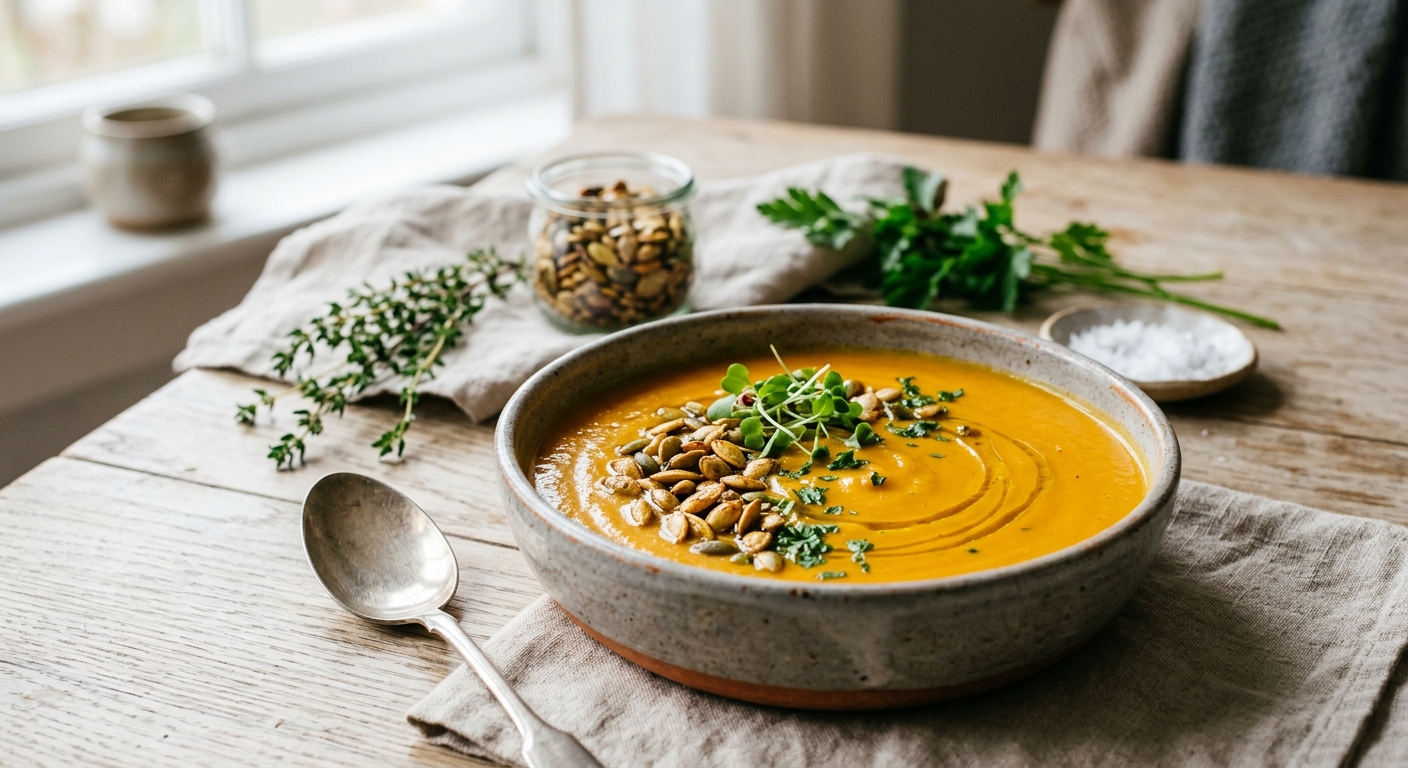
Magnesium and zinc are two of the most chronically under-consumed minerals in the modern diet, yet they underpin hundreds of enzymatic reactions, from energy metabolism and protein synthesis to immune defence and sleep regulation. Most people scramble to meet their needs through supplements, but this deeply golden pumpkin soup with a crown of toasted pepitas and sunflower seeds delivers both minerals in meaningful, food-matrix-bound quantities that your body absorbs more efficiently than any capsule. One bowl and you are genuinely moving the needle.
The hero ingredients here work in concert. Pumpkin flesh provides a soft mineral base alongside potassium and beta-carotene, while the toasted seed blend is where the magnesium and zinc story really accelerates. A 30-gram serving of pepitas (hulled pumpkin seeds) contains roughly 156mg of magnesium and 2.2mg of zinc, and toasting them in a dry pan activates their nuttiness without destroying heat-stable minerals. Sunflower seeds add a secondary hit of magnesium, vitamin E, and selenium, turning what might seem like a garnish into a serious nutritional contribution.
The soup itself is built on a foundation of roasted or sweated aromatics, coconut milk for creaminess and medium-chain triglycerides, and a restrained spice blend of cumin, coriander, and smoked paprika that complements pumpkin without overpowering it. Whether you cook it on the stovetop, let a slow cooker do the work overnight, or blast it to the table in under thirty minutes with a pressure cooker, the result is a silky, restaurant-quality bisque that happens to be one of the most mineral-dense meals you can serve from a home kitchen.
4
servings
Ingredients
- 1000 gsugar pumpkin or butternut squash, peeled, seeded, and cut into 3cm cubes
- 1 largeyellow onion, roughly chopped
- 4 clovesgarlic, smashed
- 1 piecefresh ginger, 3cm, peeled and sliced
- 2 tbspextra-virgin olive oil
- 1 tspground cumin
- 1 tspground coriander
- 1 tspsmoked paprika
- 0.25 tspground turmeric
- 0.25 tspcayenne pepper
- 750 mllow-sodium vegetable stock
- 400 mlfull-fat coconut milk (1 can)
- 1 tbspfresh lime juice
- 80 ghulled pepitas (pumpkin seeds), divided
- 40 ghulled sunflower seeds
- 1 tsptamari or low-sodium soy sauce (for seed toasting)
- 0.5 tspsmoked paprika (for seed toasting)
- —Colima Sea SaltMicroplastic Free Salt and freshly ground black pepper to taste
- —Fresh flat-leaf parsley or pumpkin seed oil, to serve (optional)
Instructions
Click on an item below to shop for the recommended items for this recipe on Amazon.
As an Amazon Associate, we earn from qualifying purchases.
- Toast the seeds first: place a dry medium skillet over medium heat. Add the pepitas and sunflower seeds and toast, stirring constantly, for 3 to 4 minutes until the pepitas begin to pop and turn golden. Drizzle in the tamari, add the smoked paprika, and stir vigorously for 30 seconds until the seeds are evenly coated and fragrant. Tip onto a plate and set aside. Reserve 60g of this mixture for garnish and set the remaining 60g aside to blend into the soup.
- In a large Dutch oven or heavy-bottomed pot, heat the olive oil over medium heat until shimmering. Add the chopped onion with a pinch of salt and cook, stirring occasionally, for 7 to 8 minutes until softened and lightly golden at the edges. Add the garlic and ginger and cook for a further 90 seconds until fragrant.
- Add the cumin, coriander, smoked paprika, turmeric, and cayenne directly to the onion mixture. Stir continuously for 60 seconds, allowing the spices to bloom in the oil. This step is critical for developing depth of flavour and activating the fat-soluble compounds in the spices.
- Add the pumpkin cubes and stir to coat thoroughly in the spiced oil. Pour in the vegetable stock, increase the heat to medium-high, and bring to a full boil. Reduce the heat to a gentle simmer, cover partially with a lid, and cook for 20 to 22 minutes until the pumpkin is completely tender when pierced with a fork.
- Remove the pot from the heat. Add the coconut milk and the reserved 60g of toasted seeds designated for blending. Use an immersion blender to puree the soup directly in the pot until completely smooth and velvety, about 2 minutes. Alternatively, transfer in batches to a countertop blender, filling no more than halfway and holding the lid firmly.
- Return the pot to low heat. Stir in the lime juice and taste carefully for seasoning, adjusting salt and pepper as needed. Warm gently for 2 to 3 minutes; do not allow to boil after adding the lime juice. Ladle into warmed bowls and top generously with the reserved toasted seed mixture. Finish with a drizzle of pumpkin seed oil or a scattering of fresh parsley if desired.
- Place the pumpkin cubes, chopped onion, smashed garlic, and sliced ginger directly into the slow cooker insert. No pre-sauteing is required, but if you have 10 minutes, briefly softening the onion in olive oil in a skillet before adding it will deepen the flavour considerably.
- Whisk together the olive oil, cumin, coriander, smoked paprika, turmeric, cayenne, and vegetable stock in a large measuring jug until combined. Pour this spiced liquid over the vegetables in the slow cooker. The pumpkin does not need to be fully submerged; it will release liquid as it cooks.
- Place the lid on the slow cooker. Cook on Low for 6.5 to 7 hours or on High for 3 to 3.5 hours, until the pumpkin is completely soft and collapsing when pressed with a spoon. The longer, lower cook yields a sweeter, more developed flavour as the pumpkin’s natural sugars concentrate slowly.
- While the soup finishes its final 20 minutes of cooking, prepare the toasted seeds on the stovetop: heat a dry skillet over medium heat, add the pepitas and sunflower seeds, and toast for 3 to 4 minutes, stirring constantly. Add the tamari and smoked paprika, stir for 30 seconds, then tip onto a plate. Reserve 60g for garnish and set aside 60g for blending into the soup.
- Turn off the slow cooker. Pour in the full-fat coconut milk and add the 60g of toasted seeds reserved for blending. Use an immersion blender to puree the soup directly in the insert until silky smooth. If using a countertop blender, allow the soup to cool for 10 minutes and work in small batches.
- Stir in the fresh lime juice and season generously with salt and black pepper. If the soup has thickened more than you prefer, stir in a splash of warm water or additional stock to reach your desired consistency. Ladle into bowls and top with the reserved toasted seed garnish.
- Set the Instant Pot or electric pressure cooker to Saute mode on Normal/Medium heat. Add the olive oil and heat until shimmering. Add the onion and a pinch of salt and saute for 5 minutes, stirring frequently, until softened. Add the garlic and ginger and saute for another 60 seconds.
- Add the cumin, coriander, smoked paprika, turmeric, and cayenne. Stir for 45 seconds, letting the spices bloom in the residual oil. Press Cancel to stop the Saute function. Immediately pour in the vegetable stock and use a wooden spoon to scrape up any browned bits stuck to the bottom of the pot; this prevents the burn warning from triggering.
- Add the pumpkin cubes and stir briefly to distribute evenly. Do not add the coconut milk yet. Secure the lid, set the pressure release valve to Sealing, and select Pressure Cook (or Manual) on High for 10 minutes.
- While the pressure cooker is running, prepare the toasted seeds on the stovetop in a dry skillet over medium heat. Toast the pepitas and sunflower seeds for 3 to 4 minutes, add the tamari and smoked paprika, stir for 30 seconds, and remove from heat. Reserve 60g for garnish and 60g for blending.
- Once the 10 minutes are complete, allow the pressure to release naturally for 10 minutes, then carefully switch the valve to Venting to release any remaining steam. Remove the lid. The pumpkin should be completely tender and partially broken down.
- Add the coconut milk and the 60g of toasted seeds designated for blending. Use an immersion blender to puree the soup directly in the pot until silky and uniform. Stir in the lime juice, taste and correct seasoning, then ladle immediately into bowls. Top with the reserved toasted seeds and any optional garnishes.
- Preheat your oven to 220 degrees Celsius (200 degrees Celsius fan / 425 degrees Fahrenheit). Line a large rimmed baking sheet with parchment paper. Spread the pumpkin cubes, chopped onion, smashed garlic cloves, and sliced ginger across the baking sheet in a single layer with space between each piece.
- Drizzle the olive oil over the vegetables, then sprinkle over the cumin, coriander, smoked paprika, turmeric, cayenne, a generous pinch of salt, and several grinds of black pepper. Toss thoroughly to coat every piece. Roast on the middle rack for 35 to 40 minutes, turning once at the halfway mark, until the pumpkin is tender, caramelised at the edges, and deeply golden.
- While the vegetables roast, prepare the toasted seeds. Spread the pepitas and sunflower seeds on a separate small baking sheet or oven-safe pan. Place in the oven alongside the vegetables for the final 8 minutes of roasting, watching carefully to prevent burning. Remove and immediately toss with the tamari and smoked paprika while still hot. The seeds will crisp as they cool. Reserve 60g for garnish and 60g for the soup.
- Transfer all the roasted vegetables and any caramelised pan juices into a large pot on the stovetop. Pour in the vegetable stock and bring to a gentle simmer over medium heat. Simmer uncovered for 10 to 12 minutes, allowing the roasted flavours to meld with the stock.
- Remove from heat. Add the coconut milk and the 60g of toasted seeds reserved for blending. Puree with an immersion blender until completely smooth. The roasted garlic and caramelised pumpkin edges will give this version a noticeably richer, slightly sweeter flavour profile compared to the other methods.
- Stir in the lime juice and taste for seasoning. The roasting will have concentrated the flavours significantly, so add salt cautiously. Ladle into warmed bowls, finish with the reserved toasted seed blend, and add a light drizzle of pumpkin seed oil if available. The colour of this version will be a deeper, more burnished amber than the stovetop or slow cooker versions.
Nutrition Breakdown
Per 1 serving (makes 4)
Vitamins & Minerals
% Daily Value based on a 2,000 calorie diet (FDA reference)
🧬 Essential Amino Acids
% of recommended daily intake (RDA) per serving
🛡 Antioxidant Profile
The Nutrition Science
Magnesium is involved in over 300 enzymatic reactions in the human body, including ATP synthesis, DNA repair, protein biosynthesis, and the regulation of neuromuscular signalling. Despite its importance, surveys consistently show that 50 to 60 percent of adults in Western countries fail to meet the Estimated Average Requirement of 350mg per day. The pepitas in this recipe are among the most magnesium-dense whole foods available, providing approximately 156mg per 30g serving, sourced in a food matrix alongside healthy fats that improve intestinal uptake compared to inorganic magnesium supplements.
Zinc deficiency is similarly widespread, particularly among those who limit animal protein. Zinc from plant sources is less bioavailable than heme-bound zinc from meat, largely because of phytic acid in seeds and legumes that chelates zinc ions in the gut. Toasting the seeds, as this recipe calls for, partially degrades phytic acid through heat, meaningfully improving the fractional absorption of zinc. The acidic lime juice added at the end further assists by lowering the gastric pH in the small intestine, an environment in which zinc absorption is enhanced. These are not trivial culinary choices; they are evidence-based preparation techniques with measurable nutritional impact.
The fat-rich coconut milk serves a dual nutritional purpose. First, it dramatically increases the bioavailability of the fat-soluble provitamin A carotenoids, primarily beta-carotene, from the pumpkin flesh. Studies show that consuming carotenoid-rich vegetables with as little as 3 to 5 grams of fat can increase beta-carotene absorption by 300 to 400 percent compared to fat-free preparations. Second, the medium-chain triglycerides (MCTs) in coconut milk are metabolised differently from long-chain fatty acids, being transported directly to the liver via the portal circulation rather than packaged into chylomicrons, providing a rapid, clean energy substrate that does not require carnitine for mitochondrial entry.
Pro Tips
- For maximum magnesium and zinc retention, avoid over-blending: blend just until smooth rather than running the blender for several minutes at high speed, which can introduce excessive air and slightly degrade heat-sensitive compounds.
- Soak the pepitas and sunflower seeds in cold water for 4 to 8 hours before toasting if you have the time. Soaking activates phytase enzymes that break down phytic acid naturally, boosting mineral absorption beyond what toasting alone achieves. Pat thoroughly dry before toasting or they will steam rather than crisp.
- Store leftover soup and seed garnish separately. The soup keeps refrigerated for up to 5 days and freezes beautifully for 3 months. The toasted seeds will lose their crunch if stored on top of hot soup, so always add them fresh at serving time.
Love this approach, Nick. Quick question on your end: are you seeing better absorption outcomes when people consume the magnesium/zinc pairing together versus isolated supplementation? I’ve noticed in my catering work that roasting the seeds at moderate temp (around 300F) seems to preserve more bioavailable forms than high-heat toasting, though honestly the flavor trade-off isn’t there. Also wonder if the soup’s fat content from cream or oil is helping with the mineral uptake or if that’s even a factor in your clinical observations.
What a wonderful way to weave together comfort and clinical nutrition! I’ve taught hundreds of students over the years that roasting seeds at moderate temperatures like Chris mentions is exactly right – I used to lose so much of the nutritional benefit by going too hot. I’m planning to make this for my next cooking class because it checks all my boxes: it demonstrates how whole foods can deliver what our bodies actually need, the flavor story is beautiful (that warm spice with nutty seeds!), and it’s approachable enough for beginners. Nick, I’m curious if you’ve noticed whether the natural food matrix of pumpkin and seeds makes a difference in how folks absorb these minerals compared to what you see with supplementation in your
This hits exactly the kind of problem I see in the ICU with magnesium deficiency sneaking up on people with poor metabolic health. The mineral density angle here is solid, but I’m curious about one thing: are you accounting for bioavailability with the seed prep? Raw seeds have phytates that actually chelate minerals, so that toasting step isn’t just about texture and flavor, it’s genuinely improving absorption. That said, pairing them with the pumpkin’s beta carotene and whatever fat source you’re using for the soup base would help with overall micronutrient uptake. Have you tested this with folks tracking their actual magnesium intake, or is this more theoretical math on