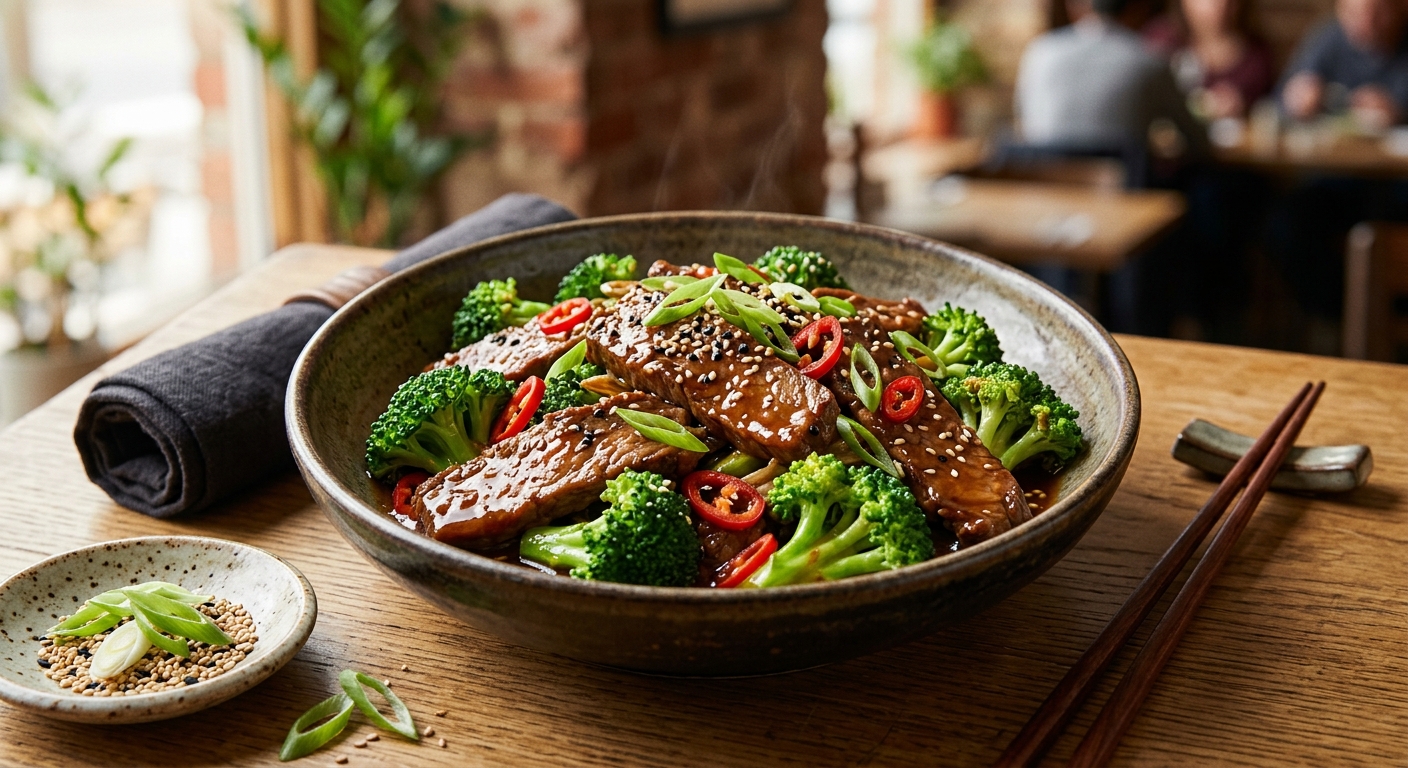
Few dishes earn the phrase “nutritional powerhouse” as honestly as a properly executed beef and broccoli stir-fry. Strip away the takeout box and look at the raw ingredients: grass-fed sirloin steak is one of the most bioavailable sources of heme iron and zinc on the planet, and broccoli contributes a meaningful dose of non-heme iron alongside its celebrated vitamin C content, which actively boosts iron absorption by up to 67% when the two are consumed together. This is nutritional synergy by design, not accident.
At Calibrated Cuisine, we built this recipe around 450 grams of sirloin per four servings, hitting 9 mg of iron and 7.2 mg of zinc per plate before you even factor in the broccoli. The sauce uses low-sodium soy sauce, oyster sauce, and a touch of sesame oil, delivering glutamate-rich umami depth without excess sodium. The cornstarch velveting technique, borrowed from Cantonese restaurant kitchens, tenderises the beef at the protein level and gives each slice a silky coating that clings sauce perfectly. This is a recipe that respects both your palate and your body.
We have tested this across three cooking methods because life is not always lived at a wok station. The stovetop version delivers the authentic wok hei char and crisp broccoli texture the dish was designed around. The slow cooker version transforms the same ingredients into a deeply braised, fall-apart beef preparation that works beautifully over brown rice for meal prep. The pressure cooker sits in between, producing tender beef in under 20 minutes. All three versions meet the same mineral targets per serving.
4
servings
Ingredients
- 450 gbeef sirloin or flank steak, sliced 3mm thin against the grain
- 500 gbroccoli florets (about 1 large head), cut into bite-sized pieces
- 3 tbsplow-sodium soy sauce, divided
- 2 tbspoyster sauce
- 1 tbsphoisin sauce
- 1 tbsptoasted sesame oil
- 2 tbspcornstarch, divided
- 120 mllow-sodium beef broth
- 1 tbspShaoxing rice wine (or dry sherry)
- 1 tspwhite sugar
- 1 tspfresh ginger, finely grated
- 4 clovesgarlic, minced
- 2 tbspAvocado Oil100% Pure Avocado Oil (avocado or grapeseed), divided
- 1 tspwhite sesame seeds, for garnish
- 2 stalksgreen onions, thinly sliced on the diagonal, for garnish
- —Colima Sea SaltMicroplastic Free Salt and white pepper to taste
Instructions
Click on an item below to shop for the recommended items for this recipe on Amazon.
As an Amazon Associate, we earn from qualifying purchases.
- In a medium bowl, combine the sliced beef with 1 tablespoon soy sauce, 1 tablespoon cornstarch, and a pinch of white pepper. Toss until every slice is evenly coated. Set aside to velvet for at least 15 minutes at room temperature. This cornstarch layer seals in moisture and creates a silky texture.
- Whisk together the sauce: remaining 2 tablespoons soy sauce, oyster sauce, hoisin sauce, beef broth, Shaoxing wine, sugar, and the remaining 1 tablespoon cornstarch in a small bowl until smooth and lump-free. Set near the stove.
- Bring a medium saucepan of lightly salted water to a boil. Blanch the broccoli florets for exactly 90 seconds, then drain and immediately transfer to a bowl of ice water for 1 minute to stop cooking. Drain thoroughly and pat dry. This parcooks the broccoli evenly and preserves its vivid green colour and vitamin C content.
- Heat your wok or skillet over the highest heat your burner allows for at least 2 minutes until it begins to smoke lightly. Add 1 tablespoon neutral oil and swirl to coat. Add the beef in a single layer (cook in two batches if needed). Sear without moving for 60 to 90 seconds until a deep brown crust forms on the underside, then toss and cook 30 seconds more. The beef should still be slightly pink inside at this point. Transfer to a clean plate.
- Return the wok to high heat and add the remaining 1 tablespoon oil. Add the garlic and ginger and stir-fry for 20 seconds until fragrant but not browned. Add the blanched broccoli and toss for 90 seconds until heated through and slightly glossed.
- Re-whisk the sauce, pour it into the wok, and bring to a boil, stirring constantly. The cornstarch will thicken the sauce within 30 to 45 seconds into a glossy, clingy glaze. Return the seared beef to the wok and toss everything together for 30 seconds until fully coated. Drizzle sesame oil over the top and remove from heat immediately.
- Transfer to a serving platter. Garnish with sesame seeds and sliced green onions. Serve immediately over steamed jasmine or brown rice.
- Cut the beef into larger pieces, roughly 4 cm chunks or 1 cm thick slices, rather than the thin strips used for stir-frying. In the slow cooker insert, whisk together 2 tablespoons soy sauce, oyster sauce, hoisin sauce, beef broth, Shaoxing wine, sugar, garlic, and ginger to form the braising liquid. Do not add cornstarch at this stage as it will not thicken properly over a long cook.
- Add the beef chunks to the slow cooker and toss to coat thoroughly in the sauce. Spread into an even layer. Cover and cook on Low for 3 hours 30 minutes to 4 hours, until the beef is very tender and pulling apart easily when pressed. Do not cook on High, as the higher temperature will seize the muscle fibers and produce tough, dry beef.
- About 30 minutes before the end of the cook time, steam the broccoli florets in a separate steamer basket over boiling water for 4 to 5 minutes, until just tender but still holding their structure. Do not add raw broccoli directly to the slow cooker, as the residual heat will overcook it to an army-green mush and destroy its vitamin C.
- In a small bowl, whisk together 2 tablespoons cornstarch with 3 tablespoons cold water until completely smooth. Remove the slow cooker lid and stir the cornstarch slurry into the beef cooking liquid. Replace the lid and cook on High for a further 20 to 25 minutes until the sauce has thickened to a glossy consistency.
- Gently fold the steamed broccoli into the slow cooker, drizzle with sesame oil and the remaining 1 tablespoon soy sauce, and toss gently to coat everything in sauce. Serve over brown rice and garnish with sesame seeds and green onions.
- Select the Saute function on High. Add 1 tablespoon neutral oil and, once shimmering, add the beef slices (no marinating needed for this method, the pressure cook will tenderise them). Sear in batches for 60 seconds per side without crowding to build flavour base. Remove beef and set aside. This searing step is optional but adds important depth to the final sauce.
- Add the remaining tablespoon of oil to the pot. Add garlic and ginger and saute for 30 seconds, scraping up any browned bits from the beef with a wooden spoon to prevent a burn notice. Add beef broth, 2 tablespoons soy sauce, oyster sauce, hoisin sauce, Shaoxing wine, and sugar. Stir to combine. Return the seared beef to the pot and stir to coat.
- Cancel Saute mode. Lock the lid, set the valve to Sealing, and cook on Manual High Pressure for 8 minutes. While the pot builds pressure, cut the broccoli into florets and set aside in a steamer basket that fits inside or over your pot.
- When the timer ends, perform a Quick Release by carefully switching the valve to Venting. Wait until all steam has fully escaped before opening. The beef should be very tender. Remove the beef with a slotted spoon and set aside briefly. Select Saute on High and bring the braising liquid to a rapid boil.
- Whisk the 2 tablespoons cornstarch with 3 tablespoons cold water until smooth, then pour the slurry into the boiling liquid while stirring constantly. The sauce will thicken within 60 to 90 seconds. Immediately cancel Saute to prevent over-thickening.
- Place the steamer basket of broccoli florets directly above the liquid inside the pot. Replace the lid without locking it and let the residual heat steam the broccoli for 3 to 4 minutes, until bright green and just tender. This uses the pot’s residual steam rather than any additional water.
- Return the beef to the pot, drizzle with sesame oil and the remaining tablespoon of soy sauce, and toss gently. Serve immediately over rice, garnished with sesame seeds and green onions.
- Preheat your oven to 230C (450F) with the rack in the upper third position. Line a large rimmed sheet pan with aluminium foil and place a wire rack on one half of it. The wire rack side is for the beef; the flat foil side is for the broccoli.
- In a medium bowl, toss the sliced beef with 1 tablespoon soy sauce, 1 tablespoon cornstarch, 1 teaspoon neutral oil, and white pepper. Marinate for 15 minutes. Meanwhile, in a separate large bowl, toss the broccoli florets with 1 tablespoon neutral oil, a pinch of salt, and half the garlic. Spread in a single layer on the foil half of the sheet pan.
- Lay the marinated beef slices in a single layer across the wire rack, ensuring no pieces overlap. Overlapping creates steam, which prevents caramelisation. Place the sheet pan in the upper oven rack and roast for 10 minutes.
- After 10 minutes, use tongs to flip each beef piece and toss the broccoli. Return to the oven for a further 10 to 12 minutes, until the beef edges are charred and caramelised and the broccoli has lightly crisped, bronzed floret tips. Watch carefully in the last 3 minutes.
- While the sheet pan is in the oven, prepare the sauce on the stovetop. Combine remaining soy sauce, oyster sauce, hoisin, beef broth, Shaoxing wine, sugar, ginger, and remaining garlic in a small saucepan over medium heat. Bring to a simmer, then whisk in the remaining 1 tablespoon cornstarch mixed with 2 tablespoons cold water. Cook, stirring, for 90 seconds until the sauce is thick and glossy. Drizzle in sesame oil and remove from heat.
- Transfer the roasted beef and broccoli to a large bowl or serving platter. Pour the hot sauce over the top and toss to coat everything evenly. The high-heat caramelised surfaces grip the sauce exceptionally well. Garnish with sesame seeds and green onions, and serve immediately over steamed rice.
Nutrition Breakdown
Per 1 serving (makes 4)
Vitamins & Minerals
% Daily Value based on a 2,000 calorie diet (FDA reference)
🧬 Essential Amino Acids
% of recommended daily intake (RDA) per serving
🛡 Antioxidant Profile
The Nutrition Science
The iron story in this dish is one of smart food combining. Sirloin steak provides heme iron, the form found only in animal tissue, which is absorbed at a rate of 15 to 35% regardless of other dietary factors. Broccoli adds non-heme iron, typically absorbed at only 2 to 10%, but the 98 mg of vitamin C per serving dramatically shifts that equation. Vitamin C reduces ferric iron (Fe3+) to ferrous iron (Fe2+) in the gut lumen, the form that binds directly to the DMT-1 transporter on intestinal enterocytes, increasing non-heme absorption by as much as 67% in controlled studies. Eating them together, as this recipe does, is not a culinary coincidence but an evidence-based pairing.
Zinc absorption from beef is similarly efficient, again because of the heme matrix. Approximately 40% of zinc in red meat is absorbed, compared to 15 to 25% from plant foods, owing to lower phytate interference. At 7.8 mg per serving, this dish meets over 70% of the daily value for zinc, a mineral essential for over 300 enzymatic reactions, immune cell proliferation, and the activity of superoxide dismutase, one of the body’s most important antioxidant enzymes. Zinc deficiency is among the most widespread micronutrient deficiencies globally, making this dish genuinely corrective for a large portion of the population.
The broccoli’s sulforaphane content deserves its own discussion. Sulforaphane is not a direct antioxidant in the classical sense; instead, it activates the Nrf2 transcription factor, which upregulates the expression of the body’s endogenous antioxidant genes, including heme oxygenase-1, NAD(P)H quinone oxidoreductase, and multiple glutathione-S-transferase isoforms. This means the broccoli in this dish essentially programmes your cells to produce more of their own antioxidant machinery for 48 to 72 hours after consumption. Sulforaphane is formed from glucoraphanin when the broccoli cell walls are damaged by cutting or chewing, and brief blanching (as used in the stovetop method) preserves the myrosinase enzyme needed for this conversion better than long boiling does.
Pro Tips
- Slice the beef against the grain at a 45-degree angle for maximum tenderness. Freezing the steak for 20 minutes before slicing makes it firm enough to cut cleanly at 3mm thickness without special equipment.
- Do not skip the velveting step when using the stovetop method. The cornstarch and soy marinade forms a protective protein coating that keeps each slice moist at the high temperatures a wok reaches, which is the single biggest textural difference between restaurant beef and broccoli and a home version.
- For maximum sulforaphane yield, cut your broccoli at least 10 minutes before cooking and do not exceed 90 seconds of blanching. Both actions preserve myrosinase activity; the cutting activates glucoraphanin hydrolysis and a brief rest before heat allows conversion to proceed before the enzyme is denatured.
This is exactly what I’ve been looking for, thank you. I’m curious about the B12 content from the beef since that’s something I track closely for my MS protocol, and I’m assuming the sirloin cut you’re using hits that pretty well? The iron/zinc combo is huge for me too, especially on days when inflammation markers feel elevated. I’ll definitely be making this soon and will probably add some extra garlic and ginger to the sauce for the additional anti-inflammatory benefits. Really appreciate you breaking down the mineral density so clearly.
This is such a smart combo for mineral absorption too! Quick question though, since I’m always thinking about thyroid function, did you cook the broccoli all the way through or keep it crisp-tender? Raw and lightly cooked brassicas have more goitrogens, but a good sear or steam really minimizes that impact, and paired with the beef’s selenium and zinc you’re basically giving your thyroid everything it needs. I’ve found that high heat stir-frying actually works better than steaming for getting those benefits without the goitrogen concern, plus the umami sauce probably helps mineral bioavailability too.
ooh this is perfect for my post long run meal plan! ive been experimenting with whether red meat recovers my iron stores faster than chicken after high mileage weeks, and the zinc is huge for immune function when training load gets heavy. do you happen to know the cooking method, like is the beef seared high heat first or more of a stir fry the whole time? im wondering if the cook temp affects nutrient bioavailability or if thats more of a supplement thing. either way this is definitely hitting my rotation for next week!