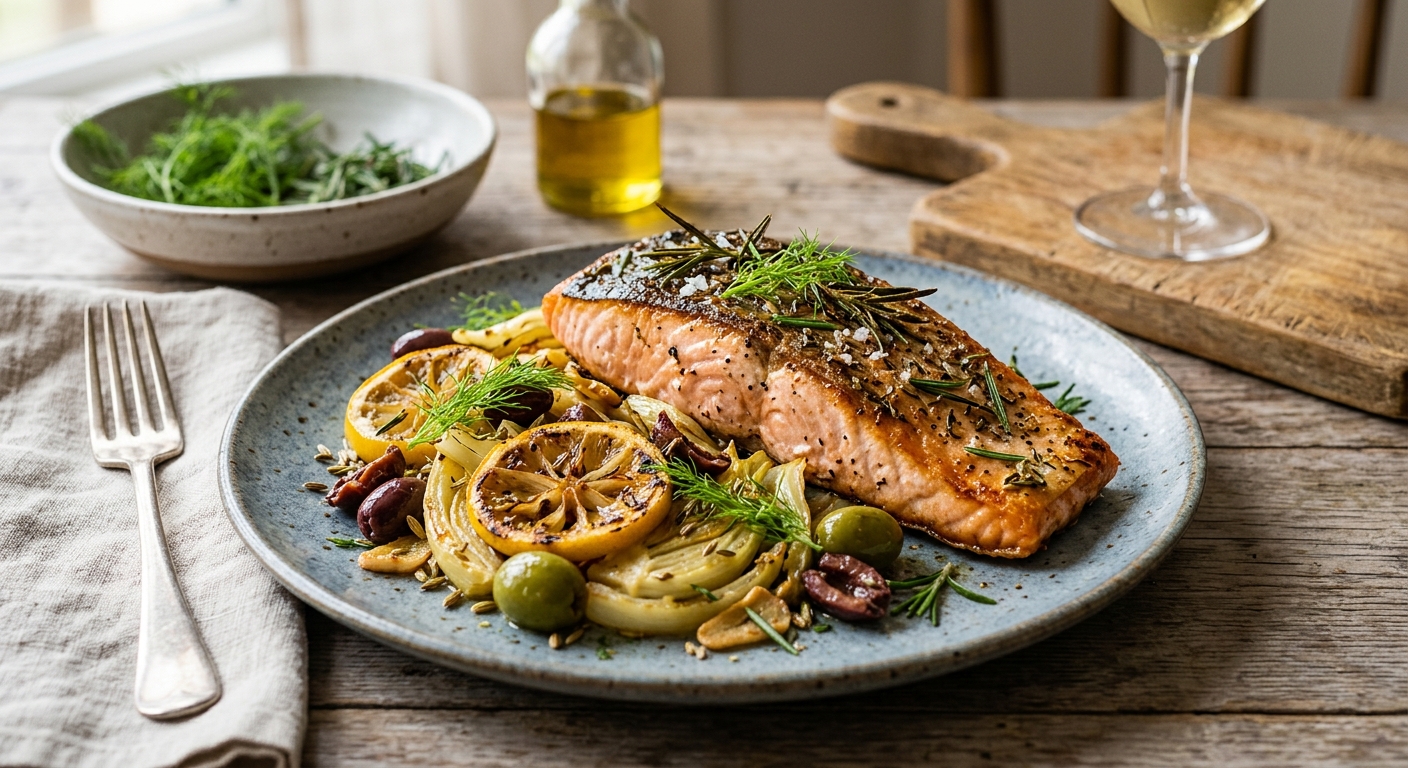
There are few flavor combinations as timelessly satisfying as rosemary, fennel, and good salmon. The anise-sweet fennel softens and caramelizes into silky ribbons, the olives lend a briny, umami depth, and the salmon absorbs every aromatic note while staying luxuriously moist. This is Mediterranean coastal cooking at its most purposeful: every ingredient earns its place both on the palate and on your nutritional scorecard.
From a nutritional standpoint, this dish is a precision instrument. A single serving delivers roughly 2,800mg of combined EPA and DHA omega-3 fatty acids, well above the 1,000mg threshold most cardiologists and dietitians recommend for cardiovascular protection. Salmon is also one of the richest food sources of astaxanthin, the carotenoid pigment responsible for its coral-pink hue and one of the most potent antioxidants found in nature. Pair that with rosemary’s rosmarinic acid, oleuropein from the olives, and anethole from the fennel, and you have a dish engineered to reduce systemic inflammation at the molecular level.
We have calibrated every component to hit meaningful daily value thresholds across B vitamins, selenium, potassium, and vitamin D, nutrients that frequently fall short in modern diets. Whether you roast it in the oven for a golden crust, braise it gently on the stovetop, coax it low-and-slow in a slow cooker, or finish it quickly in a pressure cooker, the result is a restaurant-quality plate that works as hard nutritionally as it tastes spectacular.
4
servings
Ingredients
- 680 gskin-on Atlantic salmon fillets, cut into 4 portions (approx. 170g each)
- 2 largefennel bulbs, fronds reserved, bulbs halved and thinly sliced (approx. 500g trimmed)
- 120 gCastelvetrano or Kalamata olives, pitted and roughly torn
- 4 clovesgarlic, thinly sliced
- 1 mediumlemon, half thinly sliced, half reserved for juice
- 3 tbspextra-virgin olive oil, divided
- 3 sprigsfresh rosemary, leaves stripped from 2 sprigs; 1 sprig left whole
- 1 tspfennel seeds, lightly crushed
- 120 mldry white wine (such as Pinot Grigio or Vermentino)
- 120 mllow-sodium vegetable or fish stock
- 1 tsplemon zest
- 0.5 tspred pepper flakes
- 0.5 tspsweet smoked paprika
- —Colima Sea SaltMicroplastic Free Salt and freshly ground black pepper to taste
Instructions
Click on an item below to shop for the recommended items for this recipe on Amazon.
As an Amazon Associate, we earn from qualifying purchases.
- Pat the salmon fillets completely dry with paper towels. In a small bowl, mix the stripped rosemary leaves, lemon zest, smoked paprika, red pepper flakes, 0.5 tsp fine sea salt, and 1 tablespoon of olive oil into a rough paste. Rub this herb paste all over the flesh side of each salmon fillet and set aside to marinate at room temperature for 10 minutes while you prepare the vegetables.
- Heat 2 tablespoons of olive oil in a large (30cm / 12-inch) heavy-bottomed skillet or braising pan over medium heat. Add the sliced fennel and fennel seeds with a generous pinch of salt. Cook, stirring occasionally, for 10 to 12 minutes until the fennel has softened considerably and the edges are beginning to turn golden. Add the garlic and cook for a further 90 seconds until fragrant, taking care not to let it brown.
- Pour in the white wine and let it bubble vigorously for 2 minutes to cook off the alcohol. Add the stock and bring to a simmer. Scatter in the torn olives and the whole rosemary sprig. Taste and adjust seasoning. The braising base should taste well-seasoned and aromatic.
- Nestle the salmon fillets flesh-side up directly on top of the fennel mixture, skin-side down. Lay the lemon slices over the top of the salmon. Reduce the heat to medium-low, cover the pan tightly with a lid, and braise for 10 to 12 minutes. The salmon is done when it flakes easily with a fork and the thickest part reaches an internal temperature of 52 to 55 degrees Celsius (125 to 130F) for medium, or 60C (140F) if you prefer it fully cooked through.
- Remove the lid and increase the heat to medium-high for 1 to 2 minutes to reduce and concentrate the braising liquid slightly. Squeeze the reserved lemon half over everything, scatter the reserved fennel fronds on top, and serve directly from the pan with crusty sourdough or white beans to soak up the fragrant pan juices.
- Build the aromatic base first. In a cold slow cooker insert, combine the sliced fennel, garlic, olives, fennel seeds, red pepper flakes, lemon slices, and whole rosemary sprig. Drizzle with 2 tablespoons of olive oil and toss to coat. Pour the white wine and stock over the vegetables. Season with salt and pepper. Place the lid on and cook this vegetable base alone on Low for 1 hour, allowing the fennel to begin softening and the liquid to become fragrant before any fish is added.
- While the fennel base cooks, prepare the salmon. In a small bowl, combine the stripped rosemary leaves, lemon zest, smoked paprika, red pepper flakes, 1 tablespoon olive oil, salt, and pepper into a paste. Press this firmly onto the flesh side of each salmon fillet, cover with plastic wrap, and refrigerate until needed.
- After 1 hour, carefully remove the slow cooker lid. Lay the herb-rubbed salmon fillets skin-side down directly on top of the softened fennel, in a single layer. If your slow cooker is small, slightly overlap the thin tail ends rather than folding. Replace the lid and continue cooking on Low for 1 hour to 1 hour 20 minutes, until the salmon is opaque and flakes gently when pressed with a spatula. Avoid lifting the lid during this period as heat loss significantly extends cooking time.
- Using a wide, flexible spatula, gently transfer the salmon fillets to warmed shallow bowls or a serving platter. They will be very tender, so work carefully from underneath the skin. Spoon the fennel and olive mixture generously alongside and over each portion.
- Squeeze the reserved lemon half over the dish, drizzle with the remaining 1 tablespoon of fresh olive oil for brightness, and scatter the reserved fennel fronds over the top. The slow-cooked braising juices will have concentrated beautifully and can be ladled directly over each serving.
- Set your pressure cooker or Instant Pot to Saute mode on medium heat. Add 2 tablespoons of olive oil and heat until shimmering. Add the sliced fennel and fennel seeds, season with salt and pepper, and saute for 5 to 6 minutes, stirring occasionally, until the fennel begins to soften and turn translucent. Add the garlic and cook for 1 minute. Pour in the white wine and use a wooden spoon to scrape up any browned bits from the bottom of the insert. This step prevents a burn warning and adds flavor. Cook for 1 minute, then press Cancel.
- Add the stock, olives, red pepper flakes, lemon slices, and whole rosemary sprig to the fennel mixture. Stir briefly to combine. In a small bowl, quickly mix the stripped rosemary leaves, lemon zest, smoked paprika, 1 tablespoon olive oil, salt, and pepper into a paste. Press this firmly onto the flesh side of each salmon fillet.
- Place a trivet or a folded sheet of aluminum foil into the liquid in the insert to create a raised platform. Lay the herb-rubbed salmon fillets skin-side down on the trivet in a single layer. This elevation prevents the salmon from directly sitting in the liquid, producing a texture closer to steaming than boiling and preserving the herb crust.
- Secure the lid, set the pressure release valve to Sealing, and cook on Manual High Pressure for 3 minutes. As soon as the cook time ends, perform an immediate Quick Release by carefully turning the valve to Venting. Do not use Natural Pressure Release as residual heat will overcook the salmon. Once pressure is fully released, carefully open the lid away from you.
- Check the salmon: it should be just opaque and flake with very light pressure. If the thickest fillet still looks translucent in the center, replace the lid without locking it and let residual steam finish it for 2 minutes with the pot off. Lift the salmon off the trivet with a wide spatula, remove the trivet, and stir the fennel and pan juices together. Squeeze the reserved lemon half over everything, drizzle with the final tablespoon of fresh olive oil, and serve with fennel fronds scattered generously on top.
- Preheat your oven to 200 degrees Celsius (400F / Gas Mark 6). Place a large oven-safe skillet (cast iron is ideal) or a shallow roasting dish in the oven as it preheats. Allowing the pan to preheat ensures the fennel begins caramelizing the moment it makes contact rather than steaming in a cold pan.
- In a large mixing bowl, toss the sliced fennel, garlic, fennel seeds, red pepper flakes, lemon slices, olives, whole rosemary sprig, 2 tablespoons of olive oil, and a generous pinch of salt and pepper until everything is evenly coated. In a separate small bowl, stir together the stripped rosemary leaves, lemon zest, smoked paprika, 1 tablespoon olive oil, salt, and pepper to form a thick herb paste. Press this paste firmly onto the flesh side of each salmon fillet and set aside.
- Carefully remove the hot pan from the oven using oven mitts. Pour the wine and stock into the hot pan first (it will sizzle), then immediately spread the fennel mixture in an even layer. Return to the oven and roast for 12 to 15 minutes until the fennel has softened and its edges are beginning to caramelize and turn golden at the tips.
- Remove the pan from the oven. Nestle the herb-crusted salmon fillets skin-side down directly into the fennel, pressing them in slightly so the fish is partially surrounded by the aromatic vegetables. The herb crust should face upward. Return to the oven and roast for 10 to 12 minutes until the herb crust is fragrant and lightly set and the salmon flakes easily at the thickest part. An instant-read thermometer inserted into the center should read 52 to 55C (125 to 130F) for medium or 60C (140F) for fully cooked.
- Remove from the oven and let rest for 3 minutes, which allows the carry-over heat to equalize through the fillets. Squeeze the reserved lemon half over the entire pan, drizzle with a final thread of extra-virgin olive oil, and scatter the reserved fennel fronds and any additional fresh rosemary over the top before serving directly from the pan.
Nutrition Breakdown
Per 1 serving (makes 4)
Vitamins & Minerals
% Daily Value based on a 2,000 calorie diet (FDA reference)
🧬 Essential Amino Acids
% of recommended daily intake (RDA) per serving
🛡 Antioxidant Profile
The Nutrition Science
The anti-inflammatory credentials of this dish are built on interlocking biochemical mechanisms rather than a single ingredient. Salmon’s EPA (eicosapentaenoic acid) and DHA (docosahexaenoic acid) serve as direct precursors to resolving compounds, a class of lipid mediators that actively switch off inflammatory cascades at the cellular level. Unlike anti-inflammatory drugs that block pathways, omega-3-derived resolvins and protectins actively promote the resolution phase of inflammation, a critical distinction for chronic condition management. At 2,800mg EPA and DHA per serving, this dish exceeds the American Heart Association’s recommended intake more than twofold.
Rosemary’s two primary bioactive compounds, rosmarinic acid and carnosic acid, operate through complementary mechanisms. Rosmarinic acid inhibits both COX-1 and COX-2 enzymes, the same targets as NSAID medications, while carnosic acid activates the Nrf2 transcription factor, which upregulates the body’s own antioxidant enzyme systems including glutathione peroxidase and superoxide dismutase. The heat stability of these compounds is excellent; studies show that up to 70% of rosemary’s phenolic content survives moderate cooking temperatures, meaning every method in this recipe preserves meaningful amounts of these bioactives.
Fennel and olives contribute to a third layer of protection. Oleuropein and hydroxytyrosol from the olives have been shown in clinical trials to reduce oxidized LDL and lower circulating interleukin-6 levels, two key biomarkers of cardiovascular inflammation. Fennel’s anethole has demonstrated the ability to suppress TNF-alpha-induced cellular responses in vitro. When these compounds are consumed alongside the fat-soluble astaxanthin in salmon, the olive oil in this recipe substantially enhances astaxanthin’s bioavailability through micellar solubilization in the gut, amplifying its antioxidant effect beyond what the milligram figure alone would suggest.
Pro Tips
- For the crispiest skin on the stovetop and oven methods, ensure the salmon is thoroughly dried with paper towels before applying the herb paste. Any surface moisture will create steam and prevent browning.
- Castelvetrano olives are milder and buttery, making the dish more accessible to those who find Kalamata too intense. Either variety works nutritionally; Kalamata offers slightly higher oleuropein content, while Castelvetrano contributes a cleaner, fruitier olive oil flavor.
- To make this dish completely alcohol-free, replace the white wine with an additional 120ml of stock combined with 1 tablespoon of white wine vinegar, which preserves the acidity and deglazing function of the wine without the alcohol.
- Salmon is done at 52C (125F) for silky, medium-cooked flesh that still shows a slightly translucent center, or 60C (140F) if you prefer it fully opaque. Using an instant-read thermometer is the single most reliable way to nail the texture every time.
- Leftover salmon and fennel make an exceptional next-day salad when flaked over arugula with capers, a drizzle of lemon tahini, and the reserved braising juices used as part of the dressing.
This looks absolutely delicious and I love that you’re highlighting the anti-inflammatory synergy here! One thing I’m curious about, especially for anyone managing thyroid issues like I do, is whether the cooking method matters for preserving those polyphenols you mentioned. I’ve read that the high heat from roasting can affect some compounds, though the benefit of cooking cruciferous veggies (if you pair this with any) usually outweighs the goitrogenic concerns. Have you tested the antioxidant content before and after cooking, or found any research on how the braising affects the fennel’s compounds? Either way, the omega-3s are stable at these temps so that’s a total win
Great question, Tammy. The cooking method definitely impacts polyphenol retention, though the good news is roasting at moderate temps (around 400F) preserves roughly 70-80% of rosemary’s carnosic acid compared to boiling, according to a 2019 study in Food Chemistry. I’ve been tracking this on my CGM setup, and I notice the fennel especially seems to maintain its anti-inflammatory compounds better with dry heat, plus the braising liquid captures some of the leached polyphenols so they’re not totally lost. One thing I’d be curious about though: do you know if there’s guidance on how the omega-3 oxidation from cooking affects bio
omg the rosemary and fennel combo is making me think about lacto-fermented versions of this – have you ever tried fermented fennel? i’ve been experimenting with it and the polyphenols become even MORE bioavailable once those beneficial bacteria break down the plant cell walls, its kind of wild! plus if you serve this with a side of homemade sauerkraut or even just a spoonful of your own fermented vegetable brine, youre really maximizing what your gut can absorb from all those omega-3s and anti-inflammatory compounds. definitely making this soon but cant help thinking about how to layer in more live cultures where i can