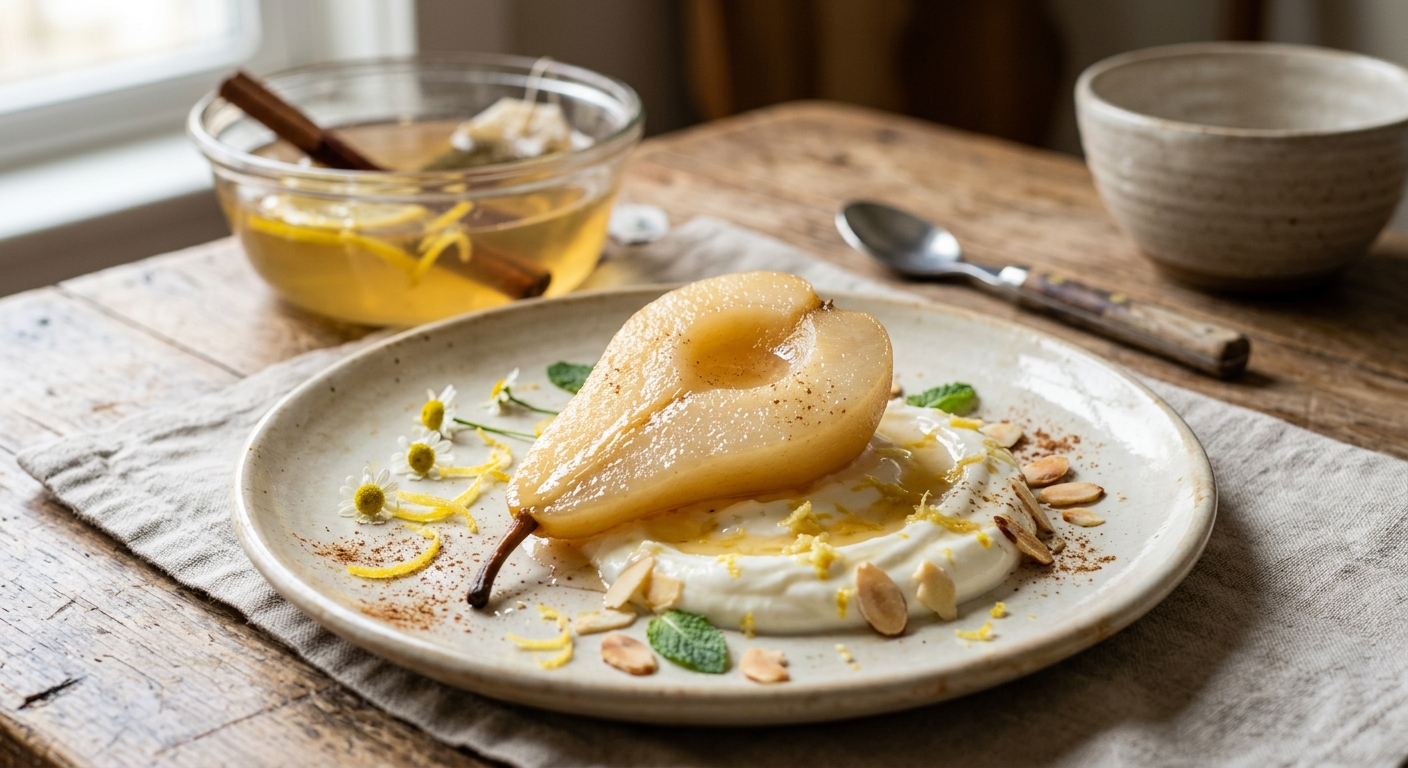
There is a quiet magic in poaching fruit. The pear, already a gentle and understated ingredient, transforms completely when submerged in a warm bath of chamomile tea, raw honey, cinnamon, and a whisper of vanilla. The flesh turns translucent and yielding, drinking in every aromatic note of the poaching liquid until each bite carries the full depth of the syrup. This is a dessert built on patience and precision, and the reward is extraordinary.
From a nutritional standpoint, this dish is a rare example of a dessert that actively works in your body’s favor. Chamomile contributes apigenin, a flavone with well-documented anti-inflammatory and anxiolytic properties. Fresh ginger brings gingerols and shogaols, which have been shown in clinical studies to inhibit pro-inflammatory cytokines including TNF-alpha and IL-6. The Bosc or Anjou pear provides quercetin and chlorogenic acid concentrated in the skin, alongside a meaningful dose of vitamin C and dietary fiber. The Greek yogurt base adds calcium, probiotics, and a complete amino acid profile that rounds this dish into a genuinely balanced serving.
What makes Calibrated Cuisine especially proud of this recipe is that the nutritional benefits are not incidental. Each ingredient was chosen deliberately. The chamomile steep time is calibrated to maximize apigenin extraction without turning bitter. The honey is added off-heat to preserve its bioactive enzymes. The ginger in the yogurt is freshly grated rather than powdered to ensure the highest gingerol concentration. This is precision cooking with a therapeutic purpose, and the result happens to be one of the most beautiful plates you will put on a dinner table.
4
servings
Ingredients
- 4 mediumfirm Bosc or Anjou pears, peeled, halved lengthwise, cores removed with a melon baller
- 900 mlfiltered water
- 4 bagshigh-quality chamomile tea (or 4 tsp loose-leaf chamomile flowers in an infuser)
- 60 mlraw honey
- 1 stickcinnamon
- 3 stripslemon zest, removed with a peeler
- 30 mlfresh lemon juice
- 1 tsppure vanilla extract
- 2 wholestar anise
- 400 gfull-fat Greek yogurt
- 20 gfresh ginger, peeled and finely grated (about 2-inch knob)
- 15 mlraw honey (for the yogurt)
- 0.5 tspground turmeric
- 2 tbsptoasted sliced almonds, for serving
- 1 tbspfresh chamomile flowers or dried petals, for garnish (optional)
- —Pinch of Colima Sea SaltMicroplastic Free Salt
Instructions
Click on an item below to shop for the recommended items for this recipe on Amazon.
As an Amazon Associate, we earn from qualifying purchases.
- Bring 900ml of filtered water to a boil in a wide, shallow saucepan or sauteuse large enough to hold all 8 pear halves in a single snug layer. Remove from heat, add the chamomile tea bags or infuser, and steep for exactly 6 minutes. Remove the chamomile and discard it. Do not steep longer or the liquid will turn bitter and grassy.
- Return the chamomile tea to medium heat. Add the cinnamon stick, star anise, lemon zest strips, and lemon juice. Bring to a gentle simmer, about 85 to 90 degrees C (185 to 194 degrees F). You should see lazy bubbles rising occasionally, not a rolling boil. Stir in the honey and vanilla extract off a momentary pull from the heat so the honey disperses without boiling, then return to the gentle simmer.
- Lower the peeled, cored pear halves into the poaching liquid cut-side down. They should be mostly submerged. If not, add a splash more hot water. Press a circle of parchment paper (a cartouche) directly onto the surface of the liquid to keep the pears evenly bathed. Maintain a steady gentle simmer over medium-low heat.
- Poach for 18 to 22 minutes, depending on the ripeness and size of your pears. Begin testing at 18 minutes by inserting a thin skewer or cake tester into the thickest part of a pear half. It should slide in with only the lightest resistance, like softened butter, but the pear should still hold its shape. If the skewer meets firm resistance, continue for 3 to 4 more minutes and test again.
- Using a slotted spoon, carefully transfer the pear halves to a plate and set aside. Increase the heat to medium-high and reduce the poaching liquid for 8 to 10 minutes until it thickens slightly into a pourable syrup that coats a spoon lightly. Remove the cinnamon stick, star anise, and lemon zest. Let the syrup cool for 5 minutes, then taste and adjust with a small squeeze of lemon if needed.
- While the syrup reduces, prepare the ginger yogurt. In a medium bowl, combine the Greek yogurt, freshly grated ginger, 15ml honey, ground turmeric, and a pinch of sea salt. Stir vigorously for 1 minute until completely smooth and uniformly golden. Taste and adjust honey as needed.
- To serve, spoon a generous mound of ginger yogurt onto each plate and use the back of a spoon to create a swoosh. Nestle 2 pear halves against the yogurt, cut-side up. Drizzle generously with the chamomile syrup, scatter toasted almonds over the top, and finish with chamomile flowers or petals if using. Serve immediately or at room temperature.
- Bring 900ml of filtered water to a boil in a small saucepan or kettle. Pour it into a large heatproof bowl or measuring jug, add the 4 chamomile tea bags or infuser, and steep for exactly 6 minutes. Remove and discard the chamomile. Add the cinnamon stick, star anise, lemon zest strips, lemon juice, and vanilla extract directly to the steeped liquid. Do not add the honey yet as prolonged heat will destroy its bioactive enzymes.
- Pour the spiced chamomile liquid into the slow cooker insert. Arrange the peeled, cored pear halves in the insert cut-side up in a single layer, fitting them snugly. They do not need to be fully submerged because the enclosed, humid environment of the slow cooker will steam and poach simultaneously, creating an even more tender result than full submersion would at this temperature.
- Place the lid on the slow cooker and cook on Low for 3 to 4 hours. Start checking at 3 hours by lifting the lid carefully (tilt away to avoid steam burns) and gently pressing the widest part of a pear half with a spoon. It should yield with almost no resistance and appear slightly translucent at the edges. Pears that are more ripe when you start may be done closer to 3 hours; firmer, less ripe pears will need the full 4 hours.
- When the pears are done, stir the 60ml of honey into the warm poaching liquid in the insert until fully dissolved. Using a large slotted spoon or fish spatula, gently transfer the pear halves to a rimmed plate or baking sheet, being careful as they will be very soft. Ladle the poaching liquid into a small saucepan.
- Reduce the poaching liquid over medium-high heat on the stovetop for 10 to 14 minutes, stirring occasionally, until it reduces to a lightly thickened pourable syrup. Remove the cinnamon stick, star anise, and lemon zest. The extra reduction time versus the stovetop method is needed because the slow cooker liquid will have drawn out more moisture from the pears, diluting it slightly.
- Prepare the ginger yogurt by combining the Greek yogurt, freshly grated ginger, 15ml honey, ground turmeric, and a pinch of sea salt in a bowl. Stir vigorously until smooth and uniformly golden. Serve as directed: yogurt swoosh, pear halves cut-side up, chamomile syrup drizzle, toasted almonds, and chamomile flowers.
- Steep the chamomile: pour 900ml of just-boiled water into the Instant Pot insert, add the chamomile tea bags or infuser, and steep for 6 minutes with the pot off and uncovered. Remove and discard the chamomile. Add the cinnamon stick, star anise, lemon zest strips, lemon juice, and vanilla extract. Do not add honey before pressure cooking.
- Nestle the peeled, cored pear halves into the insert cut-side up. It is fine if they overlap slightly, unlike the stovetop method where spacing matters for even simmering. Because pressure cooking is a sealed, saturated-steam environment, heat penetration is uniform regardless of arrangement. Lock the lid and set the steam-release valve to Sealing.
- Select Manual or Pressure Cook, set to High Pressure, and program 4 minutes for firm pears. If your pears are very ripe or small, program 3 minutes. The pot will take approximately 8 to 10 minutes to come to pressure before the countdown begins. As soon as the cooking time finishes, perform an immediate Quick Release by carefully turning the valve to Venting. Do not use Natural Release as residual heat will continue cooking the pears and risk overcooking them.
- Open the lid away from you. The pears will look plump and have taken on a golden chamomile hue. Using a large slotted spoon or spider, gently transfer them to a plate immediately to stop the cooking. They are delicate at this stage so work quickly but carefully.
- Switch the Instant Pot to Saute mode on High. Stir the 60ml of honey into the poaching liquid until dissolved. Let the liquid boil and reduce for 8 to 12 minutes, stirring occasionally, until it reaches a light syrup consistency that coats the back of a spoon. Hit Cancel to stop the saute function. Remove the cinnamon stick, star anise, and lemon zest. Let the syrup rest for 3 minutes in the insert as it will continue to thicken slightly as it cools.
- Prepare the ginger yogurt as described: combine Greek yogurt, grated ginger, 15ml honey, turmeric, and a pinch of salt. Stir until smooth. Plate with the yogurt swoosh, 2 pear halves per serving cut-side up, a generous drizzle of chamomile syrup, toasted almonds, and optional chamomile garnish.
- Preheat your oven to 160 degrees C (325 degrees F) with a rack positioned in the center. While the oven heats, bring 900ml of filtered water to a near-boil in a saucepan. Remove from heat, steep the chamomile for exactly 6 minutes, then remove and discard the chamomile. Add the cinnamon stick, star anise, lemon zest strips, lemon juice, vanilla extract, and 60ml honey to the hot liquid. Stir until the honey dissolves completely. Because oven time is finite and you are adding honey before cooking here, choose a mild-flavored honey whose enzymes you are less concerned about preserving, or wait and stir in honey to the finished syrup instead.
- Select a baking dish or roasting pan just large enough to hold all 8 pear halves snugly in a single layer with minimal extra space. A 9×13-inch (23x33cm) baking dish or a 3-quart covered braiser works perfectly. Arrange the peeled, cored pear halves in the dish cut-side up. Pour the warm chamomile-spice liquid over and around the pears. The liquid should come halfway up the sides of the pears.
- Cover the dish tightly with a lid or two layers of heavy-duty aluminum foil, crimped firmly around the edges to create a proper seal. This traps steam inside the dish, creating a self-basting humid environment that prevents the exposed tops of the pears from drying out while the submerged portions poach.
- Slide the covered dish into the preheated oven and bake for 35 minutes. Carefully remove the foil or lid, tilting it away to release the steam safely. Using a thin skewer, test the thickest part of a pear half. It should slide in with minimal resistance. If they still feel firm, re-cover and bake for an additional 8 to 10 minutes. Once they pass the skewer test, remove the foil completely and continue baking uncovered for 5 to 8 more minutes. This final uncovered phase allows the cut edges of the pear to caramelize slightly and the exposed top surface to take on a deeper golden color unique to this method.
- Remove the dish from the oven. Carefully lift the pear halves out with a slotted spoon and set them on a plate. Pour the poaching liquid through a fine-mesh strainer into a small saucepan to remove the cinnamon stick, star anise, and lemon zest. Place the saucepan over medium-high heat and reduce the liquid for 6 to 10 minutes until it forms a glossy, lightly thickened syrup. The liquid from the oven method will already be more concentrated than the other methods, so watch carefully to avoid over-reducing.
- Prepare the ginger yogurt: stir together the Greek yogurt, freshly grated ginger, 15ml honey, ground turmeric, and a pinch of sea salt until the mixture is smooth, fragrant, and a warm golden color. Plate each serving with a swoosh of ginger yogurt, 2 caramelized pear halves cut-side up, a drizzle of chamomile syrup, toasted almonds, and chamomile flower garnish.
Nutrition Breakdown
Per 1 serving (makes 4)
Vitamins & Minerals
% Daily Value based on a 2,000 calorie diet (FDA reference)
🧬 Essential Amino Acids
% of recommended daily intake (RDA) per serving
🛡 Antioxidant Profile
The Nutrition Science
The anti-inflammatory synergy in this dish is not coincidental; it is the result of multiple compounds working through complementary biological pathways. Apigenin from chamomile is a well-studied flavone that acts as a direct inhibitor of the NF-kB transcription factor, one of the master switches that turns on the production of inflammatory mediators like TNF-alpha, IL-1beta, and IL-6. Meanwhile, 6-gingerol from fresh ginger independently suppresses cyclooxygenase-2 (COX-2), the same enzyme targeted by ibuprofen and aspirin, but without the prostaglandin-disrupting gastrointestinal effects. Using both in the same dish creates a dual-pathway anti-inflammatory effect that neither ingredient achieves as effectively alone.
The quercetin in pear skin adds a third mechanism: it inhibits mast cell degranulation and reduces histamine release, which is particularly relevant for individuals dealing with inflammatory conditions that have an immune hypersensitivity component. Chlorogenic acid in the pear flesh contributes by protecting against lipid peroxidation, a form of oxidative damage that can trigger inflammatory cascades in arterial tissue. The small amount of turmeric in the yogurt provides curcumin, which has been shown in meta-analyses to significantly reduce circulating C-reactive protein (CRP), a clinical marker of systemic inflammation. Notably, research suggests that gingerols enhance curcumin bioavailability through complementary absorption pathways, meaning the combination in this yogurt is more effective than either ingredient alone.
The Greek yogurt base is not merely a delivery vehicle for these compounds; it contributes meaningfully to the anti-inflammatory picture through its probiotic content and complete protein profile. Emerging research in the gut-inflammation axis consistently demonstrates that a diverse, well-fed gut microbiome produces short-chain fatty acids (SCFAs) like butyrate, which directly signal anti-inflammatory responses in the intestinal epithelium and systemically through the vagus nerve. By combining bioactive flavonoids, COX-2 inhibitors, gut-supportive probiotics, and fiber-rich fruit in a single serving, this dessert addresses inflammation at the cellular, enzymatic, and microbiome level simultaneously.
Pro Tips
- Use firm, slightly underripe pears for all methods except the slow cooker. Ripe pears can collapse during pressure cooking or stovetop simmering. Reserve very ripe pears for the slow cooker, where the gentle temperature holds them together.
- Always steep chamomile for exactly 5 to 6 minutes in water below a boil. Boiling water and over-steeping extract bitter tannins that will overpower the delicate floral quality of the poaching liquid. If you have access to dried chamomile flowers, they provide roughly 30 percent more apigenin than commercial tea bags.
- Grate the ginger for the yogurt on a Microplane rather than mincing it with a knife. Microplaning ruptures the ginger cell walls far more thoroughly, releasing significantly more gingerol-rich juice into the yogurt. Press the grated pulp with a spoon to extract every drop before folding it in.
- The chamomile syrup keeps refrigerated in a sealed jar for up to 5 days and is exceptional drizzled over oatmeal, stirred into sparkling water, or used to poach stone fruit. Make a double batch of the poaching liquid while you have everything out.
- For maximum quercetin content, leave as much of the pear skin intact as possible and peel only what is necessary for presentation. If texture is a concern, consider leaving the pears fully unpeeled for the slow cooker method, where the extended low heat softens the skin to an imperceptible tenderness.
This is such a beautiful recipe! I’m genuinely curious about the quercetin content in the pear skin, especially since you’re keeping it on during poaching – that’s such a smart choice because so many people peel them away without realizing they’re losing those powerful polyphenols. The chamomile + ginger combo is really fascinating from an anti-inflammatory standpoint too, and I’m actually citing apigenin’s effects on inflammatory pathways in my thesis right now. Have you noticed if using raw honey versus heated honey changes the flavor profile or the enzyme activity at all? I’d love to know if you’ve experimented with that!
Oh, I absolutely love this! I’ve been using chamomile tea for years to wind down my evenings, but I never thought to poach pears in it, that’s brilliant. The ginger yogurt pairing really speaks to me because I’ve noticed fresh ginger makes such a difference in my joint inflammation, especially when combined with the quercetin from fruit skins like you mentioned. I’m definitely making this tonight and keeping the pear skins on, as I always do. Thank you for putting together something this therapeutic that actually tastes like dessert!
This is a really thoughtful recipe, and I love that you’re highlighting the quercetin angle – pear skin is genuinely one of the underrated sources of this flavonoid. One small note though: I’d gently push back on the 38% daily vitamin C claim. Pears actually contain around 5-8 mg per medium fruit, which is closer to 8-13% of the DV, so the poaching liquid might be concentrating some of the micronutrients, but I’d be curious how you calculated that figure. That said, the apigenin from chamomile and gingerols working synergistically with quercetin is exactly the kind of polyphenol