
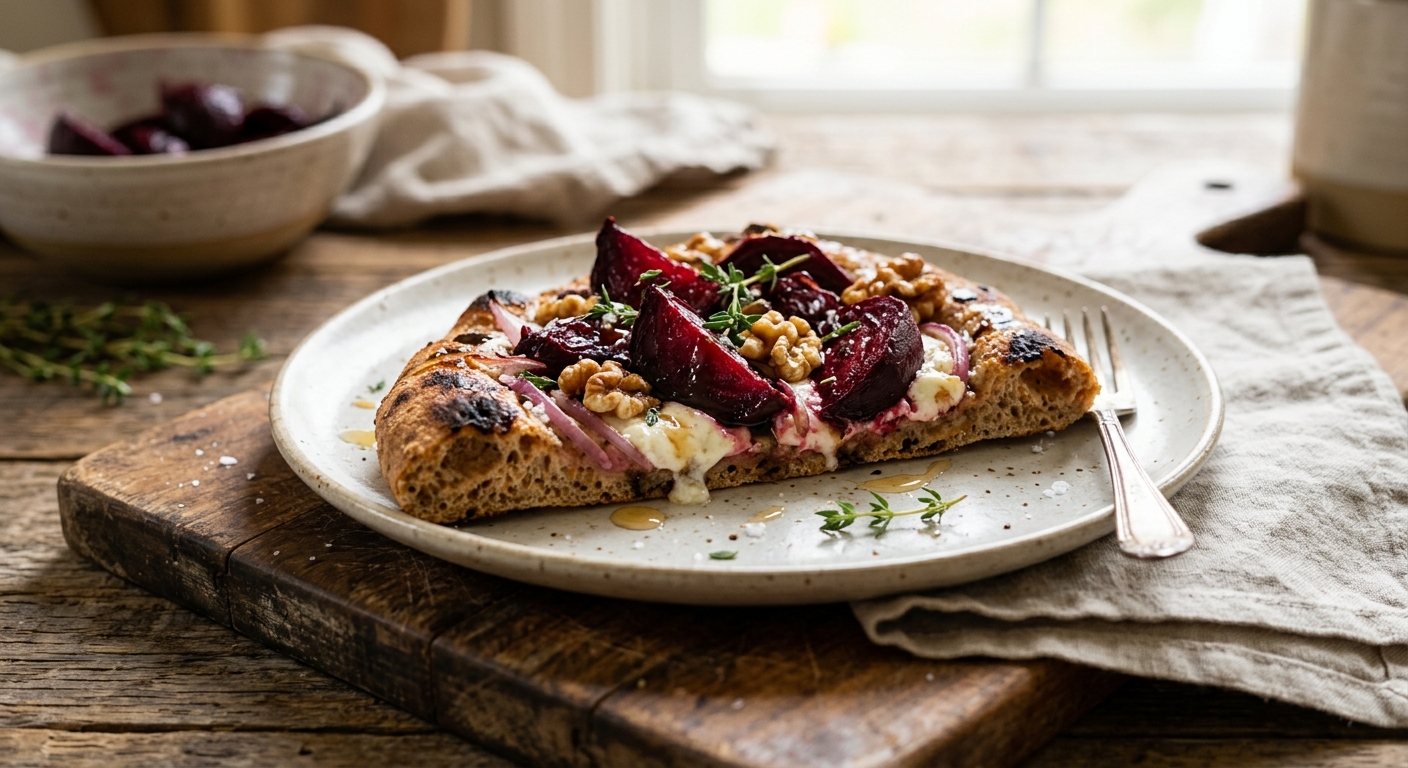
There is something almost alchemical about what heat does to a beet. Raw, it is dense and faintly sweet; roasted low and slow, it transforms into a jewel-toned, caramelised medallion with concentrated earthy depth that plays beautifully against the bright lactic tang of fresh goat cheese. Scatter a handful of walnuts over the top for crunch, a drizzle of raw honey and fresh thyme for fragrance, and you have a flatbread that looks as though it came from a wine-country bistro but costs a fraction of the price and is calibrated to a precise nutritional target.
The nutritional architecture of this dish is genuinely impressive. Beets are one of the richest dietary sources of folate, delivering roughly 148 mcg per 100 g of cooked root, while also contributing betalain pigments, the red-violet antioxidants responsible for their vivid colour and their documented ability to reduce circulating inflammatory markers. Walnuts pile on ellagitannins and alpha-linolenic acid, the plant-based omega-3 precursor associated with reduced C-reactive protein. Goat cheese, smaller in quantity than it tastes, rounds out the amino acid profile and contributes bioavailable calcium and riboflavin. Even the flatbread base, made with whole-wheat flour, adds fibre, selenium, and zinc that a refined-flour crust would forfeit.
We have developed four genuinely distinct preparation paths for the beet component, because the beet is the soul of this dish and how you cook it changes everything. The stovetop method simmers and then pan-sears the beets for concentrated flavour in under 40 minutes. The slow cooker coaxes out maximum sweetness over six to eight hours with almost zero hands-on effort. The pressure cooker delivers tender beets in under 20 minutes of total time. And the oven method, the classic approach, produces the deepest caramelisation and the most complex flavour profile. Choose your path, assemble the flatbread, and let science taste this good.
4
servings
Ingredients
- 500 gmedium red beets, scrubbed and trimmed (about 3 to 4 beets)
- 300 gstore-bought or homemade whole-wheat flatbread dough (or 4 pre-made flatbread bases, about 20 cm each)
- 120 gfresh soft goat cheese (chevre), crumbled
- 60 graw walnut halves
- 3 tbspextra-virgin olive oil, divided
- 1 tbspraw honey or pure maple syrup
- 2 tbspbalsamic vinegar
- 1 smallred onion, thinly sliced into half-moons
- 4 sprigsfresh thyme, leaves stripped
- 30 gfresh rocket (arugula), for finishing
- 1 tsplemon zest
- 120 mlwater (for stovetop and pressure cooker methods)
- —Colima Sea SaltMicroplastic Free Salt and freshly cracked black pepper to taste
- —Colima Sea SaltMicroplastic Free Salt for finishing (optional)
Instructions
Click on an item below to shop for the recommended items for this recipe on Amazon.
As an Amazon Associate, we earn from qualifying purchases.
- Place the whole scrubbed beets in a medium saucepan and cover with cold water by at least 5 cm. Add a generous pinch of salt and bring to a boil over high heat. Reduce to a steady simmer and cook uncovered for 20 to 25 minutes, until a paring knife slides into the thickest beet with only slight resistance. The beets should be just tender, not completely soft, as they will finish cooking in the skillet.
- While the beets simmer, toast the walnuts in a dry skillet over medium heat for 4 to 5 minutes, shaking the pan frequently, until fragrant and lightly golden. Transfer immediately to a cutting board and roughly chop once cool. Set aside. In the same skillet, warm 1 tablespoon of olive oil over medium-low heat, add the sliced red onion with a pinch of salt, and cook slowly for 10 to 12 minutes, stirring occasionally, until softened and lightly caramelised. Remove and set aside.
- Drain and cool the beets under cold running water for 2 minutes. Wearing kitchen gloves to prevent staining, rub the skins off with a paper towel or your hands. Slice the peeled beets into rounds approximately 5 mm thick.
- Wipe the skillet clean and set it over medium-high heat. Add 1 tablespoon of olive oil and heat until shimmering. Add the beet slices in a single layer, working in batches if needed, and sear for 2 to 3 minutes per side until edges are caramelised and slightly crisped. In the final 30 seconds, pour in the balsamic vinegar, swirl to coat, and remove the pan from heat. Season with salt and pepper.
- Preheat a separate large skillet or griddle over medium-high heat. Brush each flatbread base with the remaining tablespoon of olive oil. Cook the flatbreads one at a time for 2 minutes per side until lightly charred and crisp. Remove to a board, then immediately top each flatbread with caramelised onions, balsamic-glazed beet slices, crumbled goat cheese, and toasted walnuts. Drizzle with honey, scatter fresh thyme leaves and lemon zest, then finish with a small handful of fresh rocket. Season with flaky salt and cracked pepper before serving.
- Place the whole scrubbed and trimmed beets directly in the slow cooker insert. Add the balsamic vinegar, 120 ml of water, 4 thyme sprigs, and a generous pinch of salt. The liquid should come about 1 cm up the sides of the beets. Drizzle 1 tablespoon of olive oil over the top. Cover and cook on Low for 6 to 8 hours (or on High for 3 to 4 hours) until a skewer or paring knife pierces the largest beet cleanly with no resistance.
- About 20 minutes before the beets are done, spread the sliced red onion in a single layer on a microwave-safe plate with a small drizzle of olive oil and a pinch of salt. Microwave on high in 2-minute intervals, stirring between each, for 4 to 6 minutes total until softened and slightly translucent. Alternatively, cook the onion in a small skillet over low heat while the beets finish. Toast the walnuts in a dry skillet over medium heat for 4 to 5 minutes until fragrant, then rough-chop and set aside.
- Carefully remove the beets from the slow cooker using tongs and set aside to cool for 10 minutes. Reserve 2 tablespoons of the balsamic cooking liquid from the insert. Once cool enough to handle, rub off the skins under cold water using gloved hands or a paper towel. Slice the peeled beets into 5 mm rounds. Brush the slices with the reserved cooking liquid to re-glaze them.
- Heat a large oven-proof skillet or griddle over medium-high heat. Brush each flatbread with olive oil and cook for 2 minutes per side until lightly charred and crisp. Alternatively, if your flatbreads are pre-baked, warm them directly on a rack in a 200 C oven for 5 minutes.
- Top the warm flatbreads with the softened onions, slow-cooker beet rounds, crumbled goat cheese, and chopped toasted walnuts. Drizzle with honey, scatter the thyme leaves stripped from the reserved sprigs (or use fresh), and add lemon zest. Top with fresh rocket, a pinch of flaky salt, and cracked black pepper. Serve immediately.
- Pour 120 ml of water and 1 tablespoon of balsamic vinegar into the pressure cooker insert. Place a trivet or steamer basket in the insert and arrange the whole scrubbed beets on top. Seal the lid, set the valve to Sealing, and cook at High Pressure for 15 minutes. For very large beets (over 7 cm diameter), increase to 20 minutes. Allow a natural pressure release for 5 minutes, then carefully switch to Quick Release for the remaining pressure.
- While the pressure releases, set a dry skillet over medium heat and toast the walnuts for 4 to 5 minutes until fragrant, stirring often. Rough-chop and set aside. In the same skillet, heat 1 tablespoon of olive oil over medium heat, add the sliced red onion with a pinch of salt, and cook for 8 to 10 minutes until soft and lightly golden. Remove from heat.
- Open the lid and transfer the beets to a cutting board to cool for 5 minutes. Rub the skins off under cold running water using gloved hands. Slice the beets into 5 mm rounds. Switch the Instant Pot to Saute mode on High and let the residual liquid in the insert reduce for 2 to 3 minutes until it becomes a slightly thickened balsamic syrup. Add the beet slices to the insert, toss gently to coat in the glaze, and cook for 1 to 2 minutes until the edges just begin to caramelise. Hit Cancel and remove the beets.
- Heat a large skillet or griddle over medium-high heat. Brush each flatbread with the remaining olive oil. Cook 2 minutes per side until lightly charred and crisp with grill marks.
- Assemble immediately by layering the flatbreads with caramelised onions, pressure-cooked balsamic beet slices, crumbled goat cheese, and toasted walnuts. Drizzle honey over the top, scatter thyme leaves and lemon zest, then crown each flatbread with fresh rocket. Finish with flaky salt and freshly cracked black pepper.
- Preheat the oven to 200 C (400 F) with two racks positioned in the upper and lower thirds. Place the whole scrubbed beets on a large sheet of foil, drizzle with 1 tablespoon of olive oil and a pinch of salt, then wrap tightly into a sealed parcel. Place the parcel on the lower rack and roast for 45 to 50 minutes until a skewer pierces the largest beet with no resistance. Very large beets may require up to 60 minutes.
- After the beets have been roasting for 20 minutes, spread the sliced red onion on a rimmed baking sheet, drizzle with 1 tablespoon of olive oil, the balsamic vinegar, salt, and half the thyme leaves. Toss to coat and spread into an even layer. Place on the upper rack and roast for 20 to 25 minutes, stirring once halfway through, until the onions are jammy and caramelised at the edges.
- Spread the walnuts in a single layer on a small baking sheet or in a dry oven-proof skillet. Place on the upper rack alongside the onions for the final 6 to 8 minutes of roasting, watching carefully to prevent burning. Remove when fragrant and lightly golden, then rough-chop once cooled.
- Remove the beet parcel and allow to cool for 10 minutes. Unwrap and rub off the skins using gloved hands or a paper towel. Slice the beets into 5 mm rounds. Increase the oven temperature to 230 C (450 F) or switch to Broil / Grill mode. Arrange the flatbread bases on a large parchment-lined baking sheet, brush with the remaining tablespoon of olive oil, and top each base with the roasted onions and beet slices. Scatter goat cheese over everything.
- Slide the topped flatbreads into the oven on the upper rack and bake at 230 C for 6 to 8 minutes, until the flatbread edges are deeply golden and the goat cheese is beginning to blister and colour. If using Broil mode, broil for 3 to 4 minutes, watching closely. Remove from the oven, scatter toasted walnuts, drizzle with honey, add lemon zest and remaining thyme leaves. Crown with fresh rocket, flaky salt, and cracked black pepper, then slice and serve directly from the board.
Nutrition Breakdown
Per 1 serving (makes 4)
Vitamins & Minerals
% Daily Value based on a 2,000 calorie diet (FDA reference)
🧬 Essential Amino Acids
% of recommended daily intake (RDA) per serving
🛡 Antioxidant Profile
The Nutrition Science
The deep crimson colour of red beets is not merely ornamental; it is a direct signal of betalain density. Betalains are nitrogen-containing pigments unique to the order Caryophyllales, and they function as potent free-radical scavengers with a structure fundamentally different from the anthocyanins found in berries and red cabbage. Clinical studies have found that regular consumption of betalain-rich foods is associated with reductions in plasma TNF-alpha and interleukin-6, two cytokines that sit at the upstream origin of chronic low-grade inflammation. Roasting concentrates betalains by removing moisture, though temperatures above 175 C can begin to degrade betanin. Our recommended roasting temperature of 200 C with the beets wrapped in foil keeps the internal temperature of the beet well below that threshold, preserving the majority of the pigment load.
Walnuts are nutritionally exceptional among tree nuts because they are the only variety to contain substantial alpha-linolenic acid (ALA), providing approximately 2.5 g per 30 g serving. ALA is an essential omega-3 fatty acid that serves as the metabolic precursor to EPA and DHA, the long-chain omega-3s most directly associated with cardiovascular and neurological protection. While the conversion rate from ALA to EPA in humans is modest (roughly 8 to 12%), the absolute volume of ALA provided is large enough to contribute meaningfully to anti-inflammatory eicosanoid balance. Walnuts also supply ellagitannins, a class of polyphenol that is metabolised by colonic bacteria into urolithins, compounds shown in recent trials to improve mitochondrial function and reduce markers of muscle inflammation.
Goat cheese, though present in a modest 30 g per serving, contributes a disproportionate nutritional impact due to its small fat globule structure and different casein profile compared to cow milk cheese. The smaller fat globules make goat cheese inherently easier to digest, and its higher proportion of medium-chain fatty acids (caprylic, capric, and caproic acids) means that a greater percentage of its fat load bypasses the lymphatic system and is oxidised directly in the liver for energy rather than stored. Combined with the folate and manganese supplied by beets, the B2 from goat cheese, and the anti-inflammatory phenolics from olive oil and walnuts, this flatbread represents a genuine multi-vector anti-inflammatory meal built on whole-food synergy rather than supplementation.
Pro Tips
- Wear latex or nitrile gloves when handling roasted beets. Betanin stains skin, cutting boards, and fabric within seconds; a 50 cm sheet of parchment paper under your cutting board will protect countertops.
- If you are using pre-made flatbread bases, look for varieties with at least 3 g of fibre per base and whole wheat or spelt listed as the first flour ingredient, this measurably lowers the glycaemic index of the final dish compared to white flour bases.
- The balsamic reduction is essential for depth of flavour: do not skip it or substitute with a commercial balsamic glaze, which typically contains added sugar and caramel colour. A genuine 2-minute reduction of good-quality balsamic in the same pan develops a flavour complexity that ties all the components together.
- For maximum betalain retention, avoid pre-peeling beets before cooking. The skin acts as a protective barrier that keeps water-soluble pigments and folate from leaching into the cooking liquid during simmering or steaming.
- Toast walnuts just before assembly, never in advance, as the polyunsaturated fats in walnuts are highly susceptible to oxidation once the cellular structure is disrupted by heat. Freshly toasted walnuts have a measurably different (and superior) flavour and a higher antioxidant activity than pre-toasted store-bought walnut pieces.
This is such a beautiful way to showcase folate! I’m always thinking about how beets specifically have this deep history in African diaspora cooking – like how they show up in Caribbean and Southern soul food traditions – and it’s wild how we’ve kind of forgotten that ancestral knowledge when we’re talking modern functional nutrition. Walnuts + beets is genuinely such a smart pairing for omega-3s and that earthy sweetness, and I’m really into how you’re highlighting the micronutrient density here without making it feel clinical. Kirsten, your kefir cheese experiment sounds amazing too, the live cultures angle is exactly what makes these traditional techniques so powerful for gut health!
omg the goat cheese detail has me so excited because i’ve been experimenting with making kefir cheese lately and it has that same tangy funk but with all those active cultures still hanging around! also beets are such a gut hero, theyve got that natural betaine that feeds beneficial bacteria. do you ever ferment your beets or try them with a simple lacto-fermented situation? totally understand if thats beyond the scope here but the folate + fermentation combo would be *chef’s kiss* for microbiome diversity. either way this sounds incredible and im definitely making it this weekend!
Love that you’re making kefir cheese, Kirsten – those live cultures are doing real work for your microbiome. Just want to flag that the walnuts here are doing some serious heavy lifting too: they’re one of the few plant sources with a genuinely favorable omega-3 to omega-6 ratio (around 1:4), which matters when most of us are swimming in excess linoleic acid. The beets add betalains for additional anti-inflammatory coverage, so you’re basically stacking protective mechanisms with each bite.