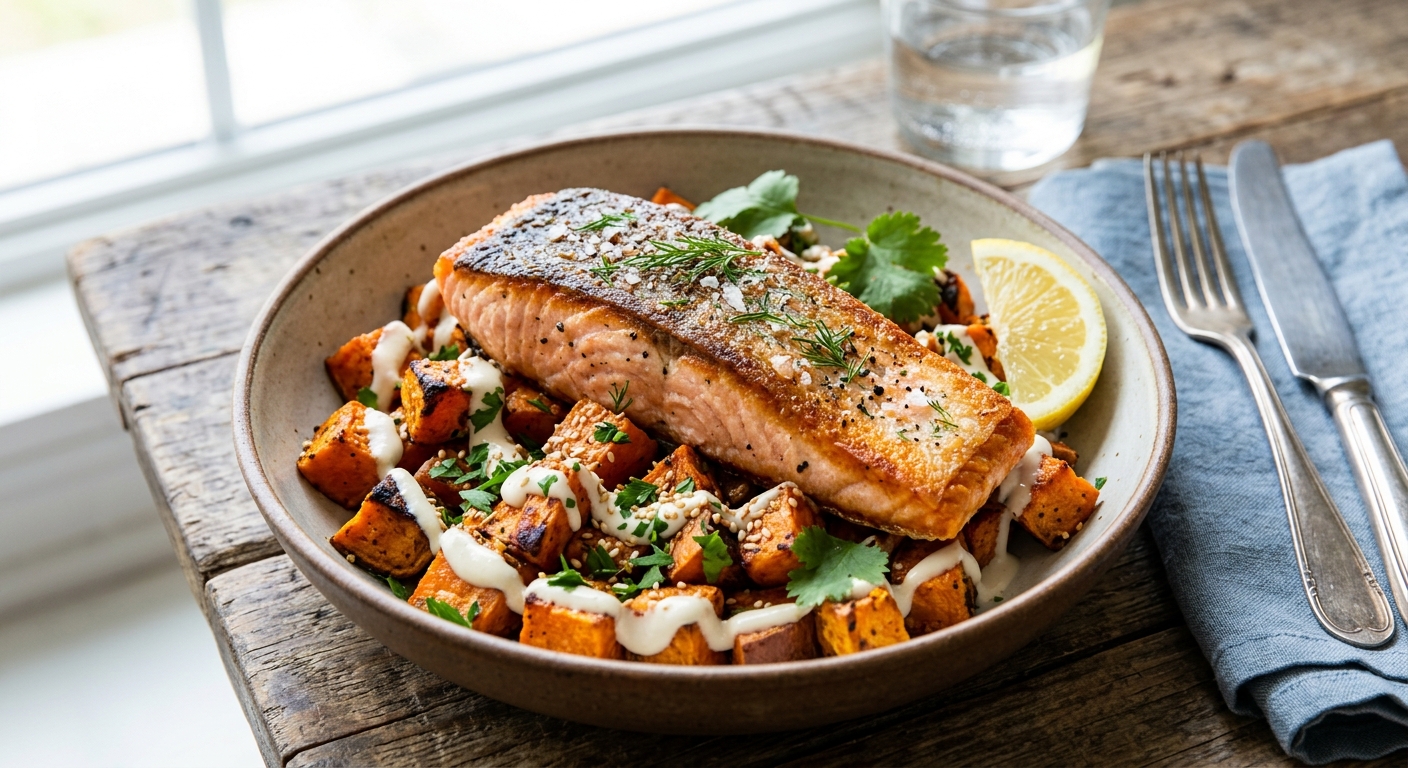
If your skeleton could place a dinner order, this would be it. Salmon and Sweet Potato with Tahini is built from the ground up around bone and joint health, pairing one of the richest dietary sources of vitamin D (wild salmon) with calcium-loaded tahini and anti-inflammatory sweet potato in a way that feels indulgent rather than medicinal. The lemon-tahini drizzle is not an afterthought. Two tablespoons of quality tahini deliver roughly 130mg of calcium, and when combined with the vitamin D from the salmon, that calcium is primed for maximum absorption in a way a supplement simply cannot replicate.
The nutritional partnership here is one of the most elegant in food science. Vitamin D acts as a hormonal regulator that signals the intestinal wall to open calcium absorption channels, meaning eating these two nutrients together is dramatically more effective than consuming them separately. Wild Atlantic or Pacific salmon provides between 600 and 800 IU of vitamin D per 150g serving, covering the full recommended daily intake for most adults. Meanwhile, sweet potato contributes vitamin K2 precursors, magnesium, and a dense supply of beta-carotene, all of which play supporting roles in bone mineral density and joint cartilage integrity.
From a culinary standpoint, this dish rewards attention. The salmon benefits from a proper sear, the sweet potato from gentle caramelisation, and the tahini sauce from a careful emulsification with lemon and warm water that transforms the dense paste into a silky, pourable drizzle. Each of the four cooking methods in this post produces a genuinely different texture profile, so choose based on your schedule and equipment. The stovetop version delivers crispy skin and speed. The oven method gives you hands-off roasting with caramelised edges. The pressure cooker version keeps the fish exceptionally moist. The slow cooker produces a tender, almost braised result perfect for meal prep.
4
servings
Ingredients
- 600 gwild salmon fillets, skin-on, cut into 4 equal portions (about 150g each)
- 600 gsweet potato (about 2 medium), peeled and cut into 2cm cubes
- 80 gtahini (sesame paste), well-stirred
- 60 mlfresh lemon juice (about 2 lemons)
- 3 tbspextra-virgin olive oil, divided
- 4 clovesgarlic, minced
- 60 mlwarm water, plus more to thin tahini sauce
- 1 tspground cumin
- 0.5 tspsmoked paprika
- 0.5 tspground turmeric
- 2 tbspfresh flat-leaf parsley, finely chopped
- 1 tbspsesame seeds, toasted, for garnish
- 1 tsphoney or maple syrup
- —Colima Sea SaltMicroplastic Free Salt and cracked black pepper to taste
Instructions
Click on an item below to shop for the recommended items for this recipe on Amazon.
As an Amazon Associate, we earn from qualifying purchases.
- Make the tahini sauce first: whisk together the tahini, lemon juice, half the minced garlic, honey, and a pinch of salt in a small bowl. Add the warm water a tablespoon at a time, whisking constantly. The mixture will seize and thicken at first, then loosen into a smooth, pourable sauce. Aim for a consistency similar to thick double cream. Season to taste and set aside.
- Pat the salmon fillets completely dry with paper towels. This is critical for achieving a proper sear. Season generously on both sides with salt, pepper, smoked paprika, and a pinch of turmeric. Allow the fillets to sit at room temperature for 10 minutes while you cook the sweet potato.
- Heat 2 tablespoons of olive oil in a large (30cm) heavy skillet or cast iron pan over medium-high heat until shimmering. Add the sweet potato cubes in a single layer, season with salt, cumin, and the remaining turmeric. Cook undisturbed for 4 to 5 minutes until a golden crust forms on the underside, then toss and cook for another 4 to 5 minutes. Add the remaining garlic and cook for 1 further minute until fragrant. Transfer the sweet potato to a warm plate, cover loosely with foil.
- Return the same pan to medium-high heat. Add the remaining 1 tablespoon of olive oil. When it begins to shimmer and just barely smoke, place the salmon fillets skin-side down. Press each fillet gently with a spatula for the first 30 seconds to prevent curling and ensure full skin contact. Cook undisturbed for 4 to 5 minutes until the skin is deeply golden and the flesh has turned opaque roughly two-thirds of the way up the side.
- Flip each fillet carefully and cook for 1 to 2 minutes more depending on thickness, aiming for an internal temperature of 52 to 55 degrees Celsius for a just-cooked, moist centre. Remove from heat and rest for 2 minutes.
- Divide the warm sweet potato between four bowls or plates. Place a salmon fillet on top, skin-side up to keep it crisp. Drizzle generously with tahini sauce, scatter with fresh parsley and toasted sesame seeds, and finish with a crack of black pepper and an extra squeeze of lemon if desired.
- Prepare the tahini sauce by whisking tahini, lemon juice, half the garlic, honey, and a pinch of salt together in a bowl. Add warm water gradually until the sauce is smooth and pourable. Reserve half the sauce for serving; the other half will form the braising liquid.
- Toss the sweet potato cubes with 2 tablespoons of olive oil, cumin, turmeric, smoked paprika, remaining garlic, salt, and pepper. Spread evenly in the base of the slow cooker insert.
- Pour 60ml of warm water into the reserved tahini braising portion and thin it slightly. Pour this diluted tahini mixture over the sweet potato. This creates a fragrant, mildly nutty braising environment that infuses both the vegetables and the fish with flavour as they cook.
- Place the slow cooker on Low and cook the sweet potato base for 2 hours until the cubes are nearly tender but still hold their shape. This staggered approach prevents the salmon from overcooking.
- Season the salmon fillets on both sides with salt, pepper, and a pinch of smoked paprika. Nestle the fillets skin-side down on top of the sweet potato in a single layer. Replace the lid quickly to retain heat. Cook on Low for 45 to 60 minutes, checking at 45 minutes. The salmon is done when it flakes easily at the thickest point and is opaque throughout. Do not overcook or it will become dry.
- Carefully lift the salmon and sweet potato onto serving plates using a wide spatula. Whisk the remaining fresh tahini sauce briefly, thin with a little warm water if needed, and drizzle over each portion. Garnish with fresh parsley and toasted sesame seeds.
- Whisk together the full tahini sauce: tahini, lemon juice, half the garlic, honey, salt, and warm water, adding water until just pourable. Set aside. This sauce is added fresh at serving, not cooked under pressure.
- Add 250ml of cold water, the remaining minced garlic, cumin, smoked paprika, and turmeric to the pressure cooker pot. Stir briefly. Place the sweet potato cubes directly into the liquid. The spiced liquid will steam and infuse the sweet potato from below.
- Place the stainless steel trivet or a steamer basket on top of the sweet potato layer. Season the salmon fillets generously with salt, pepper, and a pinch of smoked paprika on both sides. Arrange the fillets on the trivet in a single layer, skin-side up.
- Seal the lid and set to High Pressure. Cook for 4 minutes for fillets up to 3cm thick, or 5 minutes for thicker cuts. Once cooking is complete, perform an immediate quick release by carefully turning the steam valve. Do not allow the pressure to natural-release, as the residual heat will overcook the salmon.
- Remove the lid, lift out the salmon fillets, and transfer to a plate. Test the sweet potato with a fork; it should be tender and ready. If not, replace the lid and use the Saute function for 2 to 3 additional minutes. Drain excess liquid from the pot, leaving the sweet potato in the residual heat.
- Plate the sweet potato first, top with the salmon fillet, and drizzle with the fresh tahini sauce. Finish with fresh parsley, toasted sesame seeds, a squeeze of lemon, and cracked black pepper.
- Preheat the oven to 210 degrees Celsius (190 degrees fan, 425 degrees Fahrenheit). Line a large rimmed baking sheet with parchment paper. Prepare the tahini sauce by whisking tahini, lemon juice, half the garlic, honey, salt, and warm water until smooth and pourable. Set aside.
- Toss the sweet potato cubes with 2 tablespoons of olive oil, cumin, turmeric, smoked paprika, the remaining garlic, and a generous pinch of salt and pepper. Spread in a single layer on two-thirds of the prepared baking sheet, ensuring the cubes are not crowded. Roast on the upper-middle rack for 18 to 20 minutes, flipping once halfway through, until the edges are deeply caramelised and the centres are tender.
- While the sweet potato roasts, pat the salmon fillets thoroughly dry with paper towels. Brush the flesh side of each fillet with the remaining 1 tablespoon of olive oil and season generously with salt, pepper, and a pinch of smoked paprika. The dry surface is key for a slightly crisped top in the oven.
- After the sweet potato has had its 18 to 20-minute head start, push the cubes to one side of the baking sheet to make room. Place the salmon fillets skin-side down on the open section of the sheet. Roast at the same temperature for 10 to 12 minutes. The salmon is done when the flesh is opaque and flakes gently under light pressure at the thickest point, targeting an internal temperature of 52 to 55 degrees Celsius.
- Remove the baking sheet from the oven and rest the salmon for 2 minutes before serving. Divide the roasted sweet potato between four plates, top each with a salmon fillet, and drizzle generously with the tahini sauce. Scatter with fresh parsley and toasted sesame seeds, and serve with lemon wedges.
Nutrition Breakdown
Per 1 serving (makes 4)
Vitamins & Minerals
% Daily Value based on a 2,000 calorie diet (FDA reference)
🧬 Essential Amino Acids
% of recommended daily intake (RDA) per serving
🛡 Antioxidant Profile
The Nutrition Science
The calcium-vitamin D synergy in this dish is one of the most clinically validated nutrient partnerships in nutrition science. Vitamin D, obtained from the salmon, is converted in the kidneys to its active hormonal form, calcitriol, which binds to receptors in the intestinal epithelium and upregulates the expression of calbindin, the transport protein that physically carries calcium ions across the gut wall into the bloodstream. Without adequate vitamin D, dietary calcium absorption falls to as low as 10 to 15 percent of intake. With sufficient vitamin D, that absorption rate rises to 30 to 40 percent, nearly tripling the bone-building benefit of every milligram of calcium you consume. The tahini in this recipe provides approximately 130mg of calcium per two-tablespoon serving, derived from whole sesame seeds, which are among the highest calcium-containing plant foods by weight at around 975mg per 100g.
Astaxanthin, the pink carotenoid that gives salmon its characteristic colour, deserves particular attention for joint health. Unlike beta-carotene or lycopene, astaxanthin is not converted to vitamin A in the body but instead acts as a direct antioxidant with a unique molecular structure that spans the full width of a cell membrane, providing protection on both its inner and outer surfaces simultaneously. Multiple clinical trials have demonstrated that 4 to 12mg of astaxanthin daily reduces serum inflammatory markers including C-reactive protein and interleukin-6, both of which are implicated in the cartilage degradation pathway seen in osteoarthritis. A 150g serving of wild salmon delivers approximately 3 to 4mg of astaxanthin, making this a clinically meaningful dose at the upper end of studied ranges.
The sweet potato’s contribution goes beyond beta-carotene. Sweet potatoes are one of the few commonly consumed foods that provide meaningful amounts of vitamin K1, with a medium sweet potato delivering approximately 4mcg of phylloquinone. While this is modest compared to leafy greens, vitamin K plays an essential and often overlooked role in bone metabolism: it activates osteocalcin, a protein synthesised by osteoblasts that binds calcium ions into the hydroxyapatite crystal lattice of bone matrix. Without adequate vitamin K, osteocalcin remains inactive and calcium cannot be properly incorporated into bone tissue, regardless of how much calcium is consumed. The magnesium from both the sweet potato and the tahini further supports this process, as magnesium is a cofactor in the enzymatic conversion of vitamin D to its active calcitriol form, effectively completing a three-way nutritional circuit that supports bone mineralisation from multiple simultaneous angles.
Pro Tips
- Buy wild-caught salmon over farmed wherever possible. Wild Pacific or Alaskan sockeye salmon contains up to 3.5 times more astaxanthin and typically higher levels of vitamin D than Atlantic farmed salmon, making a significant nutritional difference despite the higher price.
- Stir your tahini jar thoroughly from the bottom before measuring. The oil separates to the top and unmixed tahini is far too thick to emulsify into a smooth sauce. If your tahini is very stiff and old, gently warm it in a bowl set over hot water for a few minutes before whisking.
- Do not skip drying the salmon skin before the stovetop or oven methods. Surface moisture creates steam, which prevents browning and produces a pale, rubbery skin. Even 30 seconds of thorough patting with paper towels makes an enormous difference to the final texture and flavour development through the Maillard reaction.
This is literally my kind of meal, especially with the tahini factor since sesame is such an underrated inositol source for us PCOS folks! I’m curious about the insulin impact of the sweet potato portion though, like are you pairing it with a specific ratio of protein/fat to keep blood sugar stable? I’ve found that tahini drizzle actually helps slow down the carb absorption, but I’m always looking for ways to optimize my potato servings. The omega-3s in salmon are *chef’s kiss* for hormone balance too, so I’m definitely saving this one!
This looks so nourishing, and I’m really curious about a couple of things for my Hashimoto’s context! Does the tahini sauce contain any nightshades, or is it purely tahini, lemon, and seasonings? I’ve found that sesame is generally well tolerated in my AIP modifications, but I want to make sure there aren’t any hidden peppers or spices that might trigger inflammation for me. Also, I’d love to know the iodine content of the salmon you’re using, since I have to be careful with iodine balance alongside my thyroid medication. This could be such a perfect addition to my rotation if it checks those boxes!
This sounds absolutely delicious, and I love that you’re thinking about the blood sugar piece, Rosa! Just wanted to add that pairing the sweet potato with the salmon’s protein and fat, plus that tahini sauce, is actually going to slow down the glucose response significantly. The selenium in both salmon and tahini is a nice bonus too since it supports thyroid function alongside the vitamin D. I do wonder though if the post mentions cooking method for the sweet potato, since roasting versus boiling can affect nutrient bioavailability, especially for calcium absorption alongside vitamin D.