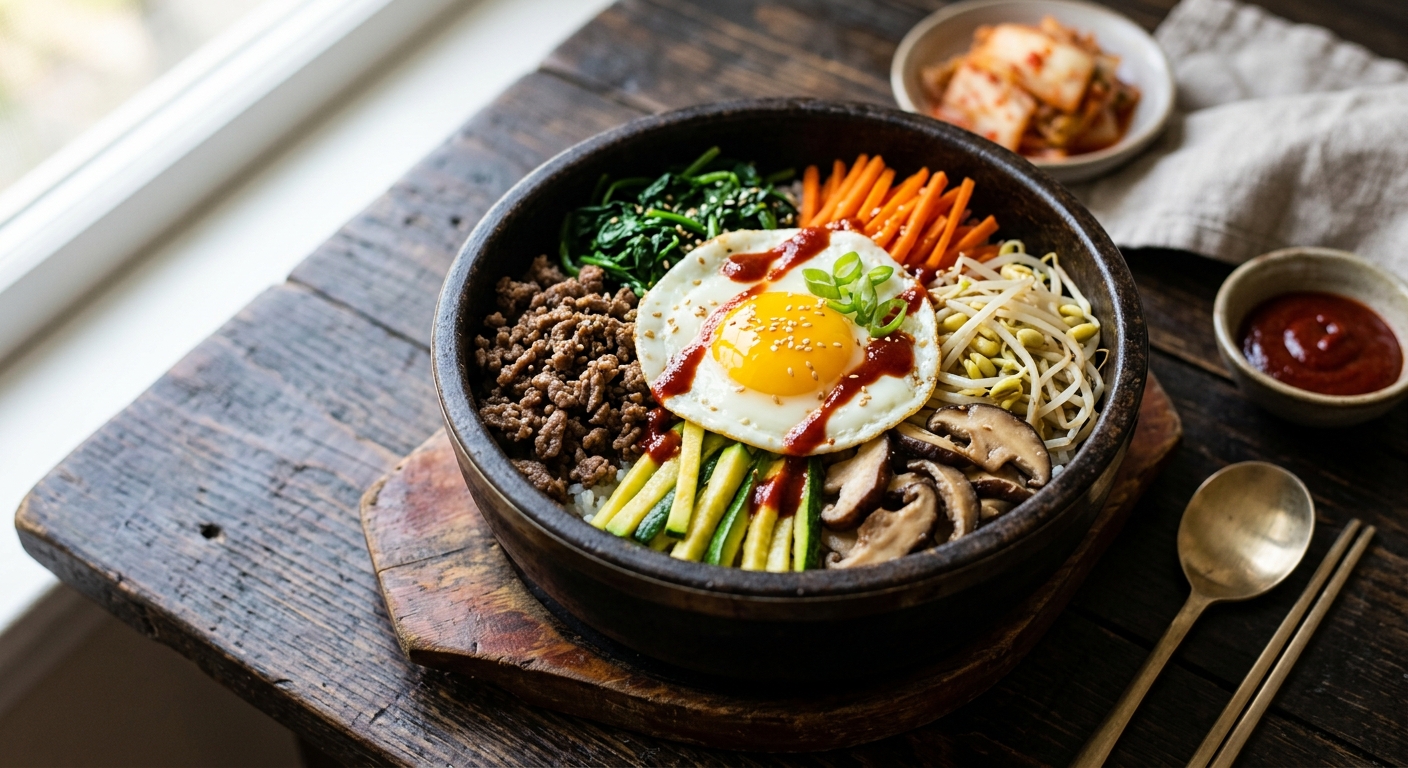
Bibimbap, which translates literally as ‘mixed rice,’ is one of Korea’s most beloved and enduring dishes, and it turns out nutritional scientists have every reason to agree with its centuries-long popularity. The architecture of the dish is deceptively simple: a warm bowl of short-grain rice topped with an artfully arranged constellation of individually seasoned vegetables, a perfectly cooked egg, a drizzle of fermented gochujang sauce, and a finishing touch of sesame oil. But beneath that beautiful presentation lies one of the most intelligently constructed meals in the global culinary canon, hitting an extraordinary range of micronutrient targets in a single serving.
What makes bibimbap so nutritionally remarkable is its diversity of plant ingredients. Each vegetable component contributes a distinct mineral and phytonutrient profile: wilted spinach delivers iron and folate, julienned carrots provide beta-carotene and vitamin K, shiitake mushrooms contribute copper, selenium, and B vitamins, and crisp bean sprouts add vitamin C and manganese. The egg provides choline, complete protein, and fat-soluble vitamins that actually improve the absorption of carotenoids from those carrots. This is not happy coincidence; it reflects the Korean culinary tradition of banchan, the philosophy of presenting many small, varied vegetable preparations together, which naturally produces a nutritionally balanced plate.
At Calibrated Cuisine, we have carefully calibrated the ingredient quantities so that a single serving provides meaningful coverage across iron, zinc, copper, manganese, selenium, folate, vitamin A, vitamin K, and vitamin C, while keeping the glycemic load moderate through fiber-rich vegetables and portion-controlled rice. Whether you are building this bowl on the stovetop in the traditional way, letting a slow cooker handle the rice and mushroom base, or using a pressure cooker for speed, the result is the same extraordinary convergence of flavor, color, and nutritional completeness.
4
servings
Ingredients
- 400 gshort-grain Japanese or Korean white rice, rinsed until water runs clear
- 200 gfresh baby spinach
- 200 gcarrots, peeled and cut into thin matchsticks
- 200 gfresh shiitake mushrooms, stems removed and caps thinly sliced
- 200 gmung bean sprouts, rinsed
- 150 gzucchini, cut into thin matchsticks
- 200 glean ground beef (90% lean)
- 4 largeeggs
- 4 tbspgochujang (Korean fermented chili paste)
- 3 tbsptoasted sesame oil, divided
- 2 tbsplow-sodium soy sauce, divided
- 2 tsphoney or maple syrup
- 4 clovesgarlic, minced, divided
- 2 tsptoasted sesame seeds
- 1 tbspAvocado Oil100% Pure Avocado Oil (such as avocado or sunflower oil) for cooking
- 1 tbsprice vinegar
- —Colima Sea SaltMicroplastic Free Salt and white pepper to taste
- —2 green onions, thinly sliced, for garnish
Instructions
Click on an item below to shop for the recommended items for this recipe on Amazon.
As an Amazon Associate, we earn from qualifying purchases.
- Cook the rice: Combine the rinsed rice with 560ml of cold water in a medium heavy-bottomed saucepan. Bring to a boil over high heat, then reduce to the lowest possible simmer, cover tightly, and cook for 15 minutes. Remove from heat and let steam, covered, for 10 minutes. Do not lift the lid during cooking.
- Make the gochujang sauce: Whisk together the gochujang, 1 tablespoon sesame oil, honey, 1 tablespoon soy sauce, 1 minced garlic clove, rice vinegar, and 2 tablespoons of water in a small bowl until smooth. Set aside.
- Season and sear the beef: Heat a large skillet or wok over medium-high heat. Add the ground beef and break it apart. Add 1 tablespoon soy sauce and 2 minced garlic cloves. Cook, stirring frequently, for 5 to 6 minutes until browned and cooked through. Season with white pepper, remove to a bowl, and keep warm.
- Cook the vegetables individually: Wipe the skillet clean. Add a thin film of neutral oil over medium-high heat. Cook each vegetable separately in the following order, removing each to its own small bowl before adding the next. Carrots: stir-fry 2 to 3 minutes until just tender, season with a pinch of salt. Zucchini: stir-fry 2 minutes, season with salt. Mushrooms: stir-fry 3 to 4 minutes with 1 minced garlic clove until golden. Bean sprouts: stir-fry 1 to 2 minutes, season lightly. Spinach: add to the dry pan, toss until just wilted, about 1 minute, then squeeze out excess moisture, season with a pinch of salt and a few drops of sesame oil.
- Fry the eggs: In the same skillet over medium-low heat, add a small amount of neutral oil. Crack the eggs in gently and fry sunny-side up, 2 to 3 minutes, until whites are set but yolks remain runny. Season lightly with salt.
- Assemble the bowls: Divide the warm rice among four wide bowls. Arrange each vegetable and the beef in separate sections around the top of the rice, like spokes on a wheel, keeping each component visually distinct. Place a fried egg in the center of each bowl. Drizzle 1 tablespoon of sesame oil total across all four bowls, scatter sesame seeds and green onions, and serve the gochujang sauce on the side for each person to mix in to taste.
- Cook the rice in the slow cooker: Lightly grease the insert of a 4 to 6-quart slow cooker with a neutral oil or cooking spray. Add the rinsed rice and 600ml of hot water (slightly more than stovetop to account for evaporation differences). Stir in a pinch of salt. Place a double layer of paper towels under the lid to absorb condensation and prevent dripping back onto the rice. Cook on High for 1 hour 45 minutes to 2 hours, or until the rice is tender and all liquid is absorbed. Do not lift the lid for the first 90 minutes.
- Prepare the beef and mushroom mixture: While the rice cooks, combine the ground beef, sliced mushrooms, 1 tablespoon soy sauce, 2 minced garlic cloves, 1 tablespoon soy sauce, and white pepper in a bowl. Mix well. If your slow cooker is large enough, transfer this mixture to a heatproof bowl or foil packet and place it on top of the rice for the last 45 minutes of cooking, stirring the beef mixture halfway through. Alternatively, cook this mixture in a separate small skillet over medium-high heat for 6 minutes just before assembly.
- Make the gochujang sauce: In a small bowl, whisk together the gochujang, 1 tablespoon sesame oil, honey, 1 tablespoon soy sauce, 1 minced garlic clove, rice vinegar, and 2 tablespoons of water. Taste and adjust sweetness or heat. Set aside.
- Quick-cook the fresh vegetables: About 20 minutes before serving, bring a medium saucepan of lightly salted water to a boil. Blanch the bean sprouts for 60 seconds, remove with a slotted spoon to a bowl, and toss with a few drops of sesame oil and a pinch of salt. Add the carrots to the boiling water and blanch for 2 minutes until just tender, then remove. In a dry non-stick skillet over medium-high heat, stir-fry the zucchini matchsticks for 2 minutes and the spinach for 1 minute, seasoning each with salt. Toss the wilted spinach with a pinch of garlic and a few drops of sesame oil.
- Fry the eggs: In a non-stick skillet over medium-low heat with a small amount of oil, fry the eggs sunny-side up for 2 to 3 minutes until whites are fully set and edges are lightly golden. Season with salt.
- Assemble the bowls: Fluff the slow cooker rice gently with a rice paddle or fork. Divide among four wide bowls. Arrange the carrots, zucchini, spinach, bean sprouts, and beef and mushroom mixture in distinct sections. Place a fried egg in the center of each bowl. Finish with a drizzle of sesame oil, sesame seeds, and green onions. Serve with gochujang sauce alongside.
- Pressure cook the rice: Add the rinsed rice and 480ml of cold water to the inner pot of a 6-quart pressure cooker or Instant Pot. Stir in a pinch of salt. Secure the lid and set the valve to Sealing. Cook on Manual High Pressure for 3 minutes. When the cycle ends, allow a natural pressure release for 10 minutes, then carefully switch the valve to Venting to release any remaining steam. Open the lid away from you, fluff the rice with a fork, and transfer to a large bowl covered with a clean towel to keep warm.
- Saute the beef: Select the Saute function on High (or use a large skillet if your pressure cooker insert is too wide for even browning). Add a thin film of neutral oil. Add the ground beef and break it apart. Add 2 minced garlic cloves, 1 tablespoon soy sauce, and white pepper. Cook for 5 to 6 minutes, stirring frequently, until browned and cooked through. Remove the beef to a bowl.
- Steam the vegetables using the pot: Add 120ml of water to the insert and place the steam rack inside. Arrange the carrot matchsticks and bean sprouts on the rack. Secure the lid and cook on Manual High Pressure for 0 minutes (the come-to-pressure time alone is enough). Immediately quick-release the pressure. Remove the vegetables carefully, season with salt and a few drops of sesame oil, and set aside. Remove the steam rack.
- Saute the mushrooms and zucchini: Select Saute on Medium. Add a film of neutral oil. Add the mushrooms with 1 minced garlic clove and stir-fry 3 minutes until golden. Add the zucchini and cook 2 minutes more, seasoning with salt. Remove to separate bowls. Finally, add the spinach directly to the hot insert and toss for 30 to 45 seconds until just wilted; season with salt and a few drops of sesame oil and remove.
- Make the gochujang sauce and fry the eggs: Whisk together the gochujang, 1 tablespoon sesame oil, honey, 1 tablespoon soy sauce, 1 minced garlic clove, rice vinegar, and 2 tablespoons water in a small bowl. In a non-stick skillet over medium-low heat, fry the eggs sunny-side up, 2 to 3 minutes, until whites are set and yolks remain soft.
- Assemble immediately: Divide the warm rice among four wide bowls. Arrange each vegetable component and the seasoned beef in separate colorful sections. Center one egg on top of each bowl. Drizzle sesame oil and scatter sesame seeds and green onions. Pass the gochujang sauce at the table.
- Pre-cook the rice: Cook the rice using the stovetop absorption method (400g rice with 560ml water, bring to boil, cover and simmer 15 minutes, rest 10 minutes off heat). You need fully cooked rice before it goes into the oven. While the rice cooks, preheat the oven to 220C / 425F with the rack in the lower-middle position.
- Prepare all the toppings before the oven phase: In a large skillet over medium-high heat, cook the ground beef with 2 minced garlic cloves, 1 tablespoon soy sauce, and white pepper for 5 to 6 minutes. Set aside. In the same pan, quickly stir-fry the carrots (2 minutes), zucchini (2 minutes), mushrooms with 1 minced garlic clove (3 to 4 minutes), and bean sprouts (1 minute) individually, seasoning each with salt. Wilt the spinach in the dry pan for 1 minute, season with salt and a few drops of sesame oil. Make the gochujang sauce by whisking gochujang, 1 tablespoon sesame oil, honey, 1 tablespoon soy sauce, 1 minced garlic clove, rice vinegar, and 2 tablespoons water.
- Load the cast iron vessels: Brush the inside of four oven-safe individual stone bowls or one large 25cm cast iron skillet generously with sesame oil, ensuring the sides are also coated. This is critical for developing the crust and for flavor. Divide the cooked rice evenly among the bowls (or spread it in the skillet), pressing it down gently into an even layer. Arrange the pre-cooked vegetable toppings and beef in distinct sections on top of the rice, but do not add the eggs yet.
- Oven-crisp the bowls: Place the loaded bowls or skillet directly on the oven rack (set a baking sheet on the rack below to catch any drips). Roast at 220C for 18 to 22 minutes, until you can hear a sizzling sound and the edges of the rice are visibly golden and pulling away from the sides. The bottom layer of rice should be deeply caramelized and crispy when you scrape a spoon along the edge.
- Add the eggs for the final blast: Carefully remove the bowls from the oven using heavy oven mitts. Working quickly, create a small well in the center of each bowl and crack one egg directly into it. Return to the oven for 4 to 5 minutes until the egg white is just set but the yolk is still runny. Alternatively, for a more controlled result, fry the eggs separately in a skillet and place them on top after the bowls come out.
- Finish and serve: Remove from the oven and immediately drizzle the remaining sesame oil over each bowl. Scatter sesame seeds and green onions. Serve the gochujang sauce alongside and instruct diners to mix everything vigorously before eating, cracking through the crispy rice crust as they stir.
Nutrition Breakdown
Per 1 serving (makes 4)
Vitamins & Minerals
% Daily Value based on a 2,000 calorie diet (FDA reference)
🧬 Essential Amino Acids
% of recommended daily intake (RDA) per serving
🛡 Antioxidant Profile
The Nutrition Science
The mineral richness of bibimbap is not accidental: it arises from the deliberate stacking of plant foods that each occupy a different mineral niche. Spinach is one of the most iron-dense leafy greens at approximately 2.7mg per 100g cooked, but it also contains oxalic acid, which binds some of that iron and reduces absorption. The solution, elegantly embedded in the dish’s recipe, is the acidic gochujang sauce and the vitamin C in the bean sprouts, both of which convert ferric iron (Fe3+) to the more bioavailable ferrous form (Fe2+). The sesame oil, meanwhile, solubilizes fat-soluble carotenoids from the carrots and spinach, dramatically increasing their bioavailability, with research showing that consuming beta-carotene-rich vegetables with even a small amount of fat can increase carotenoid absorption by three to five times compared to fat-free preparations.
Shiitake mushrooms deserve particular attention in this dish’s mineral matrix. They are one of the rare plant-based sources of copper (0.14mg per 100g), selenium, and the near-unique antioxidant ergothioneine, which humans possess a dedicated membrane transporter for, suggesting it plays a genuinely important physiological role. Shiitakes also contain lentinan, a beta-glucan polysaccharide with well-documented immunomodulatory properties, and the drying and rehydration process (if dried shiitakes are used) actually increases the concentration of eritadenine, a compound associated with modest reductions in LDL cholesterol. The egg yolk in bibimbap contributes choline (approximately 125mg per yolk), a nutrient that roughly 90% of Americans fail to meet adequate intake for, and which is critical for liver function, neurotransmitter synthesis, and fetal brain development.
The fermented gochujang paste is the dish’s most nutritionally underappreciated component. As a product of lactobacillus-driven fermentation of chili, glutinous rice, and soybean, gochujang contains live cultures that contribute to gut microbiome diversity, alongside capsaicin from the chilis, which activates TRPV1 receptors and has been linked to increased fat oxidation and reduced appetite signaling. The Maillard reaction products formed when gochujang is cooked (as in the oven dolsot method) generate additional flavor complexity without significantly degrading the capsaicin content, though heat does reduce the viable probiotic count. Serving some of the sauce uncooked on the side, as this recipe recommends, preserves those beneficial cultures.
Pro Tips
- Rinse the rice until the water is completely clear, at least 4 to 5 rinses: this removes excess surface starch and is the single biggest factor in achieving glossy, individual grains rather than a sticky clump.
- Cook every vegetable separately and season each one individually before assembly; this is the Korean technique called namul and it is what gives bibimbap its distinct layered flavor, as opposed to a stir-fry where everything tastes the same.
- To make this dish vegetarian, replace the ground beef with 200g of firm tofu crumbled and pan-fried with the same soy sauce and garlic marinade until golden; the protein per serving drops by approximately 6g but the dish remains complete in all tracked minerals.
- For a lower glycemic load, substitute half the white rice with cooked cauliflower rice or use short-grain brown rice (increase water to 650ml and cook time to 45 minutes on the stovetop), which reduces the estimated GL from 29 to approximately 16.
- The gochujang sauce keeps refrigerated for up to two weeks in a sealed jar and is arguably more useful than any hot sauce in your kitchen: use it as a marinade, a burger condiment, or stirred into scrambled eggs.

Oh wow, I’ve been making bibimbap constantly since my PCOS diagnosis because the mineral and inositol combo is *chef’s kiss* for hormone balance, especially with all those veggies! My one tweak: I sub the white rice for cauliflower rice or a mix to keep the insulin spike manageable, and I always add extra spinach plus some kimchi for the probiotics since gut health is huge for androgen metabolism. The egg yolk is such a nutrient powerhouse too, so I never skip it. Have you noticed the gochujang affecting anyone’s inflammation markers, or does the fermentation make it more tolerable for sensitive systems?
What a wonderful observation about the mineral synergy in bibimbap, Rosa! I’ve been teaching my class about how the variety of vegetables in this bowl actually enhances mineral absorption through their different phytonutrient profiles, and your PCOS focus is so smart. I’m curious though, have you found the cauliflower rice swap affects the traditional fermentation benefits of serving it with kimchi, or does the gochujang still provide enough of that probiotic element? I’m thinking about featuring this as our next class project with options for both rice versions so students can compare how the texture changes the eating experience.
ok so i made this last night with an extra scoop of gochujang and some sesame seeds, and i’m genuinely curious if youve thought about the tryptophan angle here – the egg’s obviously got it, but does the fermented gochujang potentially increase bioavailability? my sleep tracker actually showed decent sleep depth that night and i’m trying to figure out if it was the minerals rosa mentioned or if theres something about the fermentation process making the amino acids hit different, because ive been sleep deprived enough to start seeing patterns that probably aren’t there lol