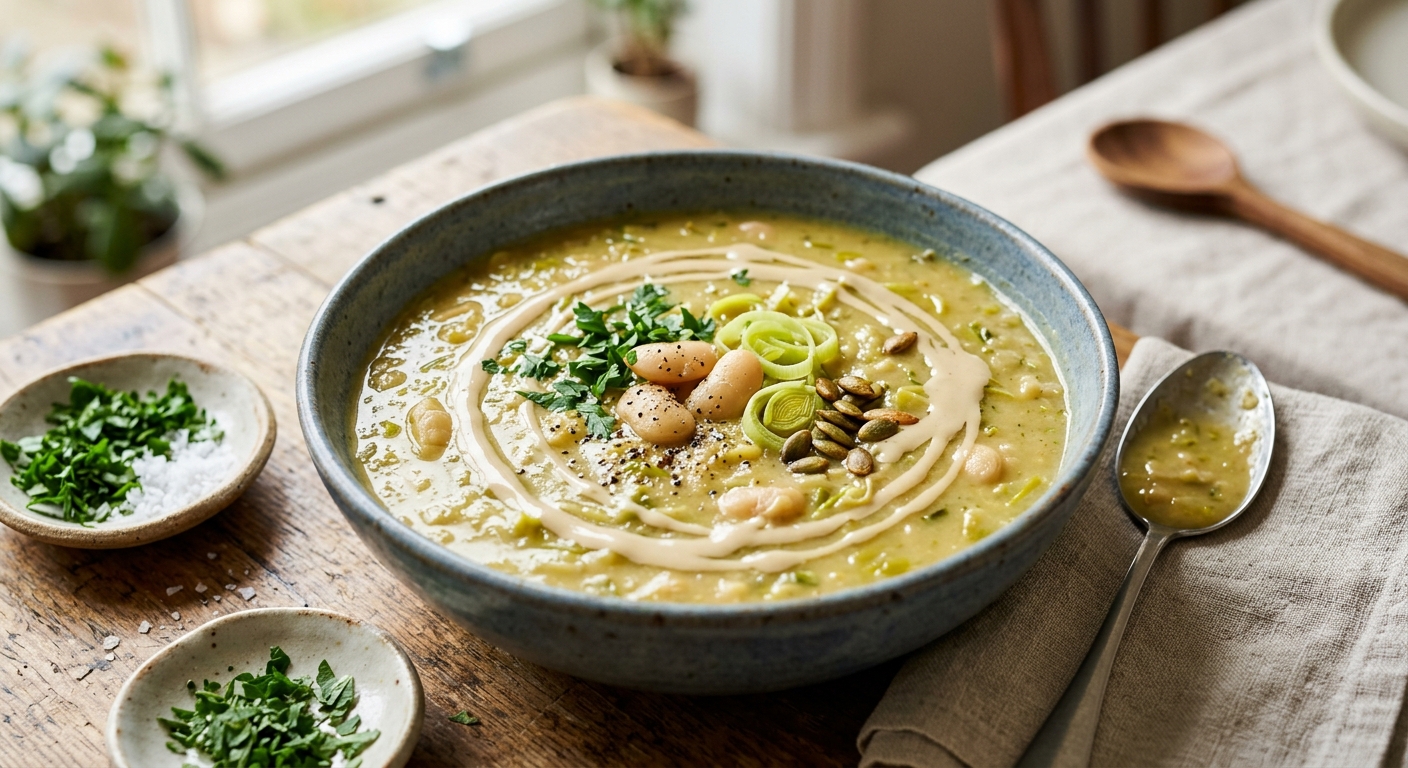
There are soups that warm you, and then there are soups that rebuild you from the inside out. This Butterbean and Leek Soup with Tahini Drizzle belongs firmly in the second category. Butterbeans, also known as large lima beans, are among the most mineral-dense legumes available, packing exceptional amounts of iron, folate, magnesium, and potassium into every spoonful. Paired with leeks, which contribute their own quiet but meaningful supply of vitamin K, vitamin C, and manganese, this bowl is a genuine mineral matrix in the most delicious possible form.
The tahini drizzle is not merely a finishing flourish. Two tablespoons of tahini contribute roughly 130mg of calcium, a notable boost for a dish that is entirely dairy-free. Sesame paste also introduces copper, zinc, and a generous dose of monounsaturated and polyunsaturated fats that improve absorption of the fat-soluble vitamins present in the leeks and the smoked paprika garnish. A squeeze of lemon stirred in at the end keeps the bright flavors alive and simultaneously improves non-heme iron absorption from the beans by providing vitamin C alongside the iron source.
Across the three cooking methods available here, the technique changes meaningfully. On the stovetop you develop a proper fond from the leeks, building savory depth that no slow cooker can fully replicate. The slow cooker surrenders that browning in exchange for an extraordinary tenderness, where the butterbeans almost melt into the broth. The pressure cooker is the weeknight hero, collapsing hours of simmering into under thirty minutes while still producing a soup rich enough to feel like it has been going all afternoon. All three versions are worth making, and all three will land this recipe in your regular rotation.
4
servings
Ingredients
- 800 gcanned butterbeans (two 400g tins), drained and rinsed
- 3 largeleeks, white and pale green parts only, halved lengthways and sliced into half-moons
- 1 mediumyellow onion, finely diced
- 4 clovesgarlic, thinly sliced
- 2 tbspextra-virgin olive oil
- 1 litregood-quality vegetable stock, low sodium
- 250 mlwater
- 3 tbsptahini (well-stirred)
- 2 tbspfresh lemon juice
- 1 tspground cumin
- 0.5 tspsmoked paprika, plus extra to garnish
- 0.5 tspground coriander
- 2 sprigsfresh thyme
- 1 tbsptahini, extra, for the drizzle
- 1 tbsplemon juice, extra, for the drizzle
- 2 tbspwarm water, for the drizzle
- 1 tbspflat-leaf parsley, finely chopped, to serve
- —Colima Sea SaltMicroplastic Free Salt and freshly cracked black pepper to taste
Instructions
Click on an item below to shop for the recommended items for this recipe on Amazon.
As an Amazon Associate, we earn from qualifying purchases.
- Place a large Dutch oven or heavy-based saucepan over medium heat. Add the olive oil and heat until shimmering. Add the diced onion with a pinch of salt and cook, stirring occasionally, for 6 to 8 minutes until softened and just beginning to turn golden at the edges.
- Add the sliced leeks to the pot. Increase heat to medium-high and cook, stirring frequently, for 8 to 10 minutes. You want the leeks to reduce significantly in volume and develop some light caramelisation on the pan, building a flavour fond. Add the garlic, cumin, ground coriander, smoked paprika, and thyme sprigs, and stir constantly for 90 seconds until the spices are fragrant and coating the vegetables.
- Pour in a small splash of the vegetable stock to deglaze, scraping up any browned bits from the base of the pot with a wooden spoon. Add the remaining stock, the water, and the drained butterbeans. Season generously with salt and black pepper. Bring to a boil, then reduce heat to a steady simmer. Cover partially and cook for 20 minutes, until the butterbeans are very tender and beginning to break down slightly.
- Remove the thyme sprigs. Using an immersion blender, blend approximately half the soup directly in the pot, aiming to create a thick, creamy base while leaving plenty of whole beans and leek pieces for texture. Alternatively, ladle half the soup into a blender, puree until smooth, and return it to the pot. Stir everything together and taste for seasoning.
- Stir in the 2 tablespoons of lemon juice. Meanwhile, prepare the tahini drizzle by whisking together 1 tablespoon of tahini, 1 tablespoon of lemon juice, and 2 tablespoons of warm water in a small bowl until smooth and pourable. Also stir the 3 tablespoons of tahini directly into the soup for body and richness. Ladle the soup into bowls, add a generous drizzle of the tahini sauce, a pinch of smoked paprika, and a scatter of chopped parsley. Serve immediately.
- Add the drained butterbeans, sliced leeks, diced onion, sliced garlic, cumin, ground coriander, smoked paprika, thyme sprigs, and vegetable stock directly to the slow cooker insert. Skip the extra 250ml of water, as the slow cooker traps all steam. Stir everything together and season well with salt and pepper.
- Place the lid on the slow cooker and cook on Low for 7 to 8 hours, or on High for 3.5 to 4 hours. By the end of cooking, the leeks will have completely melted into the broth and the butterbeans will be exceptionally tender, with some naturally breaking down and thickening the liquid without any blending required.
- Remove the thyme sprigs. Stir in the 3 tablespoons of tahini and the 2 tablespoons of lemon juice directly into the slow cooker. Using a potato masher or the back of a large spoon, roughly mash about one-quarter of the beans against the side of the insert to thicken the soup further. Stir vigorously to incorporate. If you prefer a smoother texture, use an immersion blender on half the soup at this stage. Taste and adjust seasoning, adding more salt, pepper, or lemon juice as needed.
- Prepare the tahini drizzle by whisking together 1 tablespoon of tahini, 1 tablespoon of lemon juice, and 2 tablespoons of warm water in a small bowl until loose and pourable. If the soup has thickened beyond your preference during the long cook, stir in a splash of hot water or additional stock before serving.
- Ladle into bowls and finish each serving with a generous swirl of tahini drizzle, a dusting of smoked paprika, a drizzle of extra-virgin olive oil, and the chopped flat-leaf parsley. The slow cooker version is particularly well suited to being kept on the Warm setting for up to 2 hours for effortless entertaining.
- Set your Instant Pot or electric pressure cooker to the Saute function on Normal heat. Add the olive oil and heat until shimmering. Add the diced onion with a pinch of salt and saute for 4 minutes, stirring, until softened. Add the leeks and continue sauteing for 4 to 5 minutes, pressing them against the hot surface to encourage some colour to develop. Add the garlic, cumin, ground coriander, and smoked paprika and stir for 60 seconds until fragrant.
- Pour in approximately 100ml of the vegetable stock to deglaze the pot, using a silicone spatula or wooden spoon to scrape all the browned bits from the bottom. This step is critical with the Instant Pot: any residue on the base can trigger a Burn warning during pressurisation. Once the base is clean, add the remaining stock, the 250ml of water, drained butterbeans, and thyme sprigs. Stir to combine and season with salt and pepper.
- Secure the lid and set the valve to the Sealing position. Cancel the Saute function and select Pressure Cook (or Manual) on High Pressure for 10 minutes. The pot will take approximately 8 to 10 minutes to come up to pressure before the countdown begins.
- Once the cook time is complete, allow the pressure to release naturally for 15 minutes, then carefully turn the valve to Venting to release any remaining steam. Remove the lid and discard the thyme sprigs. The soup will look very thick and the beans will be completely tender.
- Set the cooker back to Saute on Low. Stir in the 3 tablespoons of tahini and the 2 tablespoons of lemon juice. Use an immersion blender to blend roughly half the soup for a creamy, textured result, or blend more for a fully smooth version. Simmer on Saute for 2 to 3 minutes to bring everything together and allow the tahini to fully incorporate. Whisk the tahini drizzle (1 tablespoon tahini, 1 tablespoon lemon juice, 2 tablespoons warm water) in a small bowl. Ladle soup into bowls and top with the drizzle, smoked paprika, and parsley.
Nutrition Breakdown
Per 1 serving (makes 4)
Vitamins & Minerals
% Daily Value based on a 2,000 calorie diet (FDA reference)
🧬 Essential Amino Acids
% of recommended daily intake (RDA) per serving
🛡 Antioxidant Profile
The Nutrition Science
The iron in this soup warrants some explanation, because not all plant-based iron behaves the same way. Butterbeans supply non-heme iron, the form found in all plant foods, which is absorbed at a lower rate than the heme iron in meat. However, this recipe is deliberately engineered to maximize that absorption. The lemon juice added at the end contributes vitamin C, which chemically reduces ferric non-heme iron (Fe3+) to the more absorbable ferrous form (Fe2+), and research consistently shows that pairing vitamin C with non-heme iron can increase absorption by two to four times. The absence of tea or coffee with this meal, and the presence of garlic and onion alliums, further supports uptake.
Folate from butterbeans is one of the most nutritionally significant contributions of this dish. A single serving provides 55% of the daily value for this B-vitamin, which is essential for DNA synthesis, cell division, and the methylation cycle that regulates homocysteine levels in the bloodstream. Chronically elevated homocysteine is associated with cardiovascular disease, and adequate folate intake is one of the most evidence-backed dietary strategies to keep it within healthy range. Notably, the folate in cooked legumes is relatively heat-stable compared to folate in leafy greens, meaning all three cooking methods deliver comparable amounts.
Tahini’s nutritional contribution is disproportionately large for a garnish-sized quantity. Sesame seeds are one of the richest food sources of copper, a trace mineral that is chronically underconsumed in modern diets. Copper is indispensable for iron metabolism, because the enzyme ceruloplasmin requires copper to convert stored iron into a form the body can transport in the bloodstream. This means the tahini in this recipe does not merely add calcium alongside the iron-rich beans; it actively facilitates the utilisation of that iron. This kind of synergistic nutrient interaction is the nutritional design principle behind every recipe on Calibrated Cuisine.
Pro Tips
- Wash leeks with particular care: halve them lengthways and fan the layers under cold running water to flush out grit trapped between the inner leaves, which can otherwise leave your soup with a sandy texture.
- For a deeper, more complex flavor in any cooking method, add a small piece of kombu seaweed (about 5cm) to the simmering soup. Kombu contributes glutamates for umami, additional iodine, and natural sodium, allowing you to use less added salt.
- To maximize iron absorption, serve with a glass of water with lemon rather than tea or coffee, as the tannins and polyphenols in both beverages bind non-heme iron and significantly reduce how much your body can absorb at that meal.
- The soup thickens considerably on standing and refrigerating. When reheating, loosen with a splash of vegetable stock or water, and re-emulsify any separated tahini by stirring vigorously over low heat.
- Dried butterbeans can replace canned for even better mineral density. Soak 350g overnight, then drain. Increase cook time by 25 minutes on the stovetop, 2 hours on the slow cooker Low setting, or add 5 minutes at high pressure with an extra 150ml of liquid.



ooh this is exactly the kind of soup i’d make the night before a long run – that tahini drizzle is genius for getting extra calories and calcium in without feeling heavy. ive been experimenting with folate rich foods for recovery since i noticed it helps with inflammation management, so the butterbeans and leeks combo is totally calling my name. does the soup keep well in the fridge? im always looking for make-ahead fuel thats actually nutritious and not just carbs.
This is going straight into my class curriculum, honestly! I’ve been making butterbean soup for thirty years, but always finished it with cream and butter, and while it tasted wonderful, I never thought about how the tahini swap would actually enhance the mineral profile so dramatically. What I love most is that the leeks become almost silky when braised properly, and that natural sweetness pairs so beautifully with the earthiness of sesame in a way that feels less heavy than my old dairy-based versions. I’m particularly excited about the folate angle since so many of my students are in their child-bearing years, and this gives us a delicious way to talk about plant-based nutrition without it feeling like a lecture
Curious about the glycemic load here – butterbeans are solid for resistant starch when cooked properly, but I’m wondering what your glucose response looks like with the tahini drizzle? I’ve been tracking how different plant-based fat sources affect my postprandial glucose curves, and sesame tahini tends to blunt my spike compared to other oils. Did you test this one on a CGM or have macronutrient breakdowns by serving, especially the carb to fiber ratio? Melanie’s point about pre-run fueling is spot on though, the folate bioavailability from fresh leeks plus the iron from butterbeans is a legit combo.