
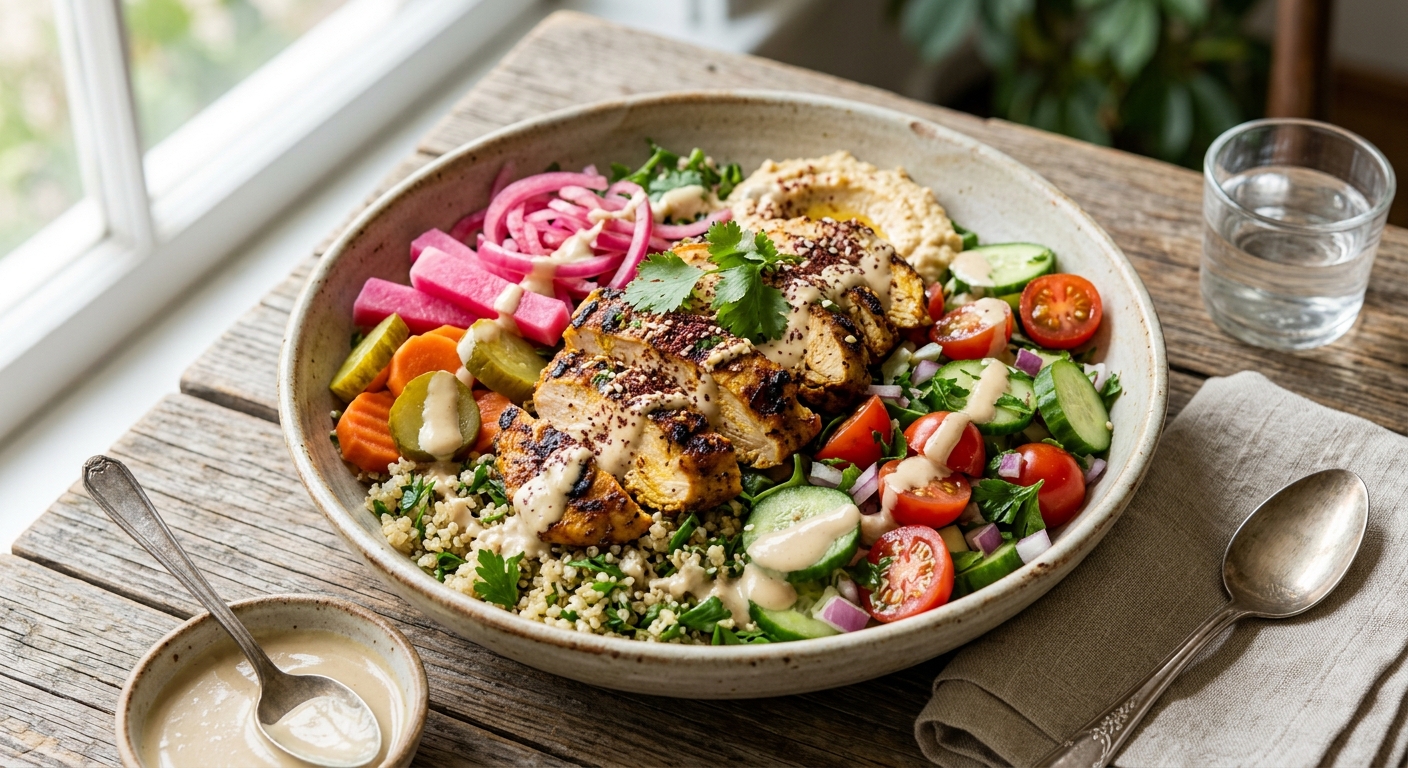
The shawarma bowl is one of the great achievements of Middle Eastern street food tradition, and for good reason: it layers bold spice, rich protein, bright acidity, and creamy fat into a single vessel that manages to feel both indulgent and deeply nourishing. Our Calibrated Cuisine version is engineered from the ground up to hit serious nutritional benchmarks without sacrificing a single gram of flavour. Bone-in, skin-on chicken thighs are marinated in a classic blend of cumin, coriander, smoked paprika, turmeric, cinnamon, and allspice, each spice pulling double duty as both flavour agent and functional micronutrient contributor.
What elevates this bowl beyond ordinary weeknight chicken is the interplay of its components. The tahini drizzle contributes a significant hit of calcium and additional plant-based protein, while the quick-pickled red onion and turnip provide prebiotic fibre and naturally occurring polyphenols that support gut microbiome diversity. The herbed rice base is cooked with a small amount of olive oil and finished with fresh parsley and dill, adding folate, vitamin K, and a clean freshness that cuts through the richness of the chicken and sesame sauce. Together, these four components create a bowl that is far greater than the sum of its parts.
We have tested this recipe across four cooking methods so you can choose the approach that fits your schedule. The stovetop sear gives you the crispiest skin and most deeply caramelised fond. The oven method unlocks true dry-heat roasting for beautifully rendered fat and oven-charred edges. The slow cooker produces impossibly tender, fall-apart chicken perfect for meal prep. And the pressure cooker delivers deeply seasoned, juicy results in under 30 minutes on a weeknight. Every method arrives at the same nutrient-packed destination, just by a different road.
4
servings
Ingredients
- 900 gboneless, skinless chicken thighs
- 3 tbspextra-virgin olive oil, divided
- 4 clovesgarlic, minced
- 2 tspground cumin
- 2 tspsmoked paprika
- 1 tspground coriander
- 1 tspground turmeric
- 0.5 tspground cinnamon
- 0.5 tspground allspice
- 0.5 tspcayenne pepper
- 2 tbspfresh lemon juice
- 300 glong-grain white rice, rinsed
- 600 mllow-sodium chicken stock
- 20 gfresh flat-leaf parsley, finely chopped
- 10 gfresh dill, finely chopped
- 1 mediumred onion, thinly sliced into half-moons
- 200 gturnip, peeled and cut into matchsticks
- 120 mlwhite wine vinegar
- 120 mlwater
- 1 tspgranulated sugar
- 80 gtahini (well-stirred)
- 3 tbspfresh lemon juice (for tahini sauce)
- 1 clovegarlic, grated (for tahini sauce)
- 3 tbspice-cold water (for tahini sauce)
- 1 mediumEnglish cucumber, sliced into half-moons
- 200 gcherry tomatoes, halved
- —Colima Sea SaltMicroplastic Free Salt and freshly cracked black pepper to taste
- —Sumac and chopped fresh parsley to garnish
Instructions
Click on an item below to shop for the recommended items for this recipe on Amazon.
As an Amazon Associate, we earn from qualifying purchases.
- Make the quick pickle first: combine the white wine vinegar, water, 1 tsp sugar, and 1 tsp fine salt in a small saucepan over medium heat. Stir until the sugar and salt dissolve, about 2 minutes. Remove from heat, add the sliced red onion and turnip matchsticks, and press them into the brine. Transfer to a jar or bowl and leave to cool at room temperature for at least 30 minutes while you proceed with the rest of the recipe.
- Combine the minced garlic, cumin, smoked paprika, coriander, turmeric, cinnamon, allspice, cayenne, 2 tablespoons of olive oil, and 2 tablespoons of lemon juice in a large bowl. Season generously with salt and pepper. Add the chicken thighs, toss thoroughly to coat every surface, and marinate at room temperature for 30 minutes (or refrigerate for up to 12 hours for deeper flavour).
- While the chicken marinates, make the herbed rice. Warm 1 tablespoon of olive oil in a medium saucepan over medium heat. Add the rinsed rice and stir to coat the grains in the oil, toasting for 90 seconds until the rice smells faintly nutty. Pour in the chicken stock and bring to a vigorous boil. Reduce the heat to the lowest setting, cover with a tight-fitting lid, and cook undisturbed for 18 minutes. Remove from heat and let steam, still covered, for 5 minutes. Fluff with a fork and fold in the chopped parsley and dill. Season with salt.
- Heat a large cast iron skillet or heavy-bottomed frying pan over medium-high heat until very hot, about 2 minutes. Add the marinated chicken thighs in a single layer, working in batches if needed to avoid crowding. Sear without moving for 5 to 6 minutes until a deep mahogany crust forms on the underside. Flip and cook for another 4 to 5 minutes until the internal temperature reads 74 degrees Celsius (165 degrees Fahrenheit) on an instant-read thermometer. Transfer to a cutting board and rest for 5 minutes.
- While the chicken rests, make the tahini sauce. Whisk together the tahini, 3 tablespoons of lemon juice, and grated garlic in a small bowl. The mixture will seize and thicken. Add the ice-cold water one tablespoon at a time, whisking vigorously after each addition, until the sauce is smooth, pale, and drizzleable. Season with salt. The cold water is key to achieving the emulsified, creamy texture.
- Slice the rested chicken thighs into strips about 1 cm thick, cutting against the grain. Divide the herbed rice among four bowls. Arrange the sliced chicken on top, then add portions of the drained pickled vegetables, fresh cucumber slices, and cherry tomatoes around the bowl. Drizzle generously with tahini sauce, dust with sumac, and finish with a scattering of chopped fresh parsley. Serve immediately.
- Make the quick pickle up to 24 hours in advance for this method, as the longer lead time suits slow cooker meal prep. Dissolve 1 tsp sugar and 1 tsp salt in 120ml white wine vinegar and 120ml water (no heating required for an overnight pickle). Submerge the sliced red onion and turnip matchsticks completely in the brine, cover, and refrigerate until ready to serve.
- Mix the shawarma spice blend: combine the minced garlic, cumin, smoked paprika, coriander, turmeric, cinnamon, allspice, cayenne, and 2 tablespoons of lemon juice in a large bowl. Add only 1 tablespoon of olive oil (less than the stovetop version, since slow cooking creates its own steam and moisture). Season well with salt and pepper. Add the chicken thighs and coat thoroughly. You do not need to marinate separately as the long cook time will fully infuse the flavour.
- Layer the spice-coated chicken thighs in a single layer in the slow cooker insert. If you need to stack them, overlap slightly rather than folding, and place the larger thighs on the bottom. Add 60ml of chicken stock to the base to prevent scorching at the start of cooking. Cover and cook on Low for 6 to 7 hours or on High for 3 to 3.5 hours, until the chicken is completely tender and reads 74 degrees Celsius internally.
- About 25 minutes before serving, cook the herbed rice on the stovetop. Toast the rinsed rice in 1 tablespoon of olive oil in a saucepan for 90 seconds, then add the chicken stock and cook covered on the lowest heat for 18 minutes. Steam off heat for 5 minutes, then fluff and fold in the parsley and dill.
- Transfer the cooked chicken to a cutting board. Pour the accumulated braising juices from the slow cooker insert into a small saucepan and bring to a boil over high heat. Reduce for 3 to 4 minutes until the liquid is glossy and slightly thickened. While the juices reduce, pull the chicken into chunky shreds using two forks, or slice into strips. Toss the shredded chicken in the reduced pan sauce.
- Make the tahini sauce by whisking together the tahini, lemon juice, grated garlic, and ice-cold water tablespoon by tablespoon until smooth and drizzleable. Season with salt. Assemble the bowls with herbed rice as the base, the saucy shredded chicken on top, and the drained pickled vegetables, fresh cucumber, and cherry tomatoes arranged around it. Drizzle with tahini sauce and finish with sumac and parsley.
- Make the quick pickle while the pressure cooker preheats. Dissolve 1 tsp sugar and 1 tsp salt in the vinegar and water in a small saucepan over medium heat, about 2 minutes. Add the sliced onion and turnip, press into the brine, and set aside to pickle at room temperature. Even 20 to 25 minutes will produce pleasantly tangy, lightly softened vegetables.
- Mix the shawarma marinade in a large bowl: minced garlic, all the spices, 1 tablespoon of olive oil, and 2 tablespoons of lemon juice. Season with salt and pepper. Coat the chicken thighs thoroughly in the marinade.
- Set your Instant Pot or electric pressure cooker to the Saute function on High. Add 2 tablespoons of olive oil. Once shimmering, sear the chicken thighs in a single layer for 3 minutes per side without moving them. You will likely need to work in two batches. Searing concentrates the Maillard flavour compounds and prevents the finished dish from tasting steamed. Remove the seared chicken and set aside.
- With the Saute function still on, pour 80ml of chicken stock into the hot pot and scrape up all the dark, spiced fond from the bottom using a wooden spoon or silicone spatula. This deglazing step is critical to prevent a burn warning during pressurisation. Return the chicken thighs to the pot, layering them in the liquid. Cancel the Saute function.
- Seal the lid and set the valve to Sealing. Cook at High Pressure for 10 minutes. While the cooker pressurises and cooks, prepare the herbed rice on the stovetop and make the tahini sauce: whisk together the tahini, lemon juice, grated garlic, and ice-cold water until smooth, pale, and pourable.
- When the cook time ends, allow a natural pressure release for 5 minutes, then carefully switch the valve to Venting to release the remaining pressure. Open the lid, check that the chicken reaches 74 degrees Celsius, and transfer to a cutting board. Slice into strips or shred with two forks. Assemble the bowls with herbed rice, sliced or shredded chicken, drained pickled vegetables, cucumber, and tomatoes. Drizzle with tahini sauce, dust with sumac, and garnish with fresh parsley.
- Make the quick pickle at the start so it has maximum time to develop. Dissolve 1 tsp sugar and 1 tsp salt in the vinegar and water in a small saucepan over medium heat, 2 minutes. Add the sliced red onion and turnip matchsticks, press into the brine, and refrigerate. The oven method gives the pickles more time to mellow beautifully.
- Combine the minced garlic, all shawarma spices, 2 tablespoons of olive oil, and 2 tablespoons of lemon juice in a large bowl. Season assertively with salt and pepper. Add the chicken thighs and coat every surface in the marinade. For the oven method, marinate for a minimum of 30 minutes at room temperature, or for up to 12 hours in the refrigerator. The longer marination allows the lemon juice to slightly tenderise the surface and the spices to penetrate more deeply, which maximises browning under dry oven heat.
- Position a rack in the upper third of the oven and preheat to 220 degrees Celsius (425 degrees Fahrenheit). Line a large rimmed baking sheet with foil and set a wire rack on top. Spray or brush the rack lightly with oil. Arrange the marinated chicken thighs on the rack in a single layer with space between each piece. Elevating the chicken on a rack allows hot air to circulate underneath, rendering the underside evenly rather than steaming in its own juices.
- Roast on the upper rack for 25 minutes, then switch the oven to the Broil (Grill) setting on High and broil for 3 to 5 minutes, watching closely, until the surface is deeply charred in spots and caramelised like spit-roasted shawarma. The chicken is done when an instant-read thermometer inserted into the thickest part reads 74 degrees Celsius. Remove from the oven and rest on the rack for 5 to 7 minutes.
- While the chicken roasts, cook the herbed rice. Toast the rinsed rice in 1 tablespoon of olive oil in a medium saucepan for 90 seconds. Add the chicken stock, bring to a boil, cover tightly, and cook on the lowest heat for 18 minutes. Steam off heat for 5 minutes, then fluff and fold in the chopped parsley and dill.
- Make the tahini sauce while the chicken rests: whisk together the tahini, lemon juice, grated garlic, and ice-cold water one tablespoon at a time until you achieve a smooth, pale, drizzleable consistency. Season with salt. Slice the rested roasted chicken crosswise into thick strips. Assemble the bowls with herbed rice, arranged chicken strips, drained pickled vegetables, fresh cucumber slices, and cherry tomatoes. Drizzle liberally with tahini sauce, dust with sumac, and scatter chopped fresh parsley over the top.
Nutrition Breakdown
Per 1 serving (makes 4)
Vitamins & Minerals
% Daily Value based on a 2,000 calorie diet (FDA reference)
🧬 Essential Amino Acids
% of recommended daily intake (RDA) per serving
🛡 Antioxidant Profile
The Nutrition Science
Chicken thighs are one of the most nutritionally complete single-ingredient proteins available in a home kitchen. A 225g serving of cooked boneless thigh meat delivers roughly 40 to 45 grams of complete protein containing all nine essential amino acids in amounts that exceed the RDA for a 70kg adult, making this bowl a genuinely efficient vehicle for muscle protein synthesis. The dark meat also contributes significantly more iron, zinc, and B vitamins than breast meat, with roughly 15 to 20% more haem iron per gram of protein. Haem iron has a bioavailability of approximately 25 to 30% compared to 5 to 12% for non-haem plant iron, making chicken thighs one of the most absorbable iron sources in the human diet. The vitamin C contributed by fresh lemon juice and parsley in this recipe further enhances non-haem iron absorption from the rice and spice blend by reducing ferric iron (Fe3+) to the more readily absorbed ferrous form (Fe2+).
The shawarma spice blend is not merely a flavour delivery system. Turmeric contains curcumin, a polyphenol with well-documented anti-inflammatory properties that works by inhibiting the NF-kB transcription pathway. Curcumin is fat-soluble, and its bioavailability is dramatically enhanced in the presence of dietary fat, which the olive oil and tahini in this recipe provide in abundance. Similarly, the piperine-adjacent compounds in black pepper can increase curcumin bioavailability by up to 20-fold according to in vivo studies. Smoked paprika contributes beta-carotene and capsanthin, both carotenoid antioxidants that are also fat-soluble and benefit from the co-consumption of olive oil for optimal absorption. Cumin provides plant-based iron as well as compounds such as cuminaldehyde that have been studied for antimicrobial and digestive enzyme-stimulating activity.
Tahini deserves particular attention as a nutritional ingredient in its own right. Made from ground sesame seeds, it is a concentrated source of calcium (approximately 130mg per 2 tablespoons), plant-based protein, and the unique lignans sesamin and sesamolin, which are not found in significant amounts in most other foods. These lignans function as phyto-oestrogens and lipid antioxidants and have been associated in observational studies with improved lipid profiles and reduced oxidative stress markers. The quick-pickled red onion and turnip contribute quercetin and glucosinolates respectively, and the acidic brine environment increases the bioavailability of quercetin by disrupting the cell walls of the onion more effectively than raw preparation alone.
Pro Tips
- For the most shawarma-authentic flavour, marinate the chicken overnight in the refrigerator. The lemon juice gently denatures surface proteins while the spices penetrate deeper into the meat, and the longer resting time allows the fat-soluble spice compounds to fully dissolve into the olive oil marinade.
- The secret to a perfectly smooth, pale tahini sauce is using ice-cold water and adding it slowly while whisking continuously. Cold water causes the proteins and fats in the sesame paste to emulsify rather than separate. If your sauce breaks or becomes grainy, add a few more drops of cold water and whisk vigorously.
- Do not skip resting the chicken after cooking. Resting for 5 to 7 minutes allows the myofibrillar proteins to relax and the muscle fibres to reabsorb released juices, resulting in visibly juicier sliced meat. Cutting immediately after cooking can result in losing up to 40% of the internal juices onto the cutting board.
ooh the pickled vegetables have me so excited!! are those fermented or just quick pickled in vinegar? because if youre open to it, fermented pickles would take the probiotic content through the roof and honestly pair even better with all that tahini, the creaminess plus the funky complexity is *chef’s kiss* i do a quick fermented veggie situation with salt brine and theyre ready in like 3-5 days, way less vinegary bite too. but either way this bowl is hitting so many microbiome-friendly notes with the chicken thighs, tahini, and those spices, looks absolutely delicious!
Great catch on the fermentation question, Kirsten. I’m curious too since the iron bioavailability here is already solid with the vitamin C from those pickled veggies, but fermented versions would add another layer. That said, I’m wondering about the total carb load on this bowl – is the herbed rice a standard white/brown blend or something more strategic? I’ve been experimenting with adding cauliflower rice to my post-ride bowls to keep carbs moderate on recovery days while maintaining protein, since my power data shows I perform better on hard days when I’m not overly carbed on easy days. Either way, 52% DV protein per serving is exactly the density I
The protein density here is solid, but I’m more interested in whether that 52% DV breaks down properly across meals – what’s the leucine hit per serving? I’m 67 and learned the hard way that it’s not just total protein, it’s distribution and hitting that 2.5-3g leucine threshold per meal for muscle protein synthesis. On that rice question, I’d actually lean toward standard brown rice over cauliflower rice for post-exercise, especially if you’re doing resistance work too – your muscles need those carbs to shuttle amino acids in, and the whole grains add more B6 which matters for protein metabolism at our age. Curious what your actual grams of chicken th
Love this angle, Kirsten. Quick pickled in vinegar still gives you that ascorbic acid boost for non-heme iron absorption from the chicken thighs, which is clutch, but you’re right that fermented versions would add the probiotic layer. From a protein utilization standpoint though, what really caught my eye is the chicken thigh choice here instead of breast – you’re looking at a DIAAS score that’s slightly lower on paper, but the fat content actually helps with micronutrient absorption and those thighs have way more bioavailable zinc and iron per serving. The tahini adds sesame lignans too, which some research suggests can help with mineral bioavail
yeah thighs over breast is the move, especially if youre optimizing for zinc and iron absorption – ive seen clients get way better mineral status switching that one thing alone. the fat solubility piece is real, fat-soluble vitamins and minerals absorb better with dietary fat, so that tahini drizzle is doing heavy lifting there too. one thing id push back on though – DIAAS scores matter less to me than total bioavailable intake, and honestly if someone’s getting consistent zinc and iron from food sources like this, thats worth more than chasing a “perfect” amino acid profile on paper. personally id want to see what the actual zinc content lands at per serving since that sesame
oh YES to the thighs over breast take, the fat situation is honestly game changing for nutrient absorption! but ok real talk, have you ever tried fermenting those pickled veggies instead of quick pickling? like i know the vinegar already helps with iron bioavailability but lacto-fermented versions would give you that extra probiotic punch plus extend the fermentation time naturally increases mineral availability even more. ive been experimenting with fermented veggie combos for my iron absorption and the difference is wild, especially when paired with sesame (the zinc density in tahini is already incredible). would love to know your take on whether your clients have noticed differences between quick pickled vs fermented in their