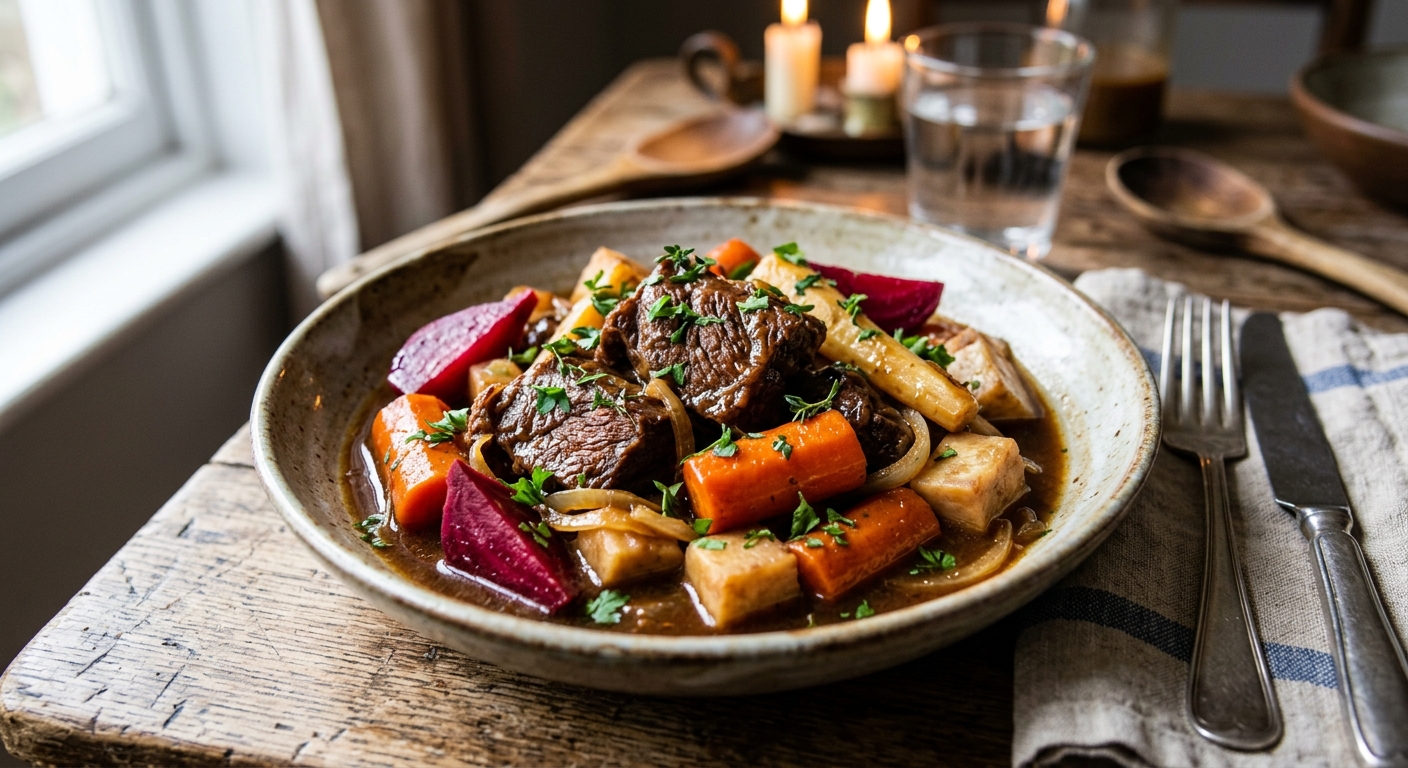
Few traditions in Eastern European cooking are as compelling as the use of kvass, a mildly fermented beverage made from rye bread, as a braising liquid. Dating back centuries in Russian, Ukrainian, and Polish kitchens, kvass-braised meats were not simply a culinary choice but a practical one: the gentle acidity of fermented kvass tenderizes tough cuts of beef while imparting a subtle, complex sourness that no amount of added vinegar can replicate. At Calibrated Cuisine, we honor that tradition and amplify it with a lineup of root vegetables chosen specifically for their anti-inflammatory credentials.
The star braising liquid here is unsweetened rye kvass, which contributes live organic acids, B vitamins, and a modest probiotic load that survives the initial high-heat sear before mellowing into the braise. Combined with beef chuck, one of the most collagen-rich cuts available, the result is a silky, deeply flavored broth thickened entirely by the natural gelatin released during long cooking. Parsnips, carrots, celeriac, and beetroot are not merely side characters: each brings its own distinct phytonutrient payload, from the betalains of beetroot to the falcarinol in carrots, creating a dish that works at the cellular level as well as satisfying deeply at the table.
What makes this recipe exceptional from a nutritional standpoint is the synergy between ingredients. Vitamin C from the root vegetables enhances the absorption of the non-heme iron in the beef braising juices. The fat-soluble carotenoids in carrots and parsnips are made bioavailable by the modest fat content of the chuck and the finishing drizzle of extra-virgin olive oil. A single serving delivers over a third of your daily iron needs, more than half your daily vitamin A requirement, and meaningful amounts of folate, potassium, and zinc, all within approximately 480 calories.
4
servings
Ingredients
- 900 gbeef chuck, cut into 5cm pieces, patted dry
- 500 mlunsweetened rye kvass (store-bought or homemade)
- 250 mllow-sodium beef stock
- 300 gcarrots, peeled and cut into 3cm chunks
- 250 gparsnips, peeled and cut into 3cm chunks
- 250 gceleriac, peeled and cut into 3cm cubes
- 200 graw beetroot, peeled and cut into 3cm wedges
- 2 mediumyellow onions, halved and thinly sliced
- 4 clovesgarlic, smashed
- 2 tbsptomato paste
- 2 tbspextra-virgin olive oil
- 1 tbspapple cider vinegar
- 2 tspcaraway seeds, lightly crushed
- 1 tspsmoked paprika
- 2 wholedried bay leaves
- 4 sprigsfresh thyme
- 2 sprigsfresh rosemary
- 15 gfresh flat-leaf parsley, roughly chopped, for serving
- —Colima Sea SaltMicroplastic Free Salt and freshly ground black pepper to taste
Instructions
Click on an item below to shop for the recommended items for this recipe on Amazon.
As an Amazon Associate, we earn from qualifying purchases.
- Season the beef chuck pieces generously on all sides with fine sea salt and freshly ground black pepper. Heat 1 tablespoon of the olive oil in a large Dutch oven over medium-high heat until shimmering. Working in two batches to avoid crowding, sear the beef for 3 to 4 minutes per side until a deep mahogany crust forms. Transfer the seared beef to a plate and set aside. Discard any burnt fat but leave the fond intact.
- Reduce the heat to medium and add the remaining tablespoon of olive oil to the Dutch oven. Add the sliced onions with a pinch of salt and cook, stirring occasionally, for 10 to 12 minutes until softened and beginning to turn golden. Add the smashed garlic, crushed caraway seeds, and smoked paprika. Cook for 1 minute, stirring constantly, until fragrant. Stir in the tomato paste and cook for another 2 minutes, allowing it to caramelize slightly against the bottom of the pot.
- Pour in the kvass and beef stock, scraping up all the caramelized bits from the bottom of the pot with a wooden spoon. Return the seared beef and any accumulated juices to the pot. Add the bay leaves, thyme sprigs, and rosemary sprigs. Bring the liquid to a vigorous simmer over medium-high heat, then immediately reduce the heat to low so the surface barely trembles. Cover tightly with a lid.
- After 1 hour of gentle simmering, nestle the carrots, parsnips, celeriac, and beetroot wedges around the beef. The vegetables go in at this stage rather than at the beginning to prevent them from disintegrating. Re-cover the pot and continue cooking on low for a further 1 hour to 1 hour 15 minutes, until the beef yields easily to a fork and the vegetables are completely tender but still holding their shape.
- Uncover the pot and remove the bay leaves, thyme sprigs, and rosemary sprigs. Increase the heat to medium and simmer the braise uncovered for 10 to 15 minutes to concentrate the braising liquid into a glossy, spoon-coating sauce. Stir in the apple cider vinegar, taste for seasoning, and adjust with salt and pepper. Ladle into warmed bowls and finish each serving with a scatter of freshly chopped flat-leaf parsley.
- Season the beef chuck pieces well with salt and pepper. Heat 1 tablespoon of olive oil in a large skillet over medium-high heat until shimmering. Sear the beef in two batches, 3 to 4 minutes per side, until deeply browned on all surfaces. Transfer to the slow cooker insert. Without cleaning the skillet, reduce heat to medium and add the remaining olive oil.
- Add the sliced onions to the skillet with a pinch of salt and cook for 8 to 10 minutes until softened and golden. Add the garlic, crushed caraway seeds, and smoked paprika, stirring for 1 minute. Add the tomato paste and cook for 2 minutes until darkened. Pour in the kvass and beef stock, scraping up all the caramelized bits. Bring to a brief simmer for 2 minutes, then pour the entire contents of the skillet over the beef in the slow cooker.
- Tuck the bay leaves, thyme, and rosemary sprigs around the beef. Place the beetroot wedges at the bottom of the slow cooker, directly against the heat source, as they require the longest time to become tender. Set the cooker to Low and cook undisturbed for 6 hours.
- After 6 hours, add the carrots, parsnips, and celeriac on top of the beef. Replace the lid and continue cooking on Low for a further 2 hours, or until both the beef and all vegetables are fully tender. Adding these vegetables late prevents them from turning to mush during the long cook.
- Using a slotted spoon, transfer the beef and vegetables to a serving dish and tent loosely with foil. Pour the braising liquid into a wide saucepan and bring to a boil over high heat. Cook for 8 to 12 minutes until reduced by about one-third and lightly thickened. Stir in the apple cider vinegar, taste for seasoning, then pour the sauce back over the beef and vegetables. Discard the herb sprigs and bay leaves, and scatter with fresh parsley before serving.
- Set your Instant Pot or electric pressure cooker to Saute on High (or use the stovetop saute function on a stove-top pressure cooker). Add 1 tablespoon of olive oil and, once shimmering, sear the seasoned beef in two batches for 3 to 4 minutes per side until well browned. Remove the beef to a plate. The Maillard crust developed here will be the primary source of flavor depth since the pressure environment limits further browning.
- Without draining the pot, add the remaining olive oil. Add the sliced onions and cook, stirring frequently, for 6 to 7 minutes until softened. Add the garlic, caraway seeds, and smoked paprika, stirring for 30 seconds. Add the tomato paste and cook for 90 seconds. Pour in 100ml of the kvass and use a flat-edged spatula to thoroughly deglaze the bottom of the pot, ensuring no browned bits remain stuck. Stuck fond will trigger a burn warning.
- Return the seared beef to the pot. Add the remaining kvass and the beef stock. Nestle the beetroot wedges, carrots, parsnips, and celeriac around the beef. All the root vegetables go in together here because the shorter cook time means they will not over-soften. Submerge the bay leaves, thyme, and rosemary beneath the liquid. The liquid should just barely cover the ingredients. If it does not, add a splash more stock rather than more kvass.
- Seal the pressure cooker lid and set the valve to Sealing. Cook on High Pressure for 45 minutes. Once the cycle completes, allow the pressure to release naturally for at least 20 minutes before carefully turning the valve to Venting to release any remaining steam. Open the lid away from you.
- Carefully remove the beef and vegetables to a warmed serving dish. Switch the Instant Pot back to Saute on High and boil the braising liquid for 8 to 10 minutes, stirring occasionally, until reduced to a sauce consistency. Stir in the apple cider vinegar and season to taste. Discard the herb sprigs and bay leaves. Pour the sauce over the beef and vegetables, scatter generously with fresh parsley, and serve immediately.
- Preheat your oven to 160C (320F) with a rack positioned in the lower third. Season the beef generously with salt and pepper. Heat 1 tablespoon of olive oil in a large oven-safe Dutch oven over medium-high heat on the stovetop. Sear the beef in two batches, 3 to 4 minutes per side, until a deep crust forms. Transfer to a plate. The lower oven temperature means this stovetop sear is the only significant Maillard browning the beef will receive, so do not rush it.
- Reduce the stovetop heat to medium. Add the remaining olive oil and cook the sliced onions for 10 to 12 minutes until golden. Add the garlic, caraway seeds, and smoked paprika, cooking for 1 minute. Stir in the tomato paste and cook for 2 minutes. Deglaze with the kvass and beef stock, scraping up every bit of fond. Bring to a simmer and cook for 3 minutes.
- Return the seared beef and its juices to the Dutch oven. The liquid should reach approximately halfway up the sides of the beef, not submerge it: oven braising uses less liquid than stovetop because evaporation is much slower in a sealed pot. Tuck in the bay leaves, thyme, and rosemary. Nestle the beetroot wedges around the beef pieces at this stage, as their longer cook time matches the full oven time.
- Bring the liquid back to a simmer on the stovetop, then cover the Dutch oven with its lid and transfer to the preheated oven. Braise for 1 hour 30 minutes undisturbed. Then, carefully remove the lid, add the carrots, parsnips, and celeriac around the beef, pressing them gently into the braising liquid. Replace the lid and return to the oven for a further 1 hour to 1 hour 15 minutes until the beef is fork-tender and the vegetables are soft throughout.
- Remove the Dutch oven from the oven and allow it to rest, uncovered, for 10 minutes. The braising liquid should already be fairly concentrated from the sealed oven environment. If you prefer a thicker sauce, set the Dutch oven over medium heat on the stovetop for 5 to 8 minutes. Stir in the apple cider vinegar, discard the herb sprigs and bay leaves, and season to taste. Serve directly from the Dutch oven at the table, scattered with fresh parsley.
Nutrition Breakdown
Per 1 serving (makes 4)
Vitamins & Minerals
% Daily Value based on a 2,000 calorie diet (FDA reference)
🧬 Essential Amino Acids
% of recommended daily intake (RDA) per serving
🛡 Antioxidant Profile
The Nutrition Science
The anti-inflammatory power of this dish operates through several distinct and complementary mechanisms. Beef chuck from grass-fed cattle provides a favorable omega-6 to omega-3 ratio (closer to 2:1 versus the 8:1 typical of grain-fed beef), which directly shifts the balance of eicosanoid production away from pro-inflammatory prostaglandins. The collagen released during the long braise breaks down into glycine-rich gelatin. Glycine is a conditionally essential amino acid that suppresses the activation of macrophages and the downstream production of TNF-alpha and IL-6, two of the most well-studied inflammatory cytokines in chronic disease.
Beetroot betalains deserve particular attention. These nitrogen-containing pigments, primarily betanin and isorhamnetin, are not carotenoids and are not found in any other common vegetable group. Clinical trials have demonstrated that betanin inhibits the COX-2 enzyme pathway at doses achievable through dietary intake, roughly equivalent to 100 to 200g of cooked beetroot, which this recipe provides per serving. The red-purple color bleeding into the braising liquid is not just visually dramatic: it is a direct indicator of betalain concentration, and adding the beetroot mid-cook rather than at the start preserves a greater proportion of these heat-sensitive compounds.
Rye kvass contributes more than flavor complexity. Unpasteurized or minimally processed kvass contains measurable amounts of B vitamins, particularly B1 (thiamine) and B6, produced as metabolic byproducts of the Lactobacillus fermentation of rye bread. While high-heat braising deactivates the live cultures, the organic acids they produce remain structurally intact and acidify the braising medium to approximately pH 4.0 to 4.5. This acidity actively tenderizes the beef collagen, achieves the same physical effect as a 24-hour acidic marinade, and simultaneously increases the solubility of non-heme iron from the beef, improving absorption in the small intestine by an estimated 30 to 50 percent compared to cooking in a neutral liquid such as plain stock.
Pro Tips
- Source rye kvass from Eastern European delicatessens or health food stores, and choose an unsweetened variety: sweetened kvass will cause the sauce to over-caramelize and become bitter during reduction. If kvass is unavailable, substitute 350ml of a dark, malty beer (such as a Czech dark lager or porter) plus 150ml of water with a teaspoon of apple cider vinegar stirred in.
- Do not peel or trim the beetroot until immediately before cooking, as the skin acts as a protective barrier that slows oxidation and nutrient loss. Wearing disposable gloves during preparation prevents staining, and adding a small splash of vinegar to your cutting board will prevent betalain pigments from transferring to other vegetables.
- For maximum anti-inflammatory benefit, finish each bowl with a light drizzle of cold extra-virgin olive oil (about half a teaspoon) added after ladling. The oleocanthal in raw EVOO is heat-sensitive and degrades significantly above 75C, so adding it post-cooking preserves its ibuprofen-like COX-inhibiting properties while adding a fruity, peppery counterpoint to the earthy braise.
This is such a thoughtfully constructed dish for reducing inflammation! I’m curious about the kvass fermentation timeline here, since the longer fermentation typically increases lactic acid bacteria and reduces the glycemic load, Ben. For my clients who are plant-based, I often recommend pairing fermented foods with plant proteins that need a little extra help with nutrient absorption, so seeing this kvass-braised approach makes me wonder if the same fermentation benefits (better mineral bioavailability) would translate if someone did a mushroom or legume version. Have you noticed any difference in how the fermentation affects the bioavailability of the iron from the beef, or is that something you’re tracking too?
Oh Ben, I love that you’re tracking this so carefully! I’ve had similar observations with fermented foods, though I’ve mostly focused on how the fermentation itself seems to reduce my CRP levels compared to regular carbs. I’d be really curious to see that 2019 study you mentioned, because the kvass fermentation process has been so helpful for my joint inflammation over the years – I’m wondering if the lactic acid bacteria might be playing a bigger role than just the carb content itself. Have you noticed whether longer fermentation times (if you’re making your own) make a difference in your CGM response?
This is exactly the kind of dish I’ve been testing lately, curious if you have glycemic impact data on the kvass component specifically? I’ve noticed my CGM responds differently to fermented beverages vs fresh carbs, and a 2019 study in Nutrients showed fermentation can reduce the glycemic load of carbohydrate sources by up to 30%, but I’m wondering if that holds for kvass at the serving sizes you’re using here. Also would love to know the omega-3 to omega-6 ratio if you’ve calculated it, since the grass-fed beef quality really does matter for that anti-inflammatory marker.