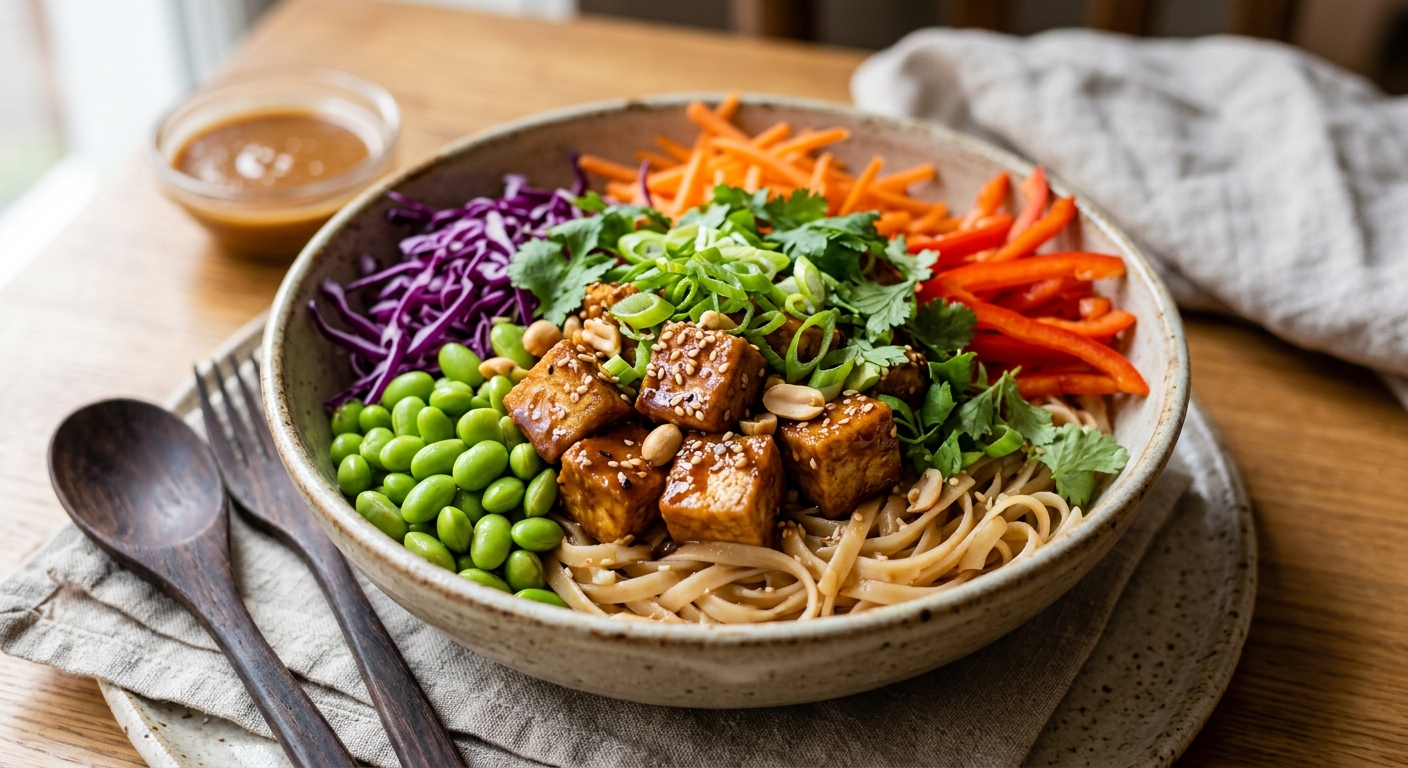
There is a reason peanut noodle bowls appear on nearly every high-performance plant-based athlete’s rotation: they are dense, satisfying, and astonishingly well-balanced. This version pairs extra-firm tofu pressed to golden perfection with thin rice noodles, julienned carrots and red cabbage, edamame, and a peanut sauce built on natural peanut butter, tamari, rice vinegar, fresh ginger, garlic, lime, and a whisper of chili. Every component was chosen not just for flavor but for its measurable contribution to your daily nutrient targets.
What separates this recipe from generic peanut noodle dishes is the deliberate layering of protein sources. Tofu contributes all nine essential amino acids, edamame adds a particularly high lysine load (the amino acid most limiting in grain-heavy diets), and peanut butter layers in additional leucine and arginine. Together they create a protein profile that rivals many omnivore meals, landing this bowl firmly in the territory of a genuine muscle-repair and recovery food, not just a trendy lunch.
We have developed three genuinely distinct preparation methods so that whether you are cooking for a weeknight dinner in twenty minutes, batch-cooking on a Sunday afternoon in the slow cooker, or pressure-cooking a week’s worth of sauce-braised tofu in under fifteen minutes of active time, this recipe fits your rhythm. The stovetop method produces the crispiest tofu. The slow cooker produces deeply marinated, meltingly tender tofu cubes with a richer sauce. The pressure cooker delivers an almost confit-like tofu texture with remarkably concentrated flavor in a fraction of the time.
4
servings
Ingredients
- 400 gextra-firm tofu, pressed for at least 30 minutes and cut into 2cm cubes
- 200 gdry rice noodles (thin or medium width, 3mm recommended)
- 180 gshelled edamame, thawed if frozen
- 2 mediumcarrots, julienned or coarsely grated
- 150 gred cabbage, finely shredded
- 4 stalksspring onions, thinly sliced
- 1 mediumred bell pepper, thinly sliced
- 30 gfresh cilantro leaves
- 20 gfresh mint leaves
- 30 groasted unsalted peanuts, roughly chopped
- 1 tbspsesame seeds, toasted
- 130 gnatural smooth peanut butter (no added sugar or oil)
- 60 mltamari (gluten-free soy sauce)
- 45 mlrice vinegar
- 30 mlfresh lime juice (approximately 2 limes)
- 20 mltoasted sesame oil
- 15 mlpure maple syrup
- 15 gfresh ginger, finely grated
- 3 clovesgarlic, minced
- 1 tspchili garlic sauce (sambal oelek or sriracha), adjust to taste
- 60 mlwarm water, to thin the sauce
- 15 mlAvocado Oil100% Pure Avocado Oil (avocado or sunflower), for stovetop and oven methods
- —Colima Sea SaltMicroplastic Free Salt and white pepper to taste
- —Lime wedges and extra chili sauce to serve
Instructions
Click on an item below to shop for the recommended items for this recipe on Amazon.
As an Amazon Associate, we earn from qualifying purchases.
- Press your tofu: Wrap the block in a clean kitchen towel, place it on a flat surface, and set a heavy cutting board or cast iron pan on top for at least 30 minutes. Cut into 2cm cubes and pat dry once more with paper towels.
- Make the peanut sauce: In a medium bowl, whisk together the peanut butter, tamari, rice vinegar, lime juice, sesame oil, maple syrup, grated ginger, minced garlic, and chili garlic sauce until smooth. Add warm water one tablespoon at a time until the sauce reaches a pourable but coating consistency (similar to heavy cream). Taste and adjust seasoning. Set aside.
- Cook the noodles: Bring a large pot of unsalted water to a rolling boil. Add the rice noodles and cook according to package directions, usually 4 to 6 minutes for 3mm noodles, until just tender but with a slight chew. Drain, rinse immediately under cold running water to stop cooking and prevent sticking, then toss with a small drizzle of sesame oil to keep them separate. Set aside.
- Sear the tofu: Heat the neutral oil in a large non-stick skillet or well-seasoned cast iron pan over medium-high heat until it shimmers. Add the tofu cubes in a single layer with space between them (work in two batches if needed). Cook undisturbed for 3 to 4 minutes until a deep golden crust forms on the bottom. Flip each cube and sear for another 2 to 3 minutes per side, rotating to get color on at least three faces. Season lightly with salt and white pepper. Remove from heat.
- Warm the edamame: In the same pan over medium heat, add the edamame with a splash of water and toss for 2 minutes until heated through. Remove and set aside.
- Assemble the bowls: Divide the noodles among four bowls. Spoon a generous amount of peanut sauce over each portion and toss gently with tongs to coat. Arrange the seared tofu, edamame, julienned carrots, shredded red cabbage, and sliced red bell pepper over the noodles. Top with spring onions, cilantro, mint, chopped peanuts, and toasted sesame seeds. Serve immediately with lime wedges and extra chili sauce on the side.
- Press and prepare the tofu: Press the tofu for at least 30 minutes as described, then cut into slightly larger 3cm cubes to prevent them from breaking down completely during the long, gentle cook.
- Build the braising sauce: In the slow cooker insert, whisk together the peanut butter, tamari, rice vinegar, lime juice, sesame oil, maple syrup, grated ginger, minced garlic, and chili garlic sauce. Use only 30ml of warm water rather than 60ml, as the slow cooker traps steam and the sauce will thin naturally. Stir until completely smooth.
- Add the tofu: Gently fold the pressed tofu cubes into the sauce, turning each piece to coat well. Nestle the sliced red bell pepper and half of the julienned carrots into the sauce as well (they will soften and sweeten during cooking). Place the lid on the slow cooker and cook on Low for 3 hours. Do not lift the lid during the first 2 hours.
- Finish and check: At the 3-hour mark, gently stir the tofu. The sauce should be thick, glossy, and clinging to the tofu. If it looks too thick, stir in a tablespoon or two of warm water. Taste and adjust with an extra squeeze of lime juice or a dash of tamari if needed. Keep the slow cooker on Warm while you prepare the noodles and fresh toppings.
- Cook the noodles: Bring a large pot of unsalted water to a boil. Cook the rice noodles for 4 to 6 minutes until just tender, drain, and rinse under cold water. Toss with a small drizzle of sesame oil.
- Assemble: Divide noodles among four bowls. Spoon the braised tofu and its sauce generously over the noodles. Top with the remaining raw julienned carrot (for textural contrast with the softened cooked carrot), shredded red cabbage, warm edamame (microwaved 2 minutes from frozen), spring onions, cilantro, mint, chopped peanuts, and sesame seeds. Serve with lime wedges.
- Press and cube the tofu: Press for at least 30 minutes, then cut into 2.5cm cubes. Pat completely dry with paper towels.
- Make the pressure-cooking sauce: In the Instant Pot insert (with it turned off), whisk together the peanut butter, tamari, rice vinegar, lime juice, sesame oil, maple syrup, grated ginger, minced garlic, and chili garlic sauce. Add the full 60ml of warm water and whisk until smooth. The pressure cooking environment concentrates flavors, so err on the side of a slightly thinner sauce here. Add the sliced red bell pepper as well.
- Add the tofu and pressure cook: Gently add the tofu cubes to the sauce and turn them gently to coat. Secure the Instant Pot lid, set the valve to Sealing, and cook on Manual High Pressure for 5 minutes. When the cycle completes, allow a full natural pressure release of 10 minutes (do not quick-release, as the sudden pressure drop can make tofu spongy and cause the peanut sauce to splatter). After 10 minutes, carefully turn the valve to Venting to release any remaining pressure.
- Reduce the sauce (optional): If the sauce looks thin after opening, switch the Instant Pot to Saute mode on Low and simmer uncovered for 2 to 3 minutes, stirring gently, until the sauce thickens and glazes the tofu. Stir in the edamame during this step and let it warm through for 1 to 2 minutes. Taste and finish with an extra squeeze of lime juice.
- Cook the noodles: While the pressure releases naturally, bring a pot of water to a boil and cook the rice noodles for 4 to 6 minutes. Drain, rinse under cold water, and toss with sesame oil.
- Assemble: Divide the noodles among four bowls. Ladle the peanut-glazed tofu and edamame over the top with plenty of sauce. Add raw shredded cabbage, julienned carrots, spring onions, cilantro, mint, chopped peanuts, and sesame seeds. Serve immediately with lime wedges and extra chili sauce.
- Preheat and prep: Preheat the oven to 210C (410F) with convection/fan if available. Line a large rimmed baking sheet with parchment paper. Press and cube the tofu into 2cm pieces, then pat completely dry.
- Make a tofu marinade and the finishing sauce: Reserve half of the peanut sauce for serving (the full sauce recipe as written). From the remaining half, toss the tofu cubes directly in a bowl with about 80ml of this peanut sauce, coating each piece well. The sauce will caramelize and crisp in the oven. Spread the coated tofu in a single layer on the prepared baking sheet, leaving space between each cube so hot air can circulate.
- Roast the tofu: Place the baking sheet on the middle rack and roast for 15 minutes. Remove the pan and, using a thin spatula, flip each tofu cube carefully. Return to the oven for another 12 to 15 minutes until the edges are deeply golden and the sauce has caramelized to a sticky glaze. The tofu should feel firm and slightly chewy with dark caramelized patches. Watch closely in the final 5 minutes as peanut butter can transition from perfectly caramelized to burnt quickly.
- Roast the bell pepper and carrots (optional): On a second baking sheet, toss the sliced red bell pepper and half of the julienned carrots with the neutral oil and a pinch of salt. Roast on the upper rack for the final 15 minutes of the tofu roasting time, until softened and lightly charred at the edges.
- Cook the noodles: While the tofu roasts, bring a large pot of water to a boil and cook the rice noodles for 4 to 6 minutes. Drain, rinse under cold water, and toss with a small amount of sesame oil. Warm the edamame in a small pan with a splash of water for 2 minutes.
- Assemble: Divide noodles among four bowls. Drizzle generously with the reserved peanut sauce and toss. Arrange the roasted tofu, roasted vegetables, raw shredded cabbage, remaining fresh carrots, edamame, spring onions, cilantro, mint, chopped peanuts, and sesame seeds on top. Finish with a squeeze of lime and serve extra chili sauce alongside.
Nutrition Breakdown
Per 1 serving (makes 4)
Vitamins & Minerals
% Daily Value based on a 2,000 calorie diet (FDA reference)
🧬 Essential Amino Acids
% of recommended daily intake (RDA) per serving
🛡 Antioxidant Profile
The Nutrition Science
The protein completeness of this bowl deserves special attention. Plant proteins are often criticized for being ‘incomplete,’ but completeness is a meal-level concept, not an ingredient-level one. Tofu provides all nine essential amino acids in meaningful quantities because soybeans, uniquely among legumes, have a PDCAAS (Protein Digestibility-Corrected Amino Acid Score) of approximately 1.0, equivalent to eggs and dairy. When you add edamame and peanut butter to the same meal, you are not just adding quantity; you are reinforcing specific amino acids, particularly lysine (from soy) and leucine and arginine (from peanuts), that drive muscle protein synthesis and vascular function respectively. The result, at 34g of highly bioavailable protein per serving, is a bowl that comfortably meets the per-meal protein threshold of 25 to 40g recommended by sports nutrition researchers for maximizing muscle protein synthesis.
The iron story here is also worth unpacking. Each serving delivers 5.8mg of non-heme iron, roughly 32% of the adult DV, from tofu, edamame, and sesame seeds. Non-heme iron is less readily absorbed than heme iron from meat, typically at a 2 to 20% absorption rate versus 15 to 35% for heme iron. However, this recipe is deliberately engineered to overcome that barrier. The 62mg of vitamin C per serving from red bell pepper, lime juice, and cabbage enhances non-heme iron absorption by reducing ferric iron (Fe3+) to the more soluble ferrous form (Fe2+) in the gut. Studies suggest vitamin C can increase non-heme iron absorption by two to fourfold when consumed in the same meal, effectively closing the gap with animal-source iron.
Manganese is the sleeper nutrient in this bowl, coming in at 139% of the daily value from rice noodles, edamame, peanuts, and sesame seeds. Manganese is a cofactor for superoxide dismutase (MnSOD), the mitochondrial antioxidant enzyme that neutralizes the superoxide radical produced as a natural byproduct of cellular respiration. It is also essential for the enzymes involved in gluconeogenesis and the synthesis of glycosaminoglycans, the structural molecules of cartilage. For athletes and anyone with high metabolic turnover, hitting manganese targets consistently supports both recovery and connective tissue integrity in ways that often go unnoticed until deficiency develops.
Pro Tips
- Freeze your tofu first for a dramatically chewier texture: freeze the entire block overnight, thaw completely in the fridge, then press and proceed. Freezing ruptures the water-filled protein matrix, creating a spongy, porous structure that absorbs marinades deeply and crisps far more readily when cooked.
- Make the peanut sauce up to five days ahead and store it in a sealed jar in the refrigerator. It will thicken considerably when cold; whisk in warm water a tablespoon at a time to restore it to a pourable consistency before serving.
- For a lower-glycemic version, substitute half of the rice noodles with spiralized zucchini or shirataki noodles, which drops the GL to the low range while preserving the satisfying volume of the bowl.

Love this, Miranda! The protein timing piece is so real, especially during perimenopause when muscle preservation becomes even more critical. I’d just add that peanuts (and peanut butter) are also fantastic sources of magnesium and folate, which can help with some of those hormonal fluctuations you’re navigating. If you ever want to switch things up, ground peanuts mixed with sesame seeds give you that same creamy sauce while bumping up your mineral profile even more – I learned that trick from my grandmother’s West African cooking and it’s basically a functional nutrition hack hiding in plain sight!
Love this, Miranda! The protein timing piece is so real, especially during perimenopause when muscle preservation becomes even more critical. I’d just add that peanuts, and peanut butter are also fantastic sources of magnesium and folate, which can help with some of those hormonal fluctuations you’re navigating. If you ever want to switch things up, ground peanuts mixed with sesame seeds give you that same creamy sauce while bumping up your mineral profile even more, I learned that trick from my grandmother’s West African cooking and it’s basically a functional nutrition hack hiding in plain sight!
Oh this is exactly what I’ve been looking for, honestly. I’ve been tracking my protein intake during perimenopause (trying to preserve muscle mass while my hormones are doing their thing) and plant-based bowls like this are so much easier to actually *enjoy* than just eating chicken for the millionth time. The tofu plus peanut sauce combo is genius for hitting those amino acids, and I’m guessing the ginger is helping with inflammation too? I’m definitely making this this week and probably adding some sesame seeds because apparently I’m in my “sprinkle seeds on everything” era now.