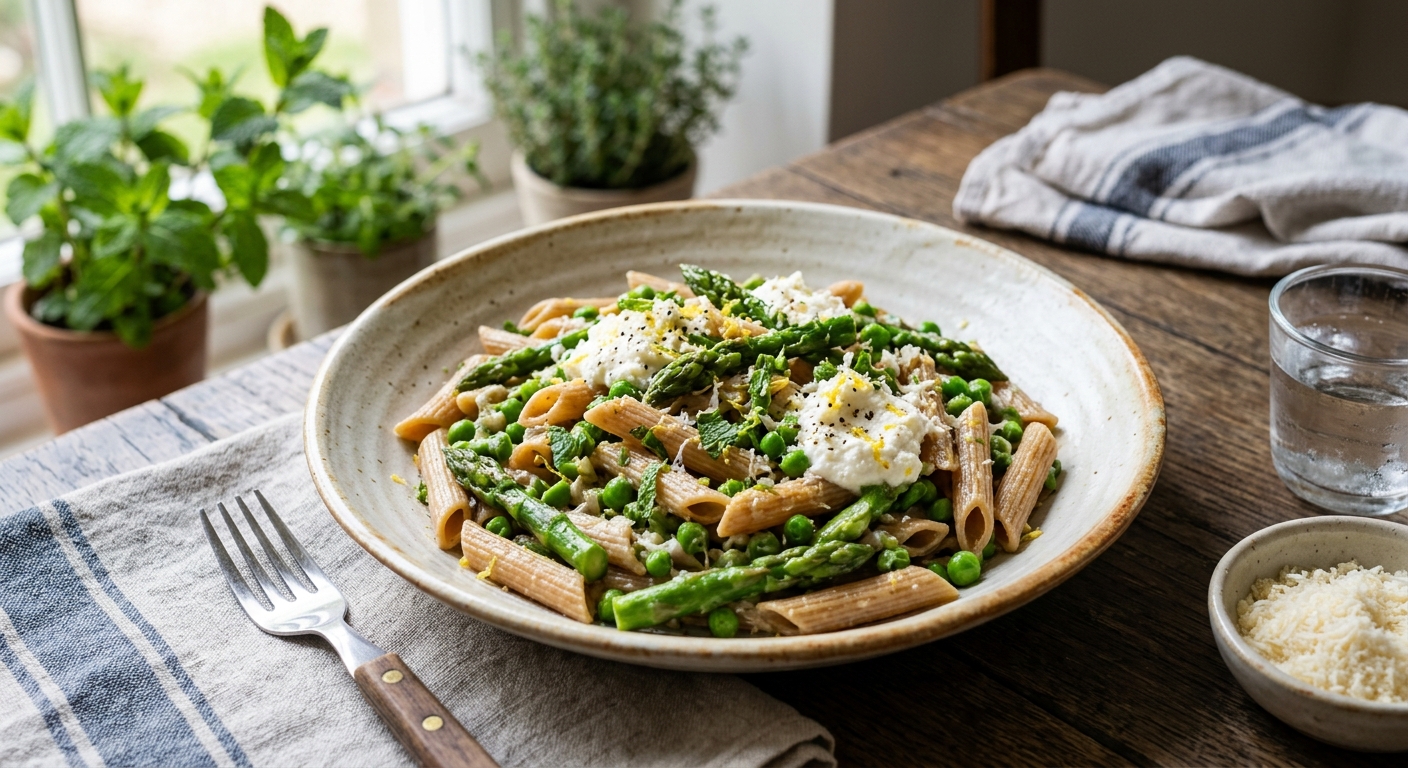
Every spring, two vegetables arrive in tandem that nutritional scientists and chefs agree on: fresh peas and asparagus. Both are brief-season performers, and both happen to be among the most folate-dense whole foods available outside of legumes and organ meats. This pasta recipe was engineered from the ground up to celebrate that overlap, layering the two vegetables with whole wheat pasta, lemon, fresh mint, and a whisper of part-skim ricotta to bind everything into a sauce that clings without weighing down.
Folate, the natural food form of vitamin B9, is essential for DNA synthesis, red blood cell formation, and neural tube development during early pregnancy. Most adults fall short of the 400 mcg DV, and the gap widens considerably for women of reproductive age, where the target climbs to 600 mcg. What makes this dish exceptional is not just the quantity of folate but the bioavailability: folate from whole vegetables is absorbed at roughly 50 to 85 percent efficiency, and pairing it with the light acidity of lemon juice and a small amount of fat from olive oil actually supports absorption across the gut lining. One bowl, cooked right, closes more than a day’s requirement.
Beyond folate, this recipe is a quiet overachiever. The asparagus contributes meaningful vitamin K, vitamin C, and the prebiotic fiber inulin. The peas add plant-based protein, iron, and thiamine. The whole wheat pasta grounds the meal with slow-releasing complex carbohydrates and additional B-vitamins, keeping the glycemic load firmly in the medium range despite a satisfying carbohydrate count. Whether you are cooking for a pregnant partner, a vegetarian athlete, or simply someone who wants to feel like they ate well, this is the bowl.
4
servings
Ingredients
- 340 gwhole wheat penne or fusilli
- 400 gfresh asparagus, woody ends snapped off, cut into 4 cm pieces
- 300 gfresh or frozen green peas (thawed if frozen)
- 3 clovesgarlic, thinly sliced
- 1 mediumshallot, finely diced
- 200 gpart-skim ricotta cheese
- 60 gParmigiano-Reggiano, finely grated, plus extra to serve
- 3 tbspextra-virgin olive oil
- 1 largelemon, zested and juiced
- 20 gfresh mint leaves, roughly torn
- 15 gfresh flat-leaf parsley, finely chopped
- 120 mldry white wine (such as Pinot Grigio)
- 700 mllow-sodium vegetable broth
- 0.5 tspcrushed red pepper flakes
- —Colima Sea SaltMicroplastic Free Salt and freshly cracked black pepper to taste
- —Extra lemon wedges to serve
Instructions
Click on an item below to shop for the recommended items for this recipe on Amazon.
As an Amazon Associate, we earn from qualifying purchases.
- Bring a large pot of water (at least 4 litres) to a rolling boil over high heat. Season aggressively with fine sea salt until it tastes like mild seawater. This is your only opportunity to season the pasta from within.
- While the water heats, warm 2 tablespoons of olive oil in a large, wide skillet or saute pan over medium heat. Add the shallot and a pinch of salt, cooking for 3 minutes until softened and translucent. Add the sliced garlic and red pepper flakes and cook for 1 more minute, stirring constantly, until fragrant but not coloured.
- Increase the heat to medium-high, pour in the white wine, and let it simmer vigorously for 2 minutes until reduced by half and the sharp alcohol smell has cooked off. Add 200 ml of the vegetable broth, stir, and reduce to a gentle simmer.
- Cook the pasta in the boiling water according to package directions for al dente, typically 9 to 11 minutes. Two minutes before the pasta finishes, add the asparagus pieces directly to the pasta water and boil alongside the pasta. This blanches them quickly while keeping their folate-rich cooking liquid contained in the pot you will scoop from.
- Reserve 240 ml of the starchy pasta water before draining. Drain the pasta and asparagus together in a colander.
- Add the peas to the skillet sauce and stir over medium heat for 2 minutes until warmed through and bright green. Reduce heat to low. Add the ricotta and 120 ml of reserved pasta water, stirring briskly to emulsify into a creamy sauce. Season with salt, pepper, and half the lemon juice.
- Add the drained pasta and asparagus to the skillet. Toss vigorously with tongs for 1 to 2 minutes, adding more pasta water a splash at a time if the sauce tightens. Remove from heat, fold in the Parmigiano-Reggiano, lemon zest, mint, and parsley. Taste and adjust with remaining lemon juice, salt, and pepper. Drizzle with the remaining tablespoon of olive oil and serve immediately.
- In the slow cooker insert, combine the shallot, garlic, asparagus pieces, olive oil, red pepper flakes, white wine, and all 700 ml of vegetable broth. Stir to distribute, season with salt and pepper, and place the lid on. Cook on Low for 2 hours and 40 minutes. The asparagus will become very tender and infuse the broth deeply with its flavour.
- While the slow cooker finishes, bring a separate pot of well-salted water to a boil on the stovetop and cook the whole wheat pasta to 2 minutes shy of al dente (it will finish cooking in the slow cooker liquid). Drain the pasta, reserving 120 ml of pasta water.
- Switch the slow cooker to High. Add the par-cooked pasta, the peas, and the reserved pasta water to the insert. Stir everything together, replace the lid, and cook on High for 18 to 22 minutes until the pasta is al dente and has absorbed much of the flavourful broth.
- Turn off the slow cooker. In a small bowl, whisk together the ricotta, half the lemon juice, and a ladleful of the hot cooking liquid from the insert until smooth and pourable. Pour this mixture over the pasta and stir gently to coat everything in a creamy sauce.
- Fold in the Parmigiano-Reggiano, lemon zest, remaining lemon juice, mint, and parsley. The residual heat will melt the cheese into the sauce. Taste and adjust seasoning. Serve directly from the insert with extra Parmigiano and lemon wedges.
- Set the Instant Pot or electric pressure cooker to Saute mode on Normal heat. Add 2 tablespoons of olive oil and, once shimmering, add the shallot with a pinch of salt. Saute for 3 minutes until softened. Add the garlic and red pepper flakes and saute for 1 minute more. Pour in the white wine and let it bubble for 90 seconds to cook off the alcohol.
- Press Cancel to stop Saute mode. Add the pasta directly to the pot in as even a layer as possible. Pour all 700 ml of vegetable broth over the pasta. The liquid should just cover the pasta; if not, add water to cover by 5 mm. Do not stir after adding the broth as this prevents sticking during pressurisation. Add a pinch of salt.
- Secure the lid and set the valve to Sealing. Cook on Manual or Pressure Cook at High Pressure for 5 minutes (for most whole wheat short pastas). This is approximately half the package time, which accounts for the pressurised environment.
- As soon as the 5 minutes is complete, perform an immediate Quick Release by carefully turning the valve to Venting. This stops the cooking instantly. Open the lid away from you. The pasta should be just al dente and the broth mostly absorbed.
- Set the Instant Pot to Saute mode on Low. Stir in the peas and asparagus pieces and cook for 3 to 4 minutes, stirring gently, until the asparagus is just tender and bright green and the peas are warmed through. The gentle heat preserves maximum folate in both vegetables.
- Turn off the Saute mode. Add the ricotta, lemon juice, and lemon zest, stirring well to form a sauce with the residual starchy liquid in the pot. Fold in the Parmigiano-Reggiano, mint, and parsley. Drizzle with the remaining tablespoon of olive oil, taste for seasoning, and serve immediately.
- Preheat your oven to 220C (425F). Toss the asparagus pieces with 1 tablespoon of olive oil, a pinch of salt, and black pepper on a rimmed baking sheet. Roast on the upper rack for 10 to 12 minutes until lightly charred at the tips and tender-firm. Remove and set aside. Reduce oven temperature to 200C (400F).
- While the asparagus roasts, bring a large pot of well-salted water to a boil and cook the pasta for 4 minutes less than package directions (it will finish in the oven). The pasta should be quite firm and underdone at this stage. Drain and reserve 180 ml of pasta water.
- In a large oven-safe skillet or Dutch oven set over medium heat, warm the remaining 2 tablespoons of olive oil. Saute the shallot for 3 minutes, then add garlic and red pepper flakes for 1 minute. Pour in the white wine and reduce for 2 minutes. Add 500 ml of the vegetable broth and bring to a simmer. Whisk in the ricotta and half the Parmigiano-Reggiano until the sauce is smooth and cohesive.
- Remove the skillet from heat. Add the par-cooked pasta, peas, roasted asparagus, lemon zest, and half the lemon juice to the skillet. Stir to coat everything in the sauce. Add reserved pasta water as needed so the mixture looks slightly soupy, as the pasta will absorb liquid during baking. Season generously with salt and pepper.
- Scatter the remaining Parmigiano-Reggiano evenly over the top. Transfer the skillet to the oven and bake uncovered at 200C (400F) for 18 to 22 minutes until the top is golden in spots, the sauce is bubbling around the edges, and the pasta is fully cooked through.
- Remove from the oven and let rest for 5 minutes. The sauce will thicken as it sits. Finish by folding in the fresh mint, parsley, and remaining lemon juice at the table. Drizzle with a thread of olive oil and serve directly from the skillet.
Nutrition Breakdown
Per 1 serving (makes 4)
Vitamins & Minerals
% Daily Value based on a 2,000 calorie diet (FDA reference)
🧬 Essential Amino Acids
% of recommended daily intake (RDA) per serving
🛡 Antioxidant Profile
The Nutrition Science
Asparagus and green peas are among the handful of vegetables that deliver folate in concentrations comparable to fortified grains. A 100 g serving of raw asparagus provides roughly 52 mcg of natural folate, while the same quantity of green peas contributes approximately 65 mcg. Critically, both deliver folate as a mixture of 5-methyltetrahydrofolate and polyglutamate forms, which require enzymatic conversion in the gut lining before absorption. This conversion is significantly impaired in individuals carrying the common MTHFR C677T gene variant, which affects up to 40% of some populations. The lemon juice in this recipe plays a functional role here: the ascorbic acid it provides stabilises the reduced folate forms during digestion, reducing the oxidative degradation that would otherwise cut bioavailability. Eating this dish alongside vitamin C, as provided by the lemon and parsley, is not merely culinary choice but nutritional strategy.
The whole wheat pasta is a deliberate structural decision. Refined pasta is typically enriched with folic acid, the synthetic oxidised form of the vitamin, which actually competes with natural food folates for intestinal absorption via the proton-coupled folate transporter (PCFT). By switching to whole wheat pasta, which retains its natural B-vitamin matrix and adds no synthetic folic acid, this recipe relies entirely on the vegetable-derived folate pool. The additional dietary fiber from whole wheat (roughly 3 g per serving compared to under 1 g in refined pasta) also feeds the gut microbiome, which independently produces small amounts of folate via bacterial synthesis in the colon. This synergy between prebiotic fiber and B-vitamin status is an underappreciated pathway to micronutrient sufficiency.
Vitamin K deserves a separate mention. Asparagus is one of the more concentrated non-leafy vegetable sources of phylloquinone (vitamin K1), providing roughly 41 mcg per 100 g raw. This fat-soluble vitamin requires dietary fat for absorption, which is exactly why this recipe includes both olive oil and ricotta: even modest fat co-ingestion increases phylloquinone absorption from vegetables by three to eight times compared to eating them plain. The olive oil also delivers a small amount of squalene and phenolic compounds, including oleocanthal, that have demonstrated synergistic anti-inflammatory effects with the quercetin and rutin contributed by the asparagus. The entire dish is, in this sense, formulated so that each component amplifies the bioavailability of the others.
Pro Tips
- Do not overcook the asparagus: folate is heat-sensitive and water-soluble. In the stovetop method, the 2-minute blanch in the pasta water is intentionally brief. Vivid green colour is your visual cue that folate degradation has been kept to a minimum.
- If using frozen peas, add them straight from the freezer to the hot sauce rather than thawing on the counter. The rapid temperature change from hot sauce to cold peas cools the sauce just enough to prevent the ricotta from breaking, and the peas reach perfect tenderness in under 2 minutes.
- For maximum folate retention across all cooking methods, prep the asparagus just before cooking. Cut surfaces oxidise and leach water-soluble folate; asparagus that has been cut and refrigerated for even an hour before cooking can lose 15 to 20% of its folate content compared to cutting immediately before use.
Oh, I love where Jasmine is going with the fava beans! They’re such an underrated folate powerhouse, plus they add that satisfying protein bump. I’m actually saving this recipe to suggest to clients doing plant-based meals, since swapping the ricotta for cashew cream or silken tofu would keep that creamy texture while making it fully vegan and honestly even more folate-dense. The lemon zest is genius too, since vitamin C helps with folate absorption, so you’re getting both the nutrient and the cofactor to actually use it in your body. Spring really is folate season!
Love seeing folate get this spotlight, especially since so many of us are deficient without even knowing it! One thing I’d add is that if folks want to amplify the folate content even further, swapping in some fava beans alongside (or instead of) the peas is a game-changer – they’re absolutely packed with folate and have this creamy texture that works beautifully with ricotta. I grew up eating fresh favas in spring and never realized until later how nutritionally dense they were compared to what was typically available in most grocery stores. The combo of fresh greens, legumes, and that bright lemon really is the sweet spot for bioavailability too.
This is exactly the kind of recipe I’ve been looking for, especially since my last quarterly labs showed my folate was running lower than ideal despite what I thought was decent intake. I’m curious about the bioavailability angle here, though, since I know folate from raw greens behaves differently than cooked sources, and I’m wondering if the light cooking method you’re using preserves more of the active form compared to something heavily reduced. Also, are you sourcing the ricotta from grass-fed dairies by chance, or do you have thoughts on whether conventional ricotta still delivers on the micronutrient density front for a recipe this focused on nutrient density?