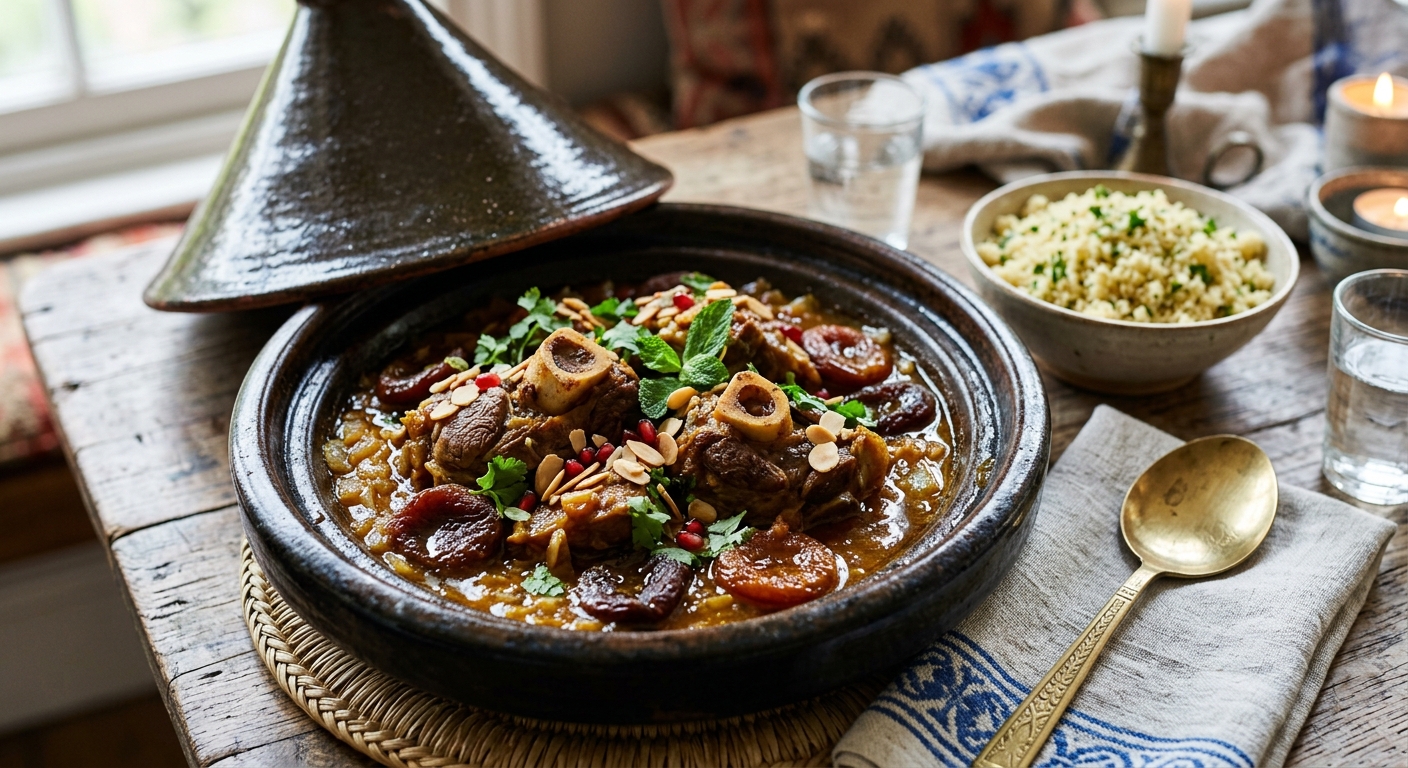
Few dishes in the world’s culinary canon manage to be simultaneously this nourishing and this transporting. The Moroccan tagine, named for the distinctive conical clay pot in which it traditionally cooks, is a masterclass in low-and-slow braising: lamb shoulder breaks down into silky, pull-apart pieces while dried apricots dissolve into a glossy, amber-hued sauce perfumed with ras el hanout, cinnamon, and saffron. Every bite carries centuries of North African spice-trade history, and every bowl carries a serious nutritional payload.
From a mineral standpoint, lamb shoulder is one of the most concentrated dietary sources of both haem iron and zinc available to home cooks. Haem iron, the form found exclusively in animal muscle tissue, is absorbed at two to three times the rate of plant-based non-haem iron, making this tagine a genuinely therapeutic meal for anyone managing low iron stores or supporting immune function. The dried apricots are no nutritional bystanders either: they contribute non-haem iron, potassium, and beta-carotene alongside a natural fructose sweetness that balances the savory depth of the braising liquid without any added refined sugar.
At Calibrated Cuisine, we have calculated every ingredient to land a four-serving batch within meaningful Daily Reference Intake ranges, not just for iron and zinc but for a broad spectrum of vitamins and minerals. Whether you cook this on the stovetop in a Dutch oven, set it in a slow cooker before work, pressure-cook it on a weeknight, or finish it in your oven the traditional way, the result is a dish where exceptional flavour and precision nutrition are inseparable.
4
servings
Ingredients
- 800 gbone-in lamb shoulder, cut into 5cm chunks (bones left in for marrow minerals)
- 180 gdried apricots, unsulphured, halved
- 1 largebrown onion, finely diced
- 4 clovesgarlic, minced
- 2 tbspextra-virgin olive oil
- 400 gcanned whole tomatoes, crushed by hand
- 300 mllamb or chicken stock, low sodium
- 2 tspras el hanout spice blend
- 1 tspground cumin
- 1 tspground coriander
- 1 tspground cinnamon
- 0.5 tspground ginger
- 0.5 tspground turmeric
- 0.25 tspcayenne pepper
- 1 pinchsaffron threads, steeped in 2 tbsp warm water for 10 minutes
- 1 tbsphoney, raw
- 1 tbsptomato paste
- 400 gcanned chickpeas, drained and rinsed
- 40 gtoasted flaked almonds
- 20 gfresh cilantro (coriander), roughly chopped
- 15 gfresh flat-leaf parsley, roughly chopped
- 1 mediumpreserved lemon, rind only, finely sliced (discard pulp)
- —Colima Sea SaltMicroplastic Free Salt and freshly ground black pepper to taste
Instructions
Click on an item below to shop for the recommended items for this recipe on Amazon.
As an Amazon Associate, we earn from qualifying purchases.
- Pat the lamb pieces thoroughly dry with paper towels, then season generously on all sides with salt and black pepper. Drying the surface is essential for achieving a deep Maillard crust rather than steaming the meat.
- Heat the olive oil in a large Dutch oven over medium-high heat until shimmering. Working in two batches to avoid crowding, sear the lamb pieces for 3 to 4 minutes per side until deeply browned on at least two faces. Transfer each seared batch to a plate and set aside. Do not skip this step: the fond that develops on the base of the pot is the backbone of the sauce’s complexity.
- Reduce the heat to medium. Add the diced onion to the same pot with the residual fat and a pinch of salt. Cook, stirring occasionally, for 7 to 8 minutes until softened and beginning to caramelise at the edges. Add the minced garlic and cook for a further 90 seconds until fragrant.
- Add the tomato paste to the onion mixture and cook, stirring constantly, for 2 minutes to caramelise it slightly and remove the raw tin flavour. Add all the dry spices (ras el hanout, cumin, coriander, cinnamon, ginger, turmeric, and cayenne) and stir into the paste for 60 seconds, toasting them in the residual oil to bloom their volatile aromatic compounds.
- Pour in the crushed tomatoes and scrape the bottom of the pot firmly with a wooden spoon to deglaze all the caramelised fond into the sauce. Add the stock, saffron water, and honey. Stir to combine, then return the seared lamb and any resting juices to the pot. The liquid should come about two-thirds of the way up the lamb; add a splash more stock or water if needed.
- Bring the liquid to a gentle boil, then immediately reduce the heat to low. Place a lid on the pot slightly ajar to allow some steam to escape, which concentrates the sauce without scorching. Simmer for 60 minutes, turning the lamb pieces halfway through.
- After 60 minutes, add the halved apricots and the drained chickpeas. Stir gently, then continue to simmer uncovered for a further 30 to 35 minutes until the lamb is completely tender and pulls away from the bone effortlessly and the sauce has reduced to a thick, glossy consistency. Taste and adjust salt.
- Remove from the heat. Stir in the preserved lemon rind and top with toasted flaked almonds, fresh cilantro, and parsley immediately before serving alongside couscous or warm flatbread.
- The night before or up to 30 minutes before loading: pat the lamb dry and season with salt and pepper. Heat the olive oil in a skillet over medium-high heat and sear the lamb in batches for 3 to 4 minutes per side until browned. Transfer directly to the slow cooker insert.
- In the same skillet over medium heat, cook the diced onion for 5 minutes until softened. Add the garlic and cook for 60 seconds. Add the tomato paste and all dry spices, stirring constantly for 90 seconds to bloom the spices in the hot fat. Deglaze the pan with a splash of the measured stock, scraping up all the fond, then pour the entire contents of the skillet over the lamb in the slow cooker.
- Add the crushed tomatoes, remaining stock, saffron water, and honey to the slow cooker. The slow cooker retains more moisture than stovetop braising, so use only 200ml of the stock rather than the full 300ml to prevent a watery sauce. Stir gently to distribute the liquid around the lamb without disturbing the bottom layer.
- Place the apricots and chickpeas directly on top of the lamb rather than stirring them in. This positions them away from the intense base heat, preventing the apricots from dissolving completely and preserving their texture through the long cook.
- Place the lid on the slow cooker, ensuring a tight seal. Cook on Low for 7 to 8 hours or on High for 4 hours. Resist lifting the lid during cooking, as each opening releases heat equivalent to roughly 20 minutes of cooking time.
- When the cook time is complete, carefully remove the lamb pieces with a slotted spoon. If the sauce appears thin, switch the slow cooker to High with the lid off and reduce for 20 to 30 minutes, or ladle the sauce into a small saucepan and reduce it on the stovetop over medium heat for 10 minutes. Return the lamb to the sauce, stir in the preserved lemon rind, and finish with almonds, cilantro, and parsley.
- Set the Instant Pot or electric pressure cooker to Saute mode on High. Once hot, add the olive oil. Pat the lamb dry, season with salt and pepper, and sear in two batches for 3 minutes per side until well browned. Use the full sear here: at pressure the lamb will be perfectly cooked in 35 minutes, so the sear is the primary source of colour and roasted flavour. Remove lamb and set aside.
- Without wiping the pot, add the onion and cook on Saute for 4 minutes, stirring frequently. Add the garlic, cook for 60 seconds, then add the tomato paste and all dry spices. Stir constantly for 60 seconds, watching carefully as the Saute mode runs hot and spices can scorch quickly in a pressure cooker.
- Pour in only 200ml of the stock (less than other methods because no evaporation occurs under pressure) and deglaze the base vigorously, scraping up every bit of fond. Any caramelised residue left on the bottom risks triggering a burn warning. Add the crushed tomatoes, saffron water, and honey, and stir to combine.
- Return the seared lamb and any collected juices to the pot. Scatter the apricots and chickpeas over the top but do not stir them into the liquid. The apricots positioned above the liquid level will steam gently rather than over-hydrate during pressurisation.
- Cancel Saute mode. Secure the lid and set the pressure-release valve to Sealing. Cook on Manual or Pressure Cook at High Pressure for 35 minutes. Allow a natural pressure release for 15 minutes, then carefully switch to Quick Release for the remaining pressure.
- Open the lid and assess the sauce consistency. The sauce will be thinner than stovetop versions due to zero evaporation. Switch back to Saute mode on Medium and simmer uncovered for 10 to 15 minutes, stirring occasionally, until the sauce reduces to a glossy, coating consistency. Taste and adjust seasoning, then stir in the preserved lemon rind and finish with almonds, cilantro, and parsley.
- Preheat your oven to 160C (325F) with a rack positioned in the lower third. A lower rack position puts the Dutch oven closer to the oven floor, mimicking the base-heavy heat of a traditional clay tagine. Meanwhile, pat the lamb dry and season generously with salt and pepper.
- Heat the olive oil in a large oven-safe Dutch oven (with a tight-fitting lid) over medium-high heat on the stovetop. Sear the lamb in two batches, 3 to 4 minutes per side, until a deep brown crust forms. Transfer to a plate. The oven will do the long work, so invest time in the stovetop sear for maximum flavour.
- Reduce the stovetop heat to medium. Cook the onion in the same pot for 7 minutes until softened and golden. Add the garlic and cook for 90 seconds. Add the tomato paste and all dry spices, stirring constantly for 2 minutes over the heat to caramelise the paste and toast the spices. This extended blooming step is important here because the even, moderate oven heat will not intensify the spice flavour as dramatically as stovetop simmering.
- Deglaze with the full 300ml of stock, scraping the base clean. Add the crushed tomatoes, saffron water, and honey, and bring to a gentle simmer. Return the seared lamb and any juices to the pot. The liquid should reach two-thirds up the meat. Add water if needed.
- Scatter the apricots and chickpeas over the lamb. Lay a sheet of parchment paper directly onto the surface of the liquid (a cartouche) before placing the lid on the pot. This two-layer seal traps steam efficiently while preventing the sauce surface from forming a skin, resulting in a more evenly reduced, glossy braise.
- Transfer the covered Dutch oven to the preheated oven. Braise undisturbed for 1 hour 45 minutes. Remove the lid and parchment, gently push the lamb below the sauce surface, and return the uncovered pot to the oven for a further 15 minutes to reduce and glaze the sauce and lightly caramelise the exposed lamb surface.
- Remove from the oven and rest, covered loosely with foil, for 10 minutes before serving. The resting period allows the braising liquid to be reabsorbed into the lamb fibres, making every piece moister and more flavourful. Finish with preserved lemon rind, toasted almonds, cilantro, and parsley.
Nutrition Breakdown
Per 1 serving (makes 4)
Vitamins & Minerals
% Daily Value based on a 2,000 calorie diet (FDA reference)
🧬 Essential Amino Acids
% of recommended daily intake (RDA) per serving
🛡 Antioxidant Profile
The Nutrition Science
The iron story in this tagine operates on two parallel tracks. Lamb shoulder supplies haem iron, the form bound within haemoglobin and myoglobin molecules in muscle tissue, which is absorbed via a dedicated haem-iron transporter in the duodenum at a rate of 15 to 35% regardless of other dietary factors. The dried apricots and chickpeas supply non-haem iron (Fe3+), which must first be chemically reduced to Fe2+ by stomach acid and dietary vitamin C before it can be absorbed via the divalent metal transporter-1 (DMT-1). The vitamin C naturally present in the tomatoes, cilantro, and parsley in this dish performs exactly that reduction function, meaning the ingredients are biochemically cooperative as well as culinarily complementary.
Zinc from lamb is equally exceptional. Lamb shoulder contains approximately 8 to 10mg of zinc per 100g of cooked meat, making it gram-for-gram one of the richest dietary zinc sources outside oysters. Zinc is a cofactor for over 300 enzymatic reactions in the human body, including those governing immune cell proliferation, DNA synthesis, and wound repair. The zinc in animal tissue is complexed with proteins and amino acids rather than phytic acid (the absorption inhibitor found in plant seeds), so its bioavailability from lamb exceeds that of plant zinc sources by a factor of roughly two to four. The chickpeas in this recipe do contain phytic acid, but the long braising process, combined with the acidic tomato environment, partially degrades phytate structures, meaningfully improving their mineral release.
The spice blend deserves its own nutritional acknowledgement. Curcumin in turmeric has been shown in clinical studies to inhibit hepcidin expression in the liver; hepcidin is the master hormone that down-regulates iron absorption when stores are perceived as adequate. By modestly suppressing hepcidin activity, turmeric may create a more permissive gut environment for iron uptake. Cinnamon contributes chromium and has a well-documented effect on insulin sensitivity, helping to moderate the glycaemic response to the fructose and natural sugars in the apricots. Ras el hanout, the complex Moroccan spice blend at the heart of this tagine, typically contains cardamom, mace, allspice, rose petals, and black pepper, all of which contribute polyphenolic compounds with cumulative antioxidant and anti-inflammatory properties that complement the primary mineral payload.
Pro Tips
- Buy bone-in lamb shoulder rather than boneless: the marrow bones release collagen and additional minerals (particularly phosphorus and calcium) into the braising liquid as they cook, producing a richer sauce and adding micronutrients that boneless cuts cannot provide.
- Use unsulphured (naturally dried) apricots: they are darker, chewier, and nutritionally superior, containing roughly 30% more iron and beta-carotene than their bright-orange sulphur-dioxide-treated counterparts, which are bleached of some pigment-bound antioxidants.
- Make this dish one to two days ahead: like all braises, the flavour deepens significantly as the spices continue to permeate the meat during refrigerator resting, and the fat that solidifies on the surface can be easily lifted and discarded before reheating, reducing the saturated fat content per serving by approximately 2 to 3g.
ooh chris youre totally right about that heme iron absorption! ive actually started timing my iron rich meals around vitamin c sources more intentionally, especially during heavy training blocks when my ferritin tends to dip. curious if anyone has tried this tagine as a post long run meal, bc that combo of easily digestible protein plus those warming spices seems like it could actually help with inflammation recovery without sitting too heavy in your stomach. the zinc is huge too for immune function during marathon training. definitely adding this to my weekly rotation!
omg YES this combo is GENIUS! i made something similar last month and my kids actually ate it without complaining lol. i snuck in some extra pumpkin seeds on top for that extra zinc boost since mine are picky about texture, and honestly the warmth of the cinnamon and cumin totally masked it. have you found that the apricots add enough sweetness that you dont need to adjust seasoning much? im always looking for ways to make mineral dense meals feel like actual comfort food and not a nutrition lecture haha
Love the mineral pairing here – lamb’s heme iron is already highly bioavailable, but adding the vitamin C from those apricots (even dried) really amplifies absorption. The low and slow braise also keeps those heat sensitive B vitamins intact, which most people overlook. I’ve been playing with tagines for my clients and found that finishing with a squeeze of fresh lemon right before serving bumps the iron uptake another 20-30% without competing with the warm spice profile. Have you tested whether the cooking vessel (clay vs. Dutch oven) impacts the final mineral content, or is it mainly technique driven?