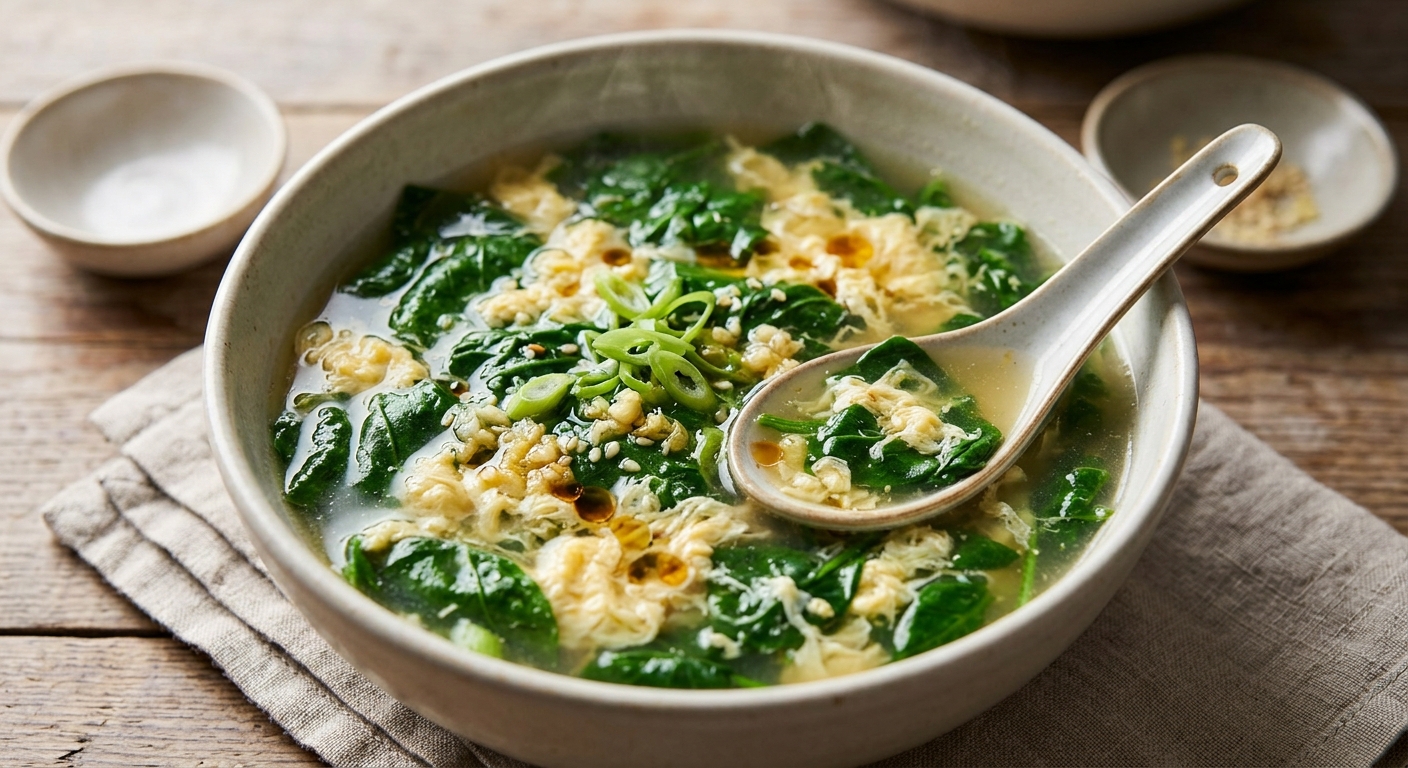
Egg drop soup is one of those deceptively simple dishes that rewards good technique far more than complicated ingredients. The magic lies in the pour: a thin, steady stream of beaten egg meeting gently simmering broth creates those iconic feathery ribbons that make every spoonful feel luxurious. Add a generous handful of baby spinach and you have transformed a light starter into a genuinely functional meal, one that delivers a remarkable concentration of two nutrients most people chronically under-consume: folate and vitamin K.
Folate (vitamin B9) is essential for DNA synthesis, red blood cell formation, and neural tube development, yet surveys consistently show that a large portion of adults fall short of the 400 mcg daily target. Baby spinach is one of the most folate-dense foods available, providing roughly 194 mcg per 100g cooked, and the brief cooking time in this soup preserves far more of that folate than boiling or prolonged steaming would. Vitamin K1 (phylloquinone), which supports blood clotting and bone mineralisation, is delivered in extraordinary quantities by spinach: a single serving of this soup provides over 400 mcg, well above the Adequate Intake of 90 to 120 mcg for adults. Together, these two nutrients make this soup one of the most efficient single-dish sources available in any cuisine.
Beyond folate and vitamin K, the eggs contribute complete protein, choline for cognitive function, and riboflavin, while the turmeric and ginger in the broth add a warm, aromatic depth alongside meaningful amounts of curcumin and gingerols, compounds with well-documented anti-inflammatory properties. This recipe is built around a clear, flavourful homemade-style broth base using quality store-bought low-sodium chicken or vegetable stock, seasoned with toasted sesame oil, white pepper, and a whisper of cornstarch to give the ribbons just the right body. It is weeknight fast, genuinely nourishing, and the kind of dish you will find yourself making on rotation.
4
servings
Ingredients
- 1200 mllow-sodium chicken or vegetable stock
- 150 gbaby spinach, washed and roughly torn
- 4 largeeggs, beaten well
- 1 tbspcornstarch
- 2 tbspcold water (to make cornstarch slurry)
- 3 clovesgarlic, minced
- 15 gfresh ginger, peeled and finely grated (about 1.5 inch piece)
- 3 spring onionsthinly sliced, whites and greens separated
- 1 tspground turmeric
- 0.5 tspground white pepper
- 1.5 tsptoasted sesame oil
- 1 tbsplow-sodium soy sauce or tamari
- 1 tsprice vinegar
- 1 tspAvocado Oil100% Pure Avocado Oil (such as avocado or sunflower)
- —Colima Sea SaltMicroplastic Free Salt and white pepper to taste
- —Toasted sesame seeds, for garnish (optional)
Instructions
Click on an item below to shop for the recommended items for this recipe on Amazon.
As an Amazon Associate, we earn from qualifying purchases.
- In a medium bowl, whisk the 4 eggs thoroughly with a pinch of salt until the whites and yolks are completely combined with no streaks. Set aside. In a small bowl, mix the cornstarch with 2 tbsp cold water to form a smooth slurry. Set both aside near the stove.
- Heat the neutral oil in a large saucepan or Dutch oven over medium heat. Add the spring onion whites, minced garlic, and grated ginger. Stir-fry for 90 seconds until fragrant and the garlic is just beginning to turn golden at the edges. Add the ground turmeric and white pepper, stirring for 30 seconds to bloom the spices in the oil.
- Pour in all 1200 ml of stock and increase the heat to medium-high. Add the soy sauce and rice vinegar. Bring the broth to a rolling simmer (small active bubbles across the surface, around 90 to 95 degrees C), then taste and adjust seasoning with salt if needed.
- Give the cornstarch slurry a quick stir to re-suspend it and pour it into the simmering broth while stirring constantly. Continue stirring for 60 to 90 seconds until the broth thickens very slightly and turns just barely translucent. This light body is what allows the egg to form delicate ribbons rather than clumping.
- Reduce the heat to medium-low so the broth is at a gentle, not vigorous, simmer. Hold a fork or chopstick over the pot and slowly drizzle the beaten egg through the tines in a thin, steady circular stream while simultaneously stirring the broth in one slow direction with your other hand. The egg will set almost immediately into silky golden threads. This step should take 20 to 30 seconds; do not rush it.
- Remove the pot from heat immediately after the last of the egg is added. Add the torn baby spinach in two large handfuls, stirring gently. The residual heat of the broth will wilt the spinach perfectly in about 60 to 90 seconds without overcooking it or destroying excess folate.
- Finish with the toasted sesame oil, then ladle into warm bowls. Garnish with spring onion greens and a sprinkle of toasted sesame seeds if using. Serve immediately.
- Place the minced garlic, grated ginger, spring onion whites, ground turmeric, white pepper, soy sauce, and rice vinegar directly into the slow cooker insert. Pour the 1200 ml of stock over everything and stir briefly to combine. Do not add the eggs, cornstarch, spinach, or sesame oil at this stage.
- Cover and cook on Low for 4 hours. During this long, gentle steep, the aromatics will fully infuse the broth with a flavour depth that is noticeably richer than the stovetop version. The broth will also reduce slightly, concentrating the seasoning. After 4 hours, taste the broth and adjust salt and white pepper as needed.
- About 10 minutes before serving, switch the slow cooker to the High setting and allow the broth to come to a lively simmer. In a small bowl, mix the cornstarch with 2 tbsp cold water to form a smooth slurry. Stir the slurry into the hot broth, replace the lid, and allow to cook on High for 5 minutes until the broth has thickened slightly.
- Whisk the 4 eggs thoroughly in a medium bowl until fully combined. Remove the lid from the slow cooker. Using a ladle, stir the broth in a slow, steady circular motion. While the broth is moving, drizzle the beaten egg in a thin, slow stream directly into the slow cooker insert. The hot broth will set the egg into ribbons within seconds. Work in sections around the pot rather than all from one spot.
- Immediately add all the torn baby spinach on top of the soup and gently push it beneath the surface with a spoon. Replace the lid for exactly 2 minutes, then turn off the slow cooker. The spinach will be perfectly wilted. Stir in the toasted sesame oil, ladle into bowls, and garnish with spring onion greens and sesame seeds.
- Select the Saute function on your Instant Pot or electric pressure cooker and heat the neutral oil until shimmering. Add the spring onion whites, garlic, and grated ginger. Saute for 2 minutes, stirring frequently, until softened and fragrant. Add the turmeric and white pepper and stir for 30 seconds to toast the spices in the residual heat.
- Pour in the 1200 ml of stock, soy sauce, and rice vinegar. Stir to deglaze any aromatics from the bottom of the pot, which is essential to avoid a burn notice. Press Cancel to turn off the Saute function.
- Secure the lid and set the pressure release valve to Sealing. Select High Pressure (Manual) and set the cook time to 3 minutes. The pot will take approximately 8 to 10 minutes to come to pressure before the timer begins. When cooking is complete, carefully perform a Quick Release by turning the valve to Venting. Stand back and keep hands and face away from the steam vent.
- Once all pressure has released and the float valve has dropped, open the lid. Set the pot back to Saute on the Low or Less setting to bring the broth to a gentle simmer. In a small bowl, whisk the cornstarch with 2 tbsp cold water and stir the slurry into the broth. Cook for 60 seconds, stirring, until the broth thickens slightly.
- Whisk the 4 eggs thoroughly in a bowl. With the broth at a gentle simmer, use one hand to stir the soup in a slow circle and the other to drizzle the beaten egg through a fork in a thin, steady stream. The pressurised, slightly thickened broth will create particularly well-defined, silky ribbons. Cancel the Saute function immediately once all egg is added.
- Stir in the torn baby spinach and the toasted sesame oil. The residual heat will wilt the spinach within 60 to 90 seconds. Taste for final seasoning, ladle into bowls, and garnish with spring onion greens and sesame seeds.
Nutrition Breakdown
Per 1 serving (makes 4)
Vitamins & Minerals
% Daily Value based on a 2,000 calorie diet (FDA reference)
🧬 Essential Amino Acids
% of recommended daily intake (RDA) per serving
🛡 Antioxidant Profile
The Nutrition Science
The extraordinary vitamin K content of this soup deserves a closer look. Spinach contains approximately 483 mcg of phylloquinone (K1) per 100g raw, but when gently wilted rather than boiled, the majority of that fat-soluble vitamin is retained. Crucially, the eggs and sesame oil in this recipe provide the dietary fat that is required for vitamin K absorption in the small intestine, since K1 is fat-soluble and essentially unavailable when eaten alongside fat-free foods. The pairing of spinach with fat is not just culinary tradition; it is a nutritional synergy that meaningfully increases the bioavailability of K1, K2 precursors, beta-carotene, and lutein simultaneously.
Folate in spinach exists primarily as polyglutamate forms that must be converted to monoglutamates by the enzyme folate conjugase in the intestinal brush border before absorption. Prolonged high-heat cooking degrades both the folate itself and the enzymatic conversion process. This recipe deliberately minimises spinach cooking time, adding it off-heat or in the final residual minutes, which research suggests preserves approximately 70 to 80% of the intrinsic folate compared to boiling losses of 40 to 60%. The vitamin C also present in spinach further stabilises folate during this brief heat exposure by acting as a reducing agent.
The eggs contribute choline (roughly 147 mg per two large eggs), a nutrient that shares the methyl-group donation pathway with folate in the one-carbon metabolism cycle. Adequate choline prevents folate from being diverted to compensate for choline deficiency in methylation reactions, meaning the two nutrients in this dish are genuinely synergistic at a biochemical level, not merely coincidentally paired. The turmeric delivers curcumin, whose absorption is typically limited to 1 to 2% from aqueous solutions but rises significantly in the presence of dietary fat and piperine; while this recipe does not include black pepper, the yolk fat already meaningfully improves curcumin bioavailability compared to a fat-free broth.
Pro Tips
- Temperature is everything for egg ribbons: the broth must be at a gentle simmer, not a rolling boil. Vigorous boiling breaks the egg into fine particles rather than threads. If your broth is too hot, remove it from the heat for 30 seconds before pouring the egg.
- For the highest folate retention, add spinach off-heat or at the very end of cooking. The difference between adding spinach 10 minutes into cooking versus at the finish is a folate loss of up to 35%. Residual broth heat (above 85 degrees C) is more than sufficient to wilt baby spinach in 60 to 90 seconds.
- Use fresh ginger rather than ground ginger if at all possible. Fresh ginger contains active gingerols that convert to less potent shogaols when dried, and the aromatic brightness it contributes to the broth is significantly superior. A 15g piece (about 1.5 inches) can be frozen whole and grated from frozen, making it a zero-waste pantry staple.




this looks amazing and i love that youre focusing on the micronutrient density, thats where most people miss the boat. quick question though – whats the net carb count on this? im assuming the spinach and ginger broth keep it pretty low but id love to know the exact numbers. ive found that pairing high folate vegetables like spinach with eggs and quality broth is such a smart move for satiety too, been doing similar combos for years now and it keeps me stable all day. definitely saving this one!
yeah this recipe sounds perfect for recovery, spinach and eggs are such a solid combo. im curious about the net carbs too since that broth base matters – if its just ginger, bone broth, and spinach youre probably looking at like 3-5g per serving which is great. ive found that getting folate from whole foods like this instead of supplements helps my energy way more, plus the satiety from the protein and fat is real. might add some butter or ghee to mine for extra micronutrient absorption, that vitamin K is fat soluble so it needs that fat to actually absorb properly.
omg yes, this is exactly the kind of recovery meal i’ve been looking for! folate and vitamin k are huge for inflammation management after long runs, and honestly a light broth based soup hits so different when youre trying to refuel without feeling heavy. the fact that its under 200 cals but still micronutrient dense means i could actually eat this post ultra and then have room for some carbs without overdoing it. gonna make this tonight and see how my body responds tomorrow on my long run – will report back!