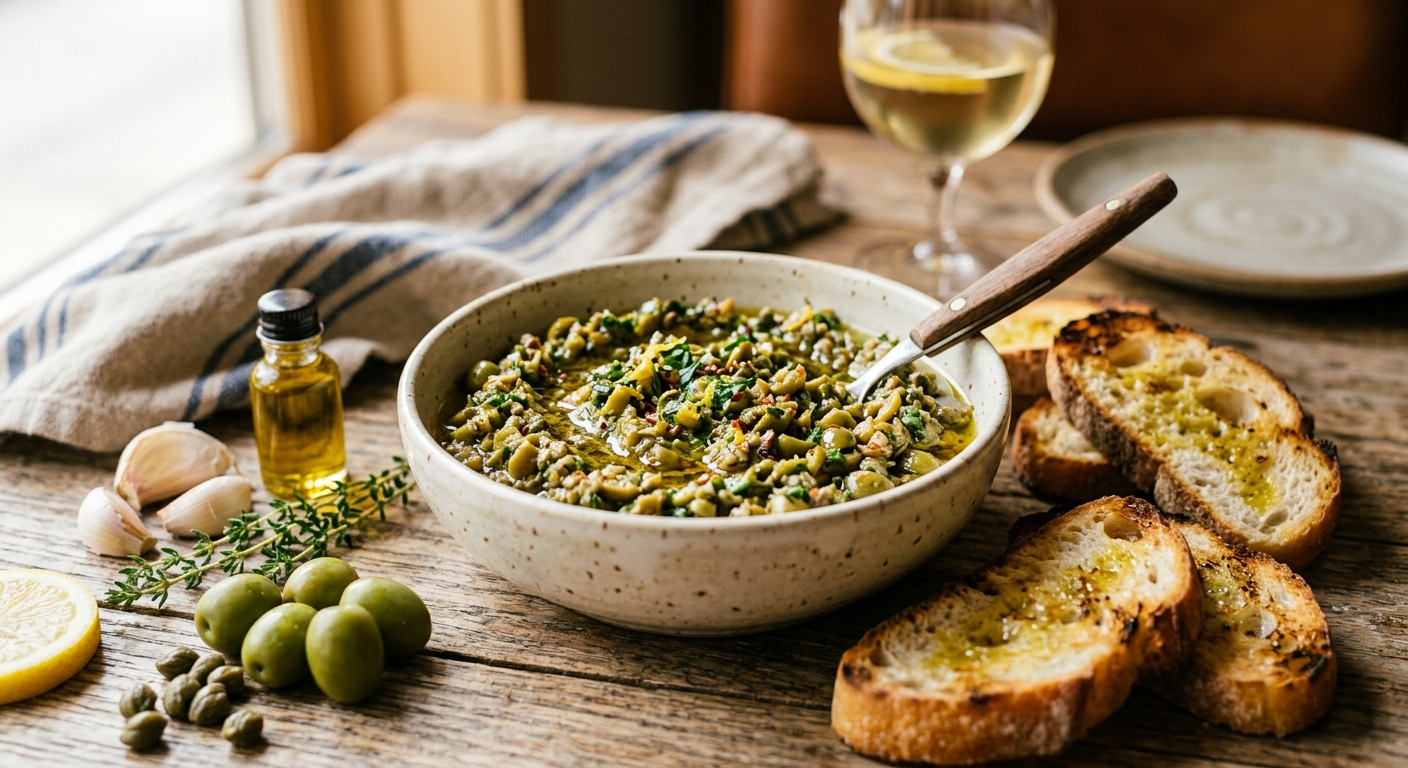
Green olive tapenade is one of the Mediterranean’s most underrated culinary treasures. Unlike its darker counterpart, green olive tapenade carries a brighter, more assertive flavor profile: pleasantly bitter, herbaceous, and citrus-forward, with a texture that ranges from rustic and chunky to silky smooth depending on your method. At Calibrated Cuisine, we have engineered this classic Provençal condiment to maximize its already impressive nutritional credentials, pairing Castelvetrano or Cerignola olives with flat-leaf parsley, fresh thyme, capers, anchovies, and cold-pressed extra-virgin olive oil for a spread that is as functional as it is extraordinary on the table.
The nutritional story here is compelling. Green olives are among the richest whole-food sources of vitamin E (as alpha-tocopherol), delivering roughly 40% of your daily value per serving while simultaneously contributing meaningful amounts of iron, copper, and calcium. The extra-virgin olive oil in this recipe amplifies those benefits with its own constellation of polyphenols, most notably oleocanthal, a compound that inhibits the same COX-1 and COX-2 enzymes targeted by ibuprofen. Meanwhile, the capers supply the flavonoid quercetin at concentrations that rival many pharmaceutical-grade supplements, and the fresh parsley brings a folate and vitamin K punch that most people would never expect from a condiment.
We have developed three genuinely distinct preparation methods for this tapenade. The stovetop method uses a brief controlled bloom of garlic and herbs in warm olive oil to unlock fat-soluble polyphenols before pulsing, yielding the deepest, most integrated flavor. The slow cooker method gently confits the olives and aromatics at low heat over several hours, producing an extraordinarily mellow, almost buttery tapenade with rounded bitterness. The pressure cooker method flash-softens the olives under steam before finishing with fresh herbs off heat, creating a uniquely silky texture in a fraction of the time. Each method is worth making in its own right.
4
servings
Ingredients
- 300 ggreen olives (Castelvetrano or Cerignola), pitted and drained
- 60 mlextra-virgin olive oil, plus more to finish
- 40 gcapers in brine, drained and rinsed
- 4 clovesgarlic, peeled and smashed
- 4 filletsoil-packed anchovy fillets (optional but recommended)
- 20 gfresh flat-leaf parsley leaves, tightly packed
- 10 gfresh thyme leaves, stripped from stems
- 1 tbspfresh lemon juice
- 1 tsplemon zest, finely grated
- 1 tspDijon mustard
- 0.5 tspsmoked paprika
- 0.25 tspcrushed red pepper flakes
- —Colima Sea SaltMicroplastic Free Salt and cracked black pepper to taste
Instructions
Click on an item below to shop for the recommended items for this recipe on Amazon.
As an Amazon Associate, we earn from qualifying purchases.
- Place a small saucepan over medium-low heat and add 2 tablespoons of the olive oil. Once the oil shimmers, add the smashed garlic cloves, thyme leaves, smoked paprika, and red pepper flakes. Cook gently, stirring frequently, for 3 to 4 minutes until the garlic turns golden at the edges and the oil is very fragrant. Do not let the garlic brown deeply or it will turn bitter.
- Add the drained green olives and anchovy fillets (if using) to the pan. Stir to coat everything in the infused oil and cook for a further 3 to 4 minutes over medium-low heat until the olives are warmed through and slightly softened. The anchovies will dissolve almost completely into the oil, building a savory backbone. Remove the pan from heat and allow the mixture to cool for 5 minutes.
- Transfer the warm olive mixture along with all the infused oil from the pan to the bowl of a food processor. Add the drained capers, Dijon mustard, lemon juice, and lemon zest.
- Pulse the processor 8 to 10 times in short, sharp bursts for a chunky, rustic tapenade. For a smoother, more spreadable texture, process for 20 to 30 seconds, scraping down the sides halfway through. Do not over-process: the tapenade should retain visible texture, not become a paste.
- Add the fresh parsley and the remaining 2 tablespoons of olive oil. Pulse 3 to 4 more times to incorporate, preserving the bright green color of the parsley. Taste and adjust seasoning with salt and black pepper, keeping in mind the olives and capers are already quite salty. Transfer to a serving bowl, drizzle with additional olive oil, and serve immediately or refrigerate for up to 7 days.
- Combine the pitted green olives, smashed garlic cloves, anchovy fillets (if using), thyme leaves, smoked paprika, red pepper flakes, and all 60 ml of olive oil directly in the slow cooker insert. Stir briefly to coat the olives evenly in oil and seasonings.
- Place the lid on the slow cooker and cook on Low for 3 hours. The goal is a gentle confit: the olives should soften and absorb the herbed oil without frying or caramelizing. After 2 hours, lift the lid briefly to check. You should see a slow, lazy bubble at the edges. If the oil is spattering or boiling actively, reduce the setting to Warm for the remainder of the time.
- After 3 hours, turn off the slow cooker and remove the lid. Add the drained capers directly to the hot insert and stir them in. Allow the entire mixture to cool in the insert for 15 minutes: this rest lets the capers absorb flavor without losing their briny snap.
- Using a slotted spoon, transfer the solids to a food processor, reserving the infused oil in the insert. Add the Dijon mustard, lemon juice, and lemon zest to the processor. Pulse 6 to 8 times for a chunky spread, or process for 15 to 20 seconds for a smoother result, adding the reserved infused oil in a thin stream through the feed tube until you reach the desired consistency.
- Fold in the fresh flat-leaf parsley by hand rather than processing it, chopping it finely first. The residual heat from the olive mixture will gently wilt the parsley just enough to integrate it without destroying its color or fresh flavor. Taste, adjust salt and pepper, then transfer to sterilized jars. Press the surface flat and pour a thin layer of olive oil over the top before sealing.
- Set the pressure cooker or Instant Pot to Saute mode on Medium heat. Add 2 tablespoons of the olive oil and let it warm for 30 seconds. Add the smashed garlic, thyme leaves, smoked paprika, and red pepper flakes and saute for 2 minutes, stirring constantly, until the garlic is golden and fragrant. Press Cancel to stop the Saute function.
- Add the pitted green olives, anchovy fillets (if using), and 60 ml of cold water to the pot. The water is essential: it creates the steam needed to build pressure and it also draws out some of the olives’ bitterness during pressurized cooking. Stir briefly to combine.
- Secure the lid and set the pressure release valve to Sealing. Select Pressure Cook on High for 5 minutes. The pot will take approximately 8 to 10 minutes to come to full pressure before the cooking countdown begins.
- When the cook time is complete, perform a Quick Release by carefully turning the valve to Venting. Once the float valve drops, remove the lid. The olives should look plump, soft, and slightly translucent. If any water remains in the pot, set the cooker to Saute for 1 to 2 minutes to evaporate it, stirring gently.
- Transfer the entire contents of the pot to a food processor. Add the capers, Dijon mustard, lemon juice, lemon zest, and the remaining 2 tablespoons of fresh olive oil. Process for 20 to 30 seconds, scraping down the sides once, until you achieve a smooth, emulsified texture. Because of the pressure cooking, this tapenade will be noticeably silkier than the stovetop version.
- Add the fresh parsley and pulse 4 to 5 times to incorporate. The contrast between the vivid green parsley and the pale olive base makes this version especially visually striking. Taste carefully for salt, adjusting as needed, then serve or refrigerate under a layer of olive oil.
- Preheat your oven to 190C (375F). Line a rimmed baking sheet with parchment paper. Spread the pitted green olives and smashed garlic cloves in a single even layer on the prepared sheet. Scatter the thyme leaves, smoked paprika, and red pepper flakes over the top, then drizzle with 2 tablespoons of olive oil and toss well to coat.
- Lay the anchovy fillets (if using) across the olive mixture. Roast on the center rack for 20 to 25 minutes, stirring once at the halfway point, until the garlic is deep golden and soft and the olives have shriveled slightly at the edges with some lightly caramelized spots. Watch carefully in the final 5 minutes: Castelvetrano olives can catch and scorch quickly due to their higher moisture content.
- Remove the baking sheet from the oven and allow everything to cool for 10 minutes. The caramelized juices on the parchment are packed with flavor: scrape them up with a spatula and include them in the food processor.
- Transfer the roasted olive mixture, along with all the pan juices, to a food processor. Add the drained capers, Dijon mustard, lemon juice, lemon zest, and the remaining 2 tablespoons of fresh olive oil. Pulse 8 to 12 times for a chunky roasted tapenade with visible texture, or process for 30 seconds for a smoother spread.
- Add the fresh flat-leaf parsley and pulse 3 to 4 times to incorporate. The roasted depth of the olive base contrasts beautifully with the raw brightness of the parsley. Taste and season with black pepper, adding salt conservatively. Serve at room temperature on toasted sourdough, alongside crudites, or stirred into warm pasta.
Nutrition Breakdown
Per 1 serving (makes 4)
Vitamins & Minerals
% Daily Value based on a 2,000 calorie diet (FDA reference)
🧬 Essential Amino Acids
% of recommended daily intake (RDA) per serving
🛡 Antioxidant Profile
The Nutrition Science
The anti-inflammatory power of this tapenade is rooted in its extraordinary polyphenol density. Green olives, particularly Castelvetrano and Cerignola varieties, retain significantly higher concentrations of oleuropein and hydroxytyrosol than black olives, because they are harvested before the ripening process converts these bitter phenolics into milder compounds. Oleuropein has been shown in multiple peer-reviewed trials to inhibit the nuclear factor kappa-B (NF-kB) signaling pathway, a master regulator of inflammatory gene expression implicated in conditions ranging from cardiovascular disease to neurodegenerative disorders. The cold-pressed extra-virgin olive oil in this recipe contributes oleocanthal, whose COX-enzyme inhibition has been quantified at roughly 10% of a standard ibuprofen dose per 50ml serving, meaningful over a lifetime of Mediterranean dietary pattern adherence.
Capers are, gram for gram, one of the richest dietary sources of quercetin on Earth, with concentrations of 180 to 234mg per 100g of raw capers documented in USDA nutrient databases. Quercetin functions as a flavonoid antioxidant by donating hydrogen atoms to neutralize reactive oxygen species, but its more clinically significant role may be as a mast cell stabilizer and histamine antagonist, making this tapenade particularly valuable for individuals managing chronic low-grade inflammatory states. Importantly, the fat-rich environment created by the olive oil in this recipe dramatically enhances quercetin’s bioavailability: studies published in the Journal of Nutrition have demonstrated that consuming flavonoids alongside dietary fat increases their intestinal absorption by up to three-fold compared to fat-free delivery.
The vitamin E content of this dish, approximately 5.9mg alpha-tocopherol per serving from the combined contribution of green olives and olive oil, deserves special attention in the context of an anti-inflammatory diet. Vitamin E is a chain-breaking antioxidant that physically intercepts lipid peroxyl radicals within cell membranes, preventing the oxidative cascade that damages membrane integrity. It works in direct biochemical partnership with the monounsaturated fatty acids (primarily oleic acid) that constitute the bulk of fat in this recipe: since MUFA-rich cell membranes are inherently more resistant to oxidation than PUFA-rich ones, and vitamin E further suppresses what little oxidative risk remains, the combination represents a genuinely synergistic protective strategy that single-nutrient supplementation cannot replicate.
Pro Tips
- For maximum polyphenol retention, always finish the tapenade with cold raw olive oil after processing rather than using all the oil during cooking: heat degrades some heat-sensitive phenolics, and a drizzle of cold oil at the end preserves these compounds while adding a fresh, grassy top note.
- If your green olives taste excessively salty or briny straight from the jar, soak them in cold water for 20 minutes before using. This reduces sodium by approximately 20 to 30% without significantly diminishing the olive flavor or polyphenol content, since hydroxytyrosol is not particularly water-soluble at cold temperatures.
- Store the finished tapenade in a clean glass jar with the surface pressed flat and covered by at least 5mm of olive oil: this anaerobic seal prevents oxidation and microbial contamination, keeping the tapenade fresh and nutritionally intact for up to two weeks in the refrigerator.

Oh Nadia, I’m so glad you mentioned the neuroprotective angle because that’s exactly why I’m making this for my next cooking class! I used to make a traditional olive spread decades ago, but it was mostly just olives and oil without any real understanding of *why* it was good for us, and honestly, some batches were too salty. This version with the fresh herbs and the emphasis on that oleocanthal content gives me such a better framework for teaching my students not just the technique but the actual science behind what makes it nourishing. I’m curious, do you have a preference between green or kalamata olives for your oleocanthal intake, or do you rotate them?
Love seeing oleocanthal get the spotlight here, especially since it’s one of those polyphenols that actually survives digestion pretty well compared to some of the more fragile ones. Quick heads-up though: that 40% DV vitamin E claim might be worth double-checking depending on your olive oil source and batch variability, since polyphenol and tocopherol content can swing pretty significantly. The real hero in this recipe is honestly the synergy between the oleocanthal and hydroxytyrosol working together on inflammation, which is where the magic happens beyond just the individual nutrient numbers.
This is exactly the kind of recipe I’ve been looking for, thank you so much for breaking down the specific polyphenols here. I’ve been trying to incorporate more oleocanthal into my diet specifically for its neuroprotective properties, and most recipes just say “use good olive oil” without explaining why it matters. The vitamin E content is also huge for me since managing inflammation around my nervous system means hitting those antioxidant targets consistently, not just once in a while. Going to make this this week and use it as a base for my Mediterranean lunch bowls.